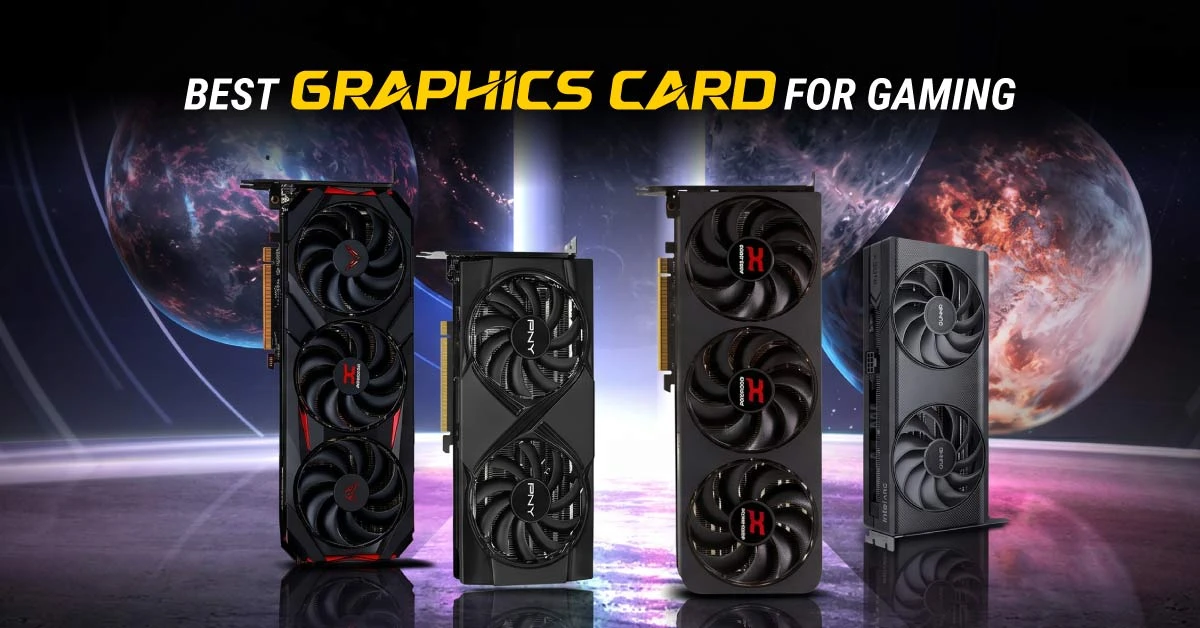
Choosing the best graphics card for gaming in Bangladesh depends on your budget, monitor resolution, favorite games, and future upgrade plan. A GPU that is good for 1080p esports may not be enough for 1440p or 4K gaming, so it is important to match the graphics card with the way you actually play.
In 2026, gamers in Bangladesh have many options from NVIDIA, AMD, and Intel. Some cards are better for high FPS gaming, some are stronger for ray tracing, and some offer more VRAM for modern AAA games. Price, warranty, PSU requirement, case size, and stock availability also matter before buying.
This guide will help you understand which gaming graphics card is right for your setup. We will cover budget, mid-range, and high-end GPUs, along with key buying factors, common mistakes, and practical recommendations for Bangladeshi PC builders.
Top 10 Gaming Graphics Cards in Bangladesh
The table below highlights ten of the most relevant gaming GPUs available across budget, mid-range, and high-end tiers.
Note:Prices fluctuate with import duty, USD-BDT rates, and stock, so always confirm the latest price on the product page before ordering.
How to Choose the Right GPU
A graphics card is the single biggest contributor to gaming performance in a modern PC build. Spending more on a CPU than the GPU is usually a mistake, but overspending on a flagship GPU paired with a 1080p 60Hz panel is equally wasteful. Use the framework below to decide which tier actually fits your situation.
Match the Graphics Card With Your Gaming Resolution
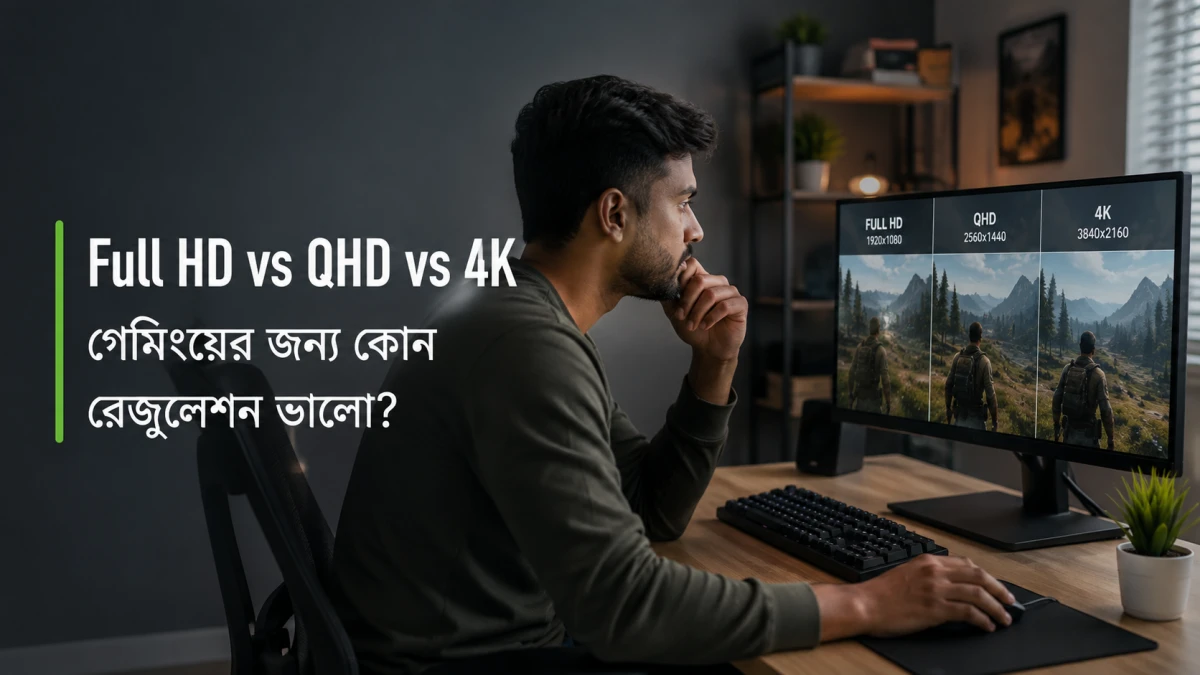
Resolution sets the floor for how powerful your dedicated GPU needs to be. A 1080p monitor at 60-144Hz can be driven beautifully by mid-range cards in the BDT 45,000-70,000 range. A 1440p panel at 144Hz typically needs a GPU in the BDT 70,000-110,000 bracket, especially for AAA titles at high settings. You need to spend more than BDT 200,000 to play games at 4K with full graphics and ray tracing on. Cards like the RTX 5080 and RX 9070 XT fall in this price range.
For competitive esports games like Valorant, CS2, PUBG, and Apex Legends, even an Intel Arc B580 or an RTX 5060 will push past 200 FPS at 1080p. For Cyberpunk 2077, Black Myth: Wukong, Alan Wake 2, or any path-traced title, expectations need to come down accordingly. Buy for the resolution and game type you actually play, not the one you imagine playing one day.
Choose the Right Vram for Modern Games
In 2026, low video memory can slow down even a good GPU. Games are loading larger texture sets, more complex shaders, and ray tracing buffers that all live in VRAM. As a working rule of thumb for this year:
8GB VRAM is the bare minimum for 1080p high settings. It still works in most titles, but some 2026 releases already push past 10GB at high textures, and stutters become noticeable.
12GB VRAM is the new sweet spot for 1080p ultra and most 1440p gaming.
16GB VRAM gives genuine future-proofing, comfortable 1440p ultra, and decent 4K with upscaling.
24GB-32GB is reserved for the RTX 5090 and is overkill for pure gaming; that capacity is for AI, 3D rendering, and professional workloads.
This is exactly why the 16GB versions of the RX 9060 XT and RTX 5060 Ti are often smarter than their 8GB siblings for anyone planning to keep their card for three to four years.
Compare NVIDIA Geforce RTX, AMD Radeon RX, and Intel ARC
The three-vendor era of gaming GPUs is real now.
NVIDIA's RTX 50 series, built on the Blackwell architecture, leads in ray tracing performance, DLSS image quality, and frame generation versatility.
AMD's RDNA 4-based RX 9000 lineup closes the ray tracing gap dramatically and tends to deliver better raster performance per taka, often with more VRAM at the same price point.
Intel's Arc Battlemage cards, especially the B580, have matured into legitimate budget contenders for 1080p and light 1440p gaming, with surprisingly capable XeSS upscaling and hardware ray tracing.
In broad strokes, NVIDIA wins on features and ecosystem (DLSS 4, NVENC for streaming, Reflex for low-latency competitive play), AMD wins on price-to-raster value and VRAM generosity, and Intel wins on absolute entry-level affordability. None of them is universally "better" - the right choice depends on which games you play and which features you actually use.
Upscaling and Frame Generation Are Now Essential Features, Not Extras.
Here is how each brand handles them:
Upscaling & Frame Generation
NVIDIA DLSS 4 uses AI to render at a lower resolution and rebuild a sharper image. Its Multi Frame Generation can insert multiple fake frames between real ones for a big FPS boost.
AMD FSR 4 is now AI-based on RDNA 4 cards and has mostly closed the image quality gap with DLSS in supported games. It also supports ML Frame Generation.
Intel XeSS works on all three brands but gives the best results on Arc cards.
Ray Tracing
NVIDIA still leads in heavy ray tracing and path tracing.
AMD RDNA 4 has improved a lot and handles moderate ray tracing well.
Intel Battlemage handles basic ray tracing well enough for its price.
Bottom Line: If you play ray tracing heavy games like Cyberpunk 2077, Alan Wake 2, or Black Myth: Wukong, an RTX 5060 Ti or RTX 5070 may be worth the extra cost over a similarly priced Radeon.
Balance Fps, Graphics Quality, and Monitor Refresh Rate
A 165Hz monitor sitting at 60 FPS is just a 60Hz monitor with extra steps. The goal of choosing a gaming GPU is to feed your display its target frame rate consistently, especially the 1% lows that determine how smooth gameplay actually feels, not the average FPS number on a benchmark slide.
Esports players should prioritize raw frame rates and consistent 1% lows; ultra settings rarely matter. AAA single-player gamers should aim for stable 60-90 FPS at their resolution of choice and use upscaling to maintain that floor. Mixed gamers benefit from the 1440p sweet spot - cards like the RTX 5060 Ti 16GB, RX 9060 XT 16GB, and RTX 5070 give you both high FPS in competitive titles and beautiful visuals in cinematic games.
Check Psu, Case Size, Cooling, and Power Connectors
A new GPU is not a simple plug-and-play upgrade. Check these four things before you buy:
PSU Wattage
RTX 5060 → 550W
RTX 5060 Ti / RX 9060 XT → 600–650W
RTX 5070 / RX 9070 → 650–750W
RTX 5070 Ti / RTX 5080 / RX 9070 XT → 750–850W
Use at least an 80 PLUS Bronze rated PSU or better.
Power Connectors
RTX 50 series cards use the new 12V-2x6 connector and come with an adapter. For safety, use an ATX 3.0 or ATX 3.1 PSU with a native cable.
RX 9000 series cards use standard 8-pin PCIe connectors, which work fine with older PSUs.
Card Size
High-end triple-fan cards from MSI, ASUS ROG, or Sapphire Nitro+ can be over 320mm long and take up three slots.
Always measure your case's GPU clearance before ordering.
Small Case Builders
Mini-ITX or Micro-ATX users should look at compact options like the ASUS Dual RTX 5060 Ti or Gigabyte WINDFORCE OC SFF cards.
A powerful GPU paired with an old CPU will hold you back. For cards like the RTX 5070 Ti, RTX 5080, RX 9070, and RX 9070 XT, you need at least a Ryzen 5 7600/9600X, Ryzen 7 7700X/9700X, or Intel Core i5-13400/14400. The RTX 5080 and RTX 5090 demand even more, ideally a Ryzen 7 9700X, Ryzen 9 9900X, or Intel Core i7-14700 and above, especially for 1080p high-refresh esports. On the PCIe side, RTX 50 and RX 9000 cards are built for PCIe 5.0 x16 but run well on PCIe 4.0 x16 with little performance loss. Avoid pairing high-end GPUs with PCIe 3.0 boards, as the limited bandwidth can bottleneck performance. For RAM, 16GB DDR4-3200 is the bare minimum, but 32GB DDR5-6000 is the right target for any RTX 5070 or RX 9070 class build.
Finally, a fast NVMe SSD will reduce texture pop-in and loading times in games that support DirectStorage, even if it does not directly boost FPS.
New vs Used Graphics Card in Bangladesh
The Bangladesh used GPU market is active, especially around BCS Computer City and various Facebook groups, and it can save you 25-40% on cards like the RTX 3060, RTX 4060, or RX 6700 XT. However, used GPUs carry real risk: previous mining use, degraded thermal pads, partial fan failures, and zero warranty. If you do buy used, insist on a thorough on-the-spot stress test, an HWInfo session showing temperatures and clock stability, and a clear history of ownership.
For most buyers, a new card from a trusted retailer like Ryans Computers - with brand warranty, replacement policy, and official BDT pricing - is worth the premium. Three years of peace of mind matters more than a 15,000 taka discount on a card with a coil whine you cannot return.
Best Gaming Graphics Card Buying Tips in Bangladesh
The technical specs are only half the story. The other half is shopping smart in the Bangladesh market, where stock, warranty terms, and current taka prices change weekly. The following habits separate confident buyers from regretful ones.
Do Not Buy Only by VRAM or Series Name
A 16GB card is not automatically better than a 12GB one. The RTX 5070 with 12GB GDDR7 outperforms the older RTX 4060 Ti with 16GB GDDR6 in nearly every modern game, because architecture, bandwidth, and core count matter far more than raw VRAM capacity. Similarly, "RTX 5060" sits well below "RTX 5060 Ti" despite the close naming, and "RX 9060 XT" is a tier below "RX 9070." Match the full tier and architecture to your use case, not the number on the box.
Choose GPU Tier Based on Your Monitor, Not Hype
Reviewers and forums tend to push the latest flagships because they generate clicks. For an actual buyer in Dhaka with a 24-inch 1080p 144Hz monitor, an RTX 5080 is wasted spending. The screen physically cannot show you the difference between 200 FPS and 300 FPS, and the GPU's extra horsepower is bottlenecked by display refresh rate. Pick your panel first, then choose a card that can drive it comfortably with about 20-30% headroom for next year's games.
Synthetic benchmarks like 3DMark Time Spy give you a rough hierarchy, but real game performance varies hugely by title. The RX 9070 XT competes head-to-head with the RTX 5070 Ti in raster-heavy games like Counter-Strike 2 or Forza Motorsport, but falls behind in path-traced titles. Look at benchmarks for the specific games you play most - Hardware Unboxed, Gamers Nexus, and Tech Yes City all publish per-game charts that paint a much more accurate picture than averages.
Check Official Warranty and Replacement Policy
Always confirm the warranty terms in writing before paying. Most graphics cards sold by Ryans Computers come with 3-year brand warranty, but some sub-brand models may have shorter coverage. Ask specifically about the replacement process: how long does the RMA take, is the unit replaced or repaired, and what voids the warranty (overclocking, BIOS flashing, custom water blocks). A long warranty is one of the strongest reasons to buy new from an authorized retailer rather than from grey-market sources.
Verify PSU Requirement and Physical Clearance
Before checkout, open your PC, measure the available GPU length from the back panel to where drive bays or AIO radiators begin, and check the PSU label for total wattage and PCIe connector count. Compare those numbers against the GPU's recommended PSU wattage and connector type listed on the product page. A BDT 100,000 GPU that cannot physically fit in your case or that trips your PSU under load is a worst-case purchase. Most Ryans product pages list approximate power consumption and dimensions specifically to help with this check.
Consider Future Game Demands Without Overpaying
Future-proofing has limits. Buying two tiers above your current needs in the hope that you will keep the card for six years rarely works out. Game engines, driver optimizations, and new upscaling features evolve so fast that a smart mid-range upgrade every three years usually delivers better total experience than a one-time flagship purchase. If you are buying in 2026 and plan to keep the card until 2029, target a card that handles your current games at 80-90 FPS with headroom, not at 200 FPS today and 60 FPS in 2029.
Compare Current Graphics Card Price in Bangladesh
Gaming GPU prices in Bangladesh move with USD-BDT exchange rates, NBR import duty changes, and global stock. The same RTX 5060 Ti can vary by 5,000-8,000 taka between brands and even between Ryans branches. Before committing, check the latest price on ryans.com, cross-reference with two or three other authorized retailers, and confirm whether EMI or COD offers can soften the upfront cost. Off-season sales (post-Eid, year-end, anniversary sales) often deliver better deals than launch-window pricing.
FAQs
How much VRAM do I need for 1080p, 1440p, and 4K gaming?
For 1080p gaming in 2026, 8GB is the practical minimum and 12GB is comfortable. For 1440p, aim for 12GB at minimum and 16GB if you want ultra textures without compromise. For 4K with ray tracing and ultra settings, 16GB is the new baseline, and 24GB+ helps in heavily modded games or content-creation workflows. Some 2026 AAA releases already push past 10GB at 4K high textures, which is why 8GB cards are no longer safe at higher resolutions.
Is NVIDIA better than AMD for gaming?
Neither is universally better. NVIDIA RTX 50 series leads in ray tracing performance, DLSS 4 image quality, NVENC streaming, and feature ecosystem. AMD RX 9000 series often delivers stronger raster performance per taka, includes more VRAM at the same price tier, and has closed the ray tracing gap meaningfully. If you stream regularly, play heavy ray tracing games, or want the cleanest upscaling, NVIDIA is the safer pick. If you want maximum raw FPS per taka in traditional rendering and more VRAM headroom, AMD often wins.
Is Intel Arc good for gaming?
Intel Arc Battlemage cards, particularly the B580, are genuinely competitive in the budget segment at 1080p and light 1440p gaming. They support hardware ray tracing and XeSS upscaling, and driver maturity has improved dramatically since the original Arc Alchemist launch. They remain less consistent in older DirectX 11 titles and have weaker performance in heavy ray tracing workloads, but for a first-time PC builder on a tight budget, an Arc B580 at BDT 37,500 is one of the strongest value plays available right now.
Is an 8GB graphics card enough for gaming?
For 1080p gaming at high settings, yes, in most current games. For 1080p ultra in the newest AAA releases or for any serious 1440p gaming, 8GB is increasingly tight. A growing list of 2026 titles - Indiana Jones and the Great Circle, Black Myth: Wukong, and others - already exceed 8GB at high textures, leading to stutters and texture pop-in even when raw GPU power is sufficient. If your budget allows the 16GB version of the RTX 5060 Ti or RX 9060 XT, the extra VRAM is one of the smartest future-proofing investments available.
Do I need ray tracing for gaming?
You do not need it, but you may want it. Ray tracing dramatically improves lighting, reflections, and shadows in games that support it - Cyberpunk 2077, Alan Wake 2, Black Myth: Wukong, Indiana Jones, and others. The cost is significant performance loss without upscaling, often 30-50%. If you mostly play esports titles like Valorant, CS2, or PUBG, ray tracing is irrelevant and you can save money on a non-RTX-prioritizing card. If you play single-player AAA games, ray tracing capability is worth paying for, and NVIDIA's RTX 50 series remains the safest bet.
What PSU do I need for a gaming graphics card?
The general guidance for 2026 GPUs is: 550W for an RTX 5060 or RX 9060, 600-650W for an RTX 5060 Ti or RX 9060 XT, 700-750W for an RTX 5070 / RX 9070, and 850W or higher for the RTX 5080 and RX 9070 XT. The RTX 5090 wants 1000W or more. Always use an 80 PLUS Bronze certified unit or better from a reputable brand (Corsair, Cooler Master, MSI, Thermaltake, DeepCool, SilverStone, ASUS). Cheap no-name PSUs are the single most common cause of system instability and component failure - this is not the place to save money.
How do I know if a graphics card will fit my PC case?
Three measurements matter: length, thickness, and width. Find your case's maximum supported GPU length on the manufacturer's spec page or measure from the rear bracket to the front of the case (clearing drive cages). Compare against the GPU's listed length on the product page. Thickness is measured in PCIe slots - a 2.5-slot or 3-slot card needs that much vertical space inside the case. Width matters less but can interfere with case side panels on slim builds. Ryans product pages typically list approximate dimensions; if in doubt, ask a Ryans representative before ordering.
Where to buy GPU in Bangladesh?
Ryans Computers is one of the most established and trusted retailers for Laptop, PC and graphics cards in Bangladesh, with branches in Dhaka, Chattogram, Sylhet, Khulna, Rajshahi, Bogura, Mymensingh, Rangpur, and Barishal. Buying from Ryans gives you authentic products, full brand warranty, EMI options through credit cards, COD in major metropolitan areas, mobile wallet payment via bKash/Nagad/Rocket, free shipping in many metros, and expert pre-sales support. You can browse the complete graphics card catalog at ryans.com, compare current prices in real time, and place orders online or visit a showroom to see the card in person before purchasing.










Leave a comment