What is the meaning of IPv8?
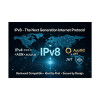
IPv8 (Internet Protocol version 8) is a managed network protocol suite that transforms how networks of every scale - from home networks to the global internet - are operated, secured, and monitored.
Every manageable element in an IPv8 network is authorised via OAuth2 JWT tokens served from a local cache. Every service a device requires is delivered in a single DHCP8 lease response. Every packet transiting to the internet is validated at egress against a DNS8 lookup and a WHOIS8 registered active route. Network telemetry, authentication, name resolution, time synchronisation, access control, and translation are unified into a single coherent Zone Server platform. IPv4 is a proper subset of IPv8. An IPv8 address with the routing prefix field set to zero is an IPv4 address. No existing device, application, or network requires modification. The suite is 100% backward compatible. There is no flag day and no forced migration at any layer.
IPv8 uses a 64-bit address split into two 32-bit parts structured as r.r.r.r.n.n.n.n.. The first 32 bits (r.r.r.r) form the Routing Prefix (identifying the network or ASN), and the last 32 bits (n.n.n.n) form the Host Address (identifying the specific device). This provides about 18.4 quintillion total addresses, with each organization getting 4.29 billion host addresses. IPv8 is fully backward compatible with IPv4: if the routing prefix is all zeros, it functions exactly like an IPv4 address.