01
True HEPA
Rated to capture more than 99.9 percent of tiny test particles which makes it effective against dust and smoke and pollen.
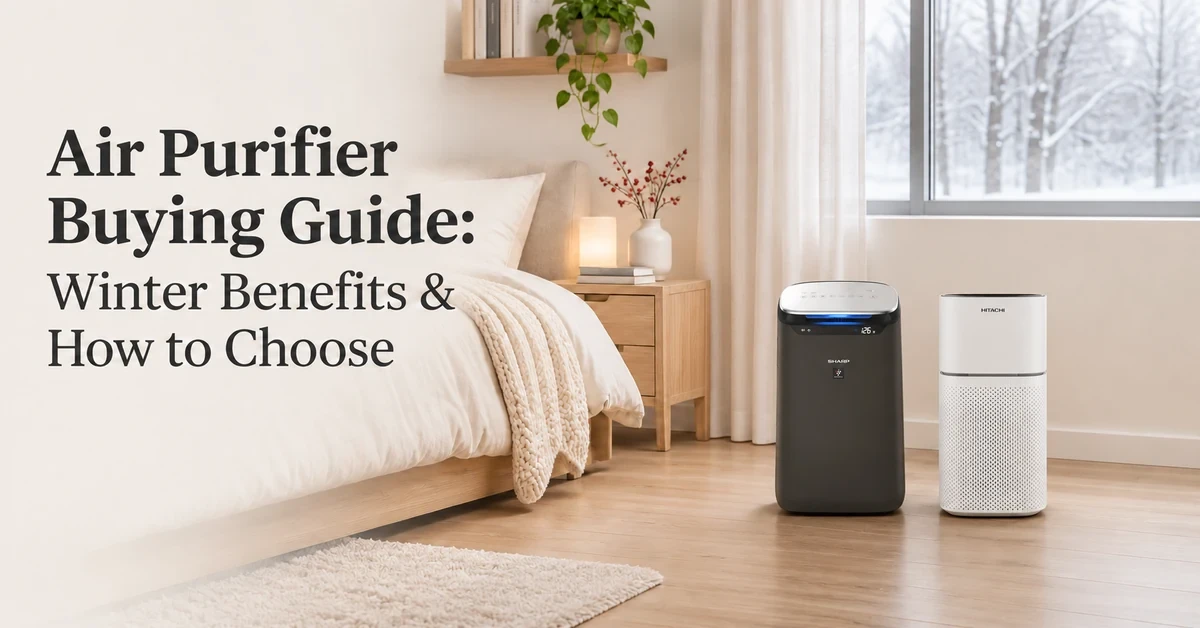
Winter brings cooler mornings and closed windows and it also brings dusty air that lingers inside your home for weeks. If you are reading this air purifier buying guide you probably want cleaner air in your bedroom or living room but you are unsure which features genuinely matter. Models differ considerably in filter type and airflow capacity and running cost so a careful comparison can save substantial money and frustration. This guide explains each factor in plain language and shows how to match a machine to your room and your budget.
Choose the filter for the pollutant that bothers you most, match the CADR to your room volume, and check noise and running cost before you pay.

During winter the air near the ground moves slowly and pollution stays trapped close to the places where people live. Smoke and dust from roads and brick kilns and heavy traffic settle over many cities including Dhaka and some of that polluted air slips inside through door gaps and open windows. Cooking smoke and incense and everyday household dust then add to the indoor concentration.
An air purifier draws room air through a filter and releases cleaner air back into the room. Over time it can reduce fine airborne particles known as PM2.5 which are small enough to travel deep into the lungs. Lower concentrations indoors can mean less irritation for people with sensitive noses and eyes.
Keep your expectations realistic. A purifier does not cure asthma or remove every smell and it cannot clean a room while the doors stand wide open. It works best as one part of a wider routine that includes wet mopping and good kitchen ventilation.

Start with the pollutant that bothers you most and then choose the filter designed to capture it.
| Concern | Filter to look for | Limitation |
|---|---|---|
| Fine dust and smoke particles | True HEPA filter | Does not remove gases |
| Pollen and pet dander | HEPA filter with a pre-filter | Pre-filter needs regular cleaning |
| Cooking smells and fumes | Activated carbon filter | Thin carbon layers fill up fast |
| Large dust and hair | Washable pre-filter | Does not catch fine particles |
01
Rated to capture more than 99.9 percent of tiny test particles which makes it effective against dust and smoke and pollen.
02
Removes odours through gas adsorption which means smell molecules stick to the carbon surface. A thicker carbon layer usually handles cooking smells more effectively.
03
Sits in front of the main filter and catches hair and large dust so that the more expensive HEPA layer lasts longer. Many models combine all three layers.
Always verify the exact filter grade on the product page because terms such as HEPA-type or HEPA-like do not mean true HEPA.
Be cautious with models that promote ionizer or ozone features since ozone can irritate the lungs. If a seller claims that a model is safe ask for emissions test results for that exact model.
CADR stands for clean air delivery rate. It tells you how much filtered air a purifier delivers every hour. It is usually shown in m³/h or cfm and unlike a simple fan airflow figure it is measured against real particles so a bigger fan number does not always indicate better cleaning performance.
m³/h
The volume of clean air delivered each hour. Some labels use cfm instead.
Area × Height
Multiply the floor area by the ceiling height to find how much air the room holds.
4 to 5
Multiply the room volume by four or five to find the CADR you need.
Sizing Formula
CADR needed (m³/h) = Floor Area × Ceiling Height × 4 or 5
| Room | Volume | Air changes | CADR needed |
|---|---|---|---|
| Bedroom, 12 m² with 2.8 m ceiling | 33.6 m³ | 5 per hour | About 168 m³/h |
| Living room, 20 m² with 2.8 m ceiling | 56 m³ | 4 per hour | About 224 m³/h |
Treat these figures as a guide and not a strict rule. Tall ceilings and heavy smoke call for a higher number.
Ignore the largest coverage claim printed on the box since those figures often assume slow cleaning. The Philips 600i Series AC0650 is listed with a CADR of 170 m³/h which fits the bedroom example above but you should confirm that figure on the product page before buying.
Mini purifiers have a low CADR so they suit a desk or a study corner or a very small room of approximately 5 to 8 square metres. They are not designed for a full living room. The Smart Air QT3 portable purifier is one compact example and the wider Smart Air range has more options.
A small body also means a small filter that wears out faster so check the filter life before you choose.
Allergies
A true HEPA filter and a CADR matched to your room matter most here. A sealed filter housing is beneficial because it stops air from slipping around the filter.
Asthma
These can set off symptoms so a carbon layer is beneficial. The purifier should run continuously during bad air days.
Many online lists of the best air purifiers for allergies are written for other countries. Use them for general ideas and then compare the filter type and CADR of each model on your own shortlist.

A baby’s room follows the same rules with a few extra checks:
01 Out of Reach
Place the unit where the baby cannot touch it and where the cord stays out of reach.
02 Keep a Distance
Keep it approximately a metre from the cot so the airflow does not blow straight at the baby.
03 Ask Your Doctor
If your baby has any breathing trouble ask your paediatrician before choosing a model.

Noise is measured in dB(A) and the figure that matters is the one for the speed you will really use because many machines are quiet on low and loud on high.
30 dB(A)
A reading near this level is similar to a quiet library.
50 dB(A)
A reading near this level is closer to normal conversation.
Low
A bedroom unit should stay close to a whisper on its lowest setting.
01 Dimmable Display
A dimmable display or a display off option helps since bright lights disturb sleep.
02 Particle Sensor
Measures air quality and adjusts the fan in auto mode which saves effort.
03 Sleep Mode and Timer
Minor features with considerable daily value.
04 Filter Reminder
Tells you when the filter needs cleaning or replacing.
05 Standby Power
Matters too because the unit stays plugged in all day.
06 App or Manual Dial
An app is handy for schedules but a simple manual dial works just as well if you prefer less fuss.
Cheap sensors can be inaccurate. Treat the colour light as a rough hint and not a laboratory reading.
The price tag is only the start because two running costs follow.
Cost 1: Electricity
kWh = (Watts ÷ 1000) × Hours
Cost = kWh × Tariff (Tk per kWh)
Cost 2: Replacement Filters
Monthly filter cost = Filter Price ÷ Filter Life in Months
| Cost | Working | Result |
|---|---|---|
| Daily energy | 30 W ÷ 1000 × 10 hours | 0.3 kWh |
| Daily electricity | 0.3 kWh × Tk 10 | About Tk 3 |
| Monthly filter | Tk 6000 ÷ 12 months | Tk 500 |
The rate of Tk 10 per kWh and the filter price are examples only. Check your own bill for the real rate and use the wattage of your usual fan speed since higher speeds draw more power.
A machine with a CADR above your minimum can run at a lower speed. That often means quieter operation and lower power use than a smaller machine working at full speed.
Confirm the exact filter code and the local stock and warranty provider before you pay. This matters for every brand including DeLonghi and Hitachi because a cheap machine with a rare filter can cost more over time.
Use this list before you pay.
Once your requirements are clear you can compare models side by side. The air purifiers in Bangladesh page is a good starting point. A manufacturer range becomes useful if you already have a preference such as Philips air purifiers or Sharp air purifiers.
01
Remove all protective packaging from the filters before first use. Many people skip this step and then wonder why nothing improves.
02
Leave at least 30 cm between the purifier and walls or furniture so air can flow freely.
03
Put it in the room where you spend the most time such as the bedroom at night.
04
Keep doors and windows closed while it runs. Use a higher speed for the first hour before switching to auto or low.
05
Run the purifier for many hours each day instead of short bursts because new pollutants keep entering the room all day.
06
Rinse or vacuum the pre-filter every two to four weeks as the manual advises and wipe the sensor opening with a dry cloth. Replace the main filter on schedule and save the date as a phone reminder since dusty weeks can shorten the filter life.
The best purifier is the one that fits the room you use most and the pollutants you worry about. Choose a CADR that suits your room volume and a filter that targets your main concern and then check that the noise level and running costs suit your daily routine.
Beko air purifiers are also worth a look if you want one more option.
Not very well because a portable unit mainly cleans the room where it sits. With the door open some air moves between rooms but the CADR gets shared and cleaning slows down. Use one purifier for each main room or choose a higher CADR model for an open plan space.
Yes they can share a room as long as you keep them at least a metre apart so that mist does not wet the filter or confuse the sensor. Keep room humidity below about 60 percent to avoid damp and mould and wipe up any moisture that collects near the purifier.
A faint plastic smell from a new unit is common and it usually fades within a few days in a ventilated room. A burning or sharp chemical smell is different so you should unplug the unit immediately and contact the seller under warranty.
Unplug it and wipe the outside and clean the pre-filter and then seal the main filter in a clean bag and store everything in a cool and dry place away from direct sun. Check the filter date when you restart so that you know how much life remains.
It is not a good idea because a clogged filter lowers airflow and cleaning power and it can strain the fan. Ask the seller or the brand service centre about a compatible filter before the old one reaches the end of its life.
No because oils can coat the filter and clog it and they may harm the sensor while some oils also release compounds into the air that you are trying to remove. Use a separate diffuser far from the purifier if you want scent.
No because the mesh in a split AC catches only large dust and hair and it cannot capture fine particles like PM2.5 or smoke. A dedicated purifier with a HEPA filter does that job and the two can work side by side.
No Comments








Leave a comment