Convection
Warming the Air
Air touches the hot parts and rises. Cooler air moves in to replace it. This circulation slowly warms the whole room.
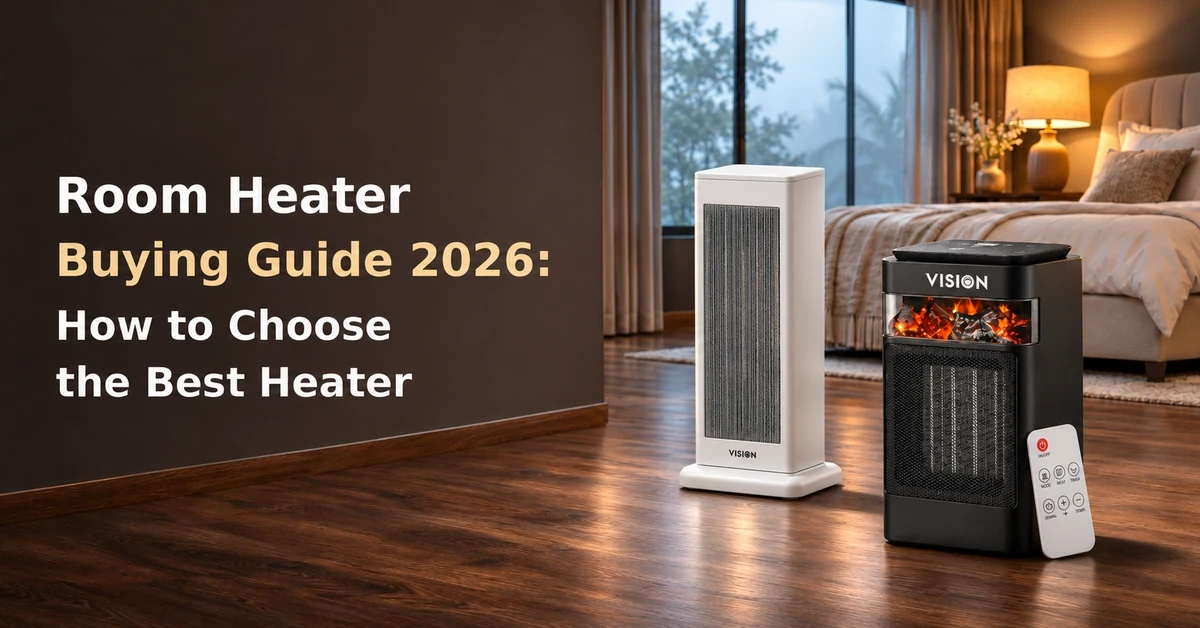
Winter in Bangladesh does not last long but the cold can feel sharp when you wake up early or study late. Many homes are damp and many rented rooms have thin walls and gaps around the windows. A good heater makes these hours easier. A poor choice wastes money and can even be unsafe.
This room heater buying guide is written for Bangladesh households. That includes renters and students and people who work from home. It starts with your room and your daily routine instead of the product box. You will learn how a heater works and which type fits your needs. You will also learn how to read watts and BTU and how to estimate the electricity bill. At the end you get a simple way to shortlist a room heater in Bangladesh.
Before buying, check your room size, how long you will use the heater, and the safety features your household needs.
A room heater turns electricity into heat. Current flows through a heating element. The element resists the flow so it gets hot. Most home heaters use a metal coil or a quartz tube or a PTC ceramic plate. Ceramic is a type of element. It is not a separate way of heating.
Once the element is hot the warmth reaches you in two ways:
Convection
Air touches the hot parts and rises. Cooler air moves in to replace it. This circulation slowly warms the whole room.
Radiation
A hot surface sends infrared heat straight to people and objects in front of it. You feel it on your skin at once even when the air is still cold.
This is the difference between heating a room and warming a person nearby. A radiant heater is great when you sit still at a desk. It does little for someone across the room. A convection heater warms the air so everyone benefits but it needs more time.
Many heaters add a fan. The fan spreads warm air faster. It does not create extra heat. Strong airflow can feel impressive but it says nothing about capacity. Capacity comes from the rated power and we cover that later in this guide.
Pick the type by how you will use it. A mini room heater or a portable room heater is enough for a desk or a small study corner. A family bedroom needs something more considered.
| Type | Best use | Warm-up time | Noise level | Light output | Trade-offs |
|---|---|---|---|---|---|
| Fan heater | Quick warmth in a small room | Fast | Audible fan | Usually none | Heat stops as soon as you switch off |
| PTC ceramic heater | Bedrooms and study rooms | Fast | Fan noise if it has a fan | None | Often fan-assisted and may cost more than a basic coil heater |
| Quartz or halogen radiant heater | Warming one person at a desk or sofa | Almost instant | Silent | Visible glow | Warms only what it faces |
| Convection or panel heater | Steady background warmth | Moderate | Quiet | None | Slow to feel at the start |
| Oil-filled radiator | Long evenings and bedrooms | Slow | Very quiet | None | Heavy and slow to start but stays warm briefly after switch-off |
01
A PTC ceramic or fan heater gives quick warmth for study hours.
02
A radiant heater warms your hands and legs without heating the whole room.
03
A quiet convection heater or an oil-filled radiator suits long hours.
04
Choose enough power for the space and keep the heater on while you use the room.
Some heaters mix technologies such as a ceramic element with a fan. Read the specification instead of guessing from the name.

Capacity is where most buying mistakes happen. Listings show three units:
W
The power the heater draws. For an electric resistance heater this is a good guide to how much heat it produces.
BTU/h
Another way to show heat output. One watt is about 3.412 BTU/h.
kWh
The energy used over time. Your electricity bill is based on this.
Wattage alone cannot tell you the right size. These points change what your room needs:
01
Multiply length by width to get the floor area. A bigger area needs more output.
02
Tall rooms hold more air to warm.
03
Gaps around doors and windows let heat leak out.
04
Glass loses heat faster than walls.
05
A colder night or a warmer target asks more from the heater.
A simple method works well. Measure your room in feet and work out the floor area. Then compare it with the coverage the manufacturer states. If your room is draughty or has big windows choose the next size up instead of the smallest one that fits.
The best room heater for winter is the one that suits your space. It is not the most powerful one on the shelf.
Short answer: about 140 sq ft or 13 sq m in an illustrative case. The rating alone cannot guarantee coverage.
Coverage Example
4777 BTU/h equals about 1400 W. Assume the heater needs 10 W for each square foot of floor.
1400 W ÷ 10 W = 140 sq ft (about 10 ft × 14 ft)
Please treat this as an illustration and not a universal rule. A well-sealed room may do better and a draughty one worse. Always compare with the manufacturer’s own coverage claim. For instance Ryans lists the Vision Easy 2000W heater for 100 to 120 sq ft. Our 10 W example would suggest about 200 sq ft for 2000 W. The stated figure is more cautious so use it when the two disagree.
Everything gets harder as space grows. Open-plan areas let warm air drift away. High ceilings leave warmth near the roof. Big windows and thin walls let heat escape. A small heater cannot make up for missing capacity. It will run all the time and the room will still feel cold.
The best heater for large room use has an output that truly matches the space. If one heater is not enough consider two units in different zones such as the seating area and the work desk. Plug them into separate outlets and make sure your wiring can carry the load. Ask an electrician if you are unsure.
Manufacturer coverage claims deserve a careful look. Ask whether the figure assumes a sealed room. Be cautious when a modest wattage claims to cover a very large area.
01 Close Doors
Close the door of rooms you are not using.
02 Thick Curtains
Draw thick curtains after sunset.
03 Seal Gaps
Seal visible gaps with draught strips.
04 Add a Rug
Lay a rug over a cold floor.
05 Clear Airflow
Keep furniture away from the heater so air can flow.
You can estimate the cost before you buy. Use these two steps:
Step 1: Electricity Consumption
kWh = (Heater Wattage ÷ 1000) × Operating Hours
Step 2: Electricity Cost
Cost = kWh × Applicable Tariff (Tk per kWh)
For example a 2000 W heater used for 6 hours consumes 12 kWh. At the sample tariff below that costs Tk 120.
| Heater | 4 hours | 6 hours | 8 hours |
|---|---|---|---|
| 1000 W | 4 kWh and Tk 40 | 6 kWh and Tk 60 | 8 kWh and Tk 80 |
| 1500 W | 6 kWh and Tk 60 | 9 kWh and Tk 90 | 12 kWh and Tk 120 |
| 2000 W | 8 kWh and Tk 80 | 12 kWh and Tk 120 | 16 kWh and Tk 160 |
The table uses a sample tariff of Tk 10 per kWh. This number is only for illustration and it is not the current tariff. Check your latest electricity bill for your real rate.
These figures assume full power for every hour. A thermostat turns the heating element on and off to hold your chosen temperature. So real consumption depends on how you use the heater and on room conditions.
Electric resistance heaters turn almost all the power they draw into heat. So when you look for energy efficient room heaters focus on what you control. Choose the right size. Use a timer. Pick a heater with a working thermostat. Warm only the room you are using. Be careful with brochure promises of big savings that come without clear testing.

Small details decide how pleasant a heater is to live with:
01 Adjustable Thermostat
Lets you set a target temperature instead of running at full power.
02 Selectable Wattage
A low setting for mild evenings and a high setting for cold nights.
03 Timer
Switches the heater off so it does not run all night by mistake.
04 Readable Controls
Clear buttons or a display you can read in a dim room.
05 Fan Noise
Test it if you can. A sound that is fine in the day can disturb sleep.
06 Visible Glow
Some heaters glow orange and that may bother light sleepers.
07 Handles and Wheels
Useful if you move the heater between rooms.
08 Storage Space
A compact body and a place to wrap the cord help when winter ends.
Do not mix up two protections. A thermostat controls room temperature during normal use. An overheat cut-off is an emergency device. It switches the heater off when internal parts become dangerously hot. A thermostat cannot replace a cut-off and a cut-off is not a temperature control.

Safety features matter more than extra functions. Look for these protections:
01
A heater draws a lot of power. A 2000 W heater on a 220 V supply draws roughly 9 A. Make sure the plug and the cable and the socket are in good condition.
02
Check that the body and the guard around the element feel solid.
03
The cut-off explained above switches the heater off when internal parts get too hot.
04
A switch that cuts the power if the heater falls. Wall-mounted models may not list one so secure fixing matters.
Think about the people in the room. Homes with children or older adults benefit from a child lock and a stable base and controls that are easy to read.
Installation needs differ by model. A portable heater mainly needs a safe spot and a good socket. A wall-mounted unit needs secure fixing. Always follow the instruction manual for your model.
01 Keep Your Distance
Keep the heater at least 3 ft (0.9 m) away from bedding and curtains and furniture. Follow the manufacturer’s larger distance if it gives one.
02 Stable Surface
Place it on a stable and flat surface.
03 Clear Surroundings
Keep the area around it clear and do not block any vent.
04 Direct Socket
Plug a portable heater straight into a suitable wall outlet.
05 Follow the Manual
Follow the manufacturer’s instructions for your model.
!
Never leave a heater unattended if it looks damaged or smells odd or makes strange noises. Unplug it and have it checked.
The honest answer is that it depends on the type of heater and how you use it. Normal electric resistance heating does not burn fuel. So it does not release combustion by-products inside your room the way a fuel-burning appliance can. Fuel-burning appliances need proper ventilation and installation so follow their instructions closely.
Comfort is a separate question. Some people find heated air dry. Others are sensitive to dust that rises when a fan runs. If you have a respiratory condition or allergies or care for a baby or an older relative speak to a doctor before using a heater for many hours.
This is general guidance and not medical advice. It does not mean that every room heater is harmful. A heater that suits your room and is used with care is a common winter choice.
Shortlisting works best in a fixed order. Follow these steps and leave price for last:
01
Such as a bedroom or a study desk or a living area.
02
Match capacity to the room using the stated coverage.
03
Look at the controls and safety features.
04
Use the formula above with your own tariff.
05
Confirm the warranty terms and how service is handled.
06
Compare the purchase price of the heaters that passed.
The best room heater in Bangladesh for you is the one that passes the first five steps and then fits your budget.
Below are three examples from the Vision room heaters at Ryans. The details come from the product pages checked on 2026. Specifications and availability can change so confirm on the page before you order. Ryans states that it confirms availability and final price before processing an order.
Capacity: 2000 W with High and Low heat modes. Listed coverage is 100 to 120 sq ft.
Suitable for: A single bedroom or study room.
Features: Simple two-mode operation. Check the product page for any extra controls.
Safety: Overheat protection is listed.
Consider it if: You want a straightforward heater for one small room.
Capacity: 1500 W with 750 W and 1500 W settings. Ryans lists no coverage area so ask before using it in a larger room.
Suitable for: A small bedroom or a home-office corner.
Features: PTC ceramic element and touch screen LED display and oscillation. It has a timer with a 1 to 24 hour range and a temperature setting from 10 to 49 degrees C.
Safety: Overheat protection and a tip-over switch.
Consider it if: You like precise touch controls and a timer.
Capacity: 2000 W with 1000 W and 2000 W settings. No coverage area is listed so confirm with the seller.
Suitable for: Rooms where floor space is tight.
Features: PTC ceramic element and remote control and LED display and one-touch start. It has 24-hour and one-week timers and a window open function and wide-angle oscillating louvers. Wall mounting sets are included.
Safety: Overheat protection and a child lock. It carries an IP22 rating. No tip-over switch is listed so secure wall installation matters.
Consider it if: You want a clear floor and a remote control. Renters should check whether drilling is allowed.
Warranty: Ryans lists a one-year warranty by Vision for these products. Keep the warranty card because Ryans does not bear the warranty.
A good heater purchase comes down to three questions. Is the capacity right for your room? Does it have the safety features your household needs? Can you afford to run it for the hours you plan? If the answer is yes to all three you have found a good fit.
When you are ready to compare more options visit the Ryans room heater category and check each listing against these questions. The best buy room heaters are the ones that fit your room and carry real safety features and suit your budget. The biggest number on the box does not decide that.
No. The oil sits sealed inside the radiator and only carries heat. It is not fuel so it never gets used up. Do not open the unit. If you see a leak stop using it and contact the service centre.
Usually the thermostat or the overheat cut-off is responding. Dust or blocked vents or a wall too close can trigger it. Unplug the heater and let it cool and clear the vents and check the setting. If it keeps happening contact service.
A light smell can come from dust or manufacturing residue burning off the element. Run the heater briefly in a ventilated room. If the smell is strong or does not fade or you see smoke unplug it and contact the seller.
Unplug it and let it cool fully. Wipe the body with a dry or slightly damp cloth and brush dust from the vents. Let it dry completely. Store it upright in a dry place and preferably in its box.
Most electric heaters stop producing heat the moment they switch off. Warmth then escapes through windows and gaps and walls. Poor insulation makes this faster. Oil-filled radiators hold heat a little longer but they cannot fix a leaky room.
Not reliably. A portable heater mainly warms the area around it and little heat travels far through a doorway. The second room may feel less cold but it will not be properly warm. Use a heater suited to each room.
Only if the model has a heating mode listed in its specifications. Cooling-only units cannot heat. Whether it can replace a heater depends on the model and the room and the running cost. Check these before you rely on it.
No Comments











Leave a comment