2-Way
2-Way Cassette AC
A 2-way cassette AC sends air from two sides. It is better suited to corridors, narrow offices, and long rectangular rooms where airflow needs to move in two directions.
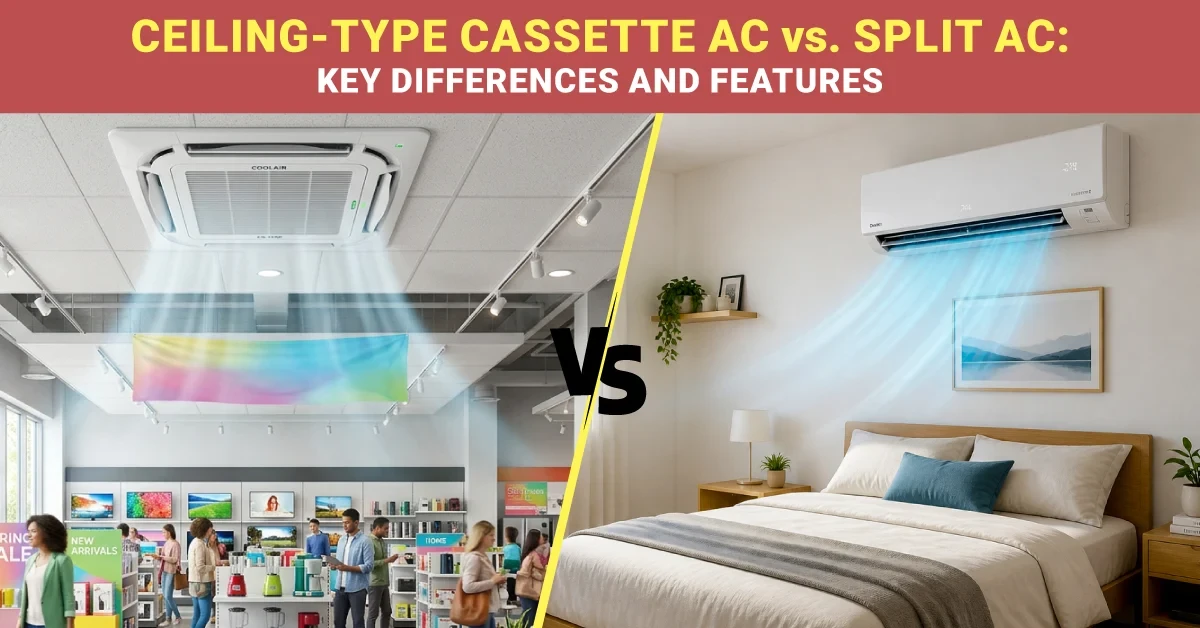
Look at your ceiling first. No false ceiling? Then a split AC is the practical answer. It mounts on the wall, needs no ceiling work, and can usually be installed within hours. Got a false ceiling already? Then a cassette AC can sit inside it, leaving only a flat panel visible while cool air spreads across the room.
Bangladesh summers can push past 35°C, so choosing the right AC type matters for comfort, installation cost, and long-term energy use. This guide compares ceiling-type cassette AC vs. split AC in simple terms, including cooling coverage, electricity use, dimensions, installation, and suitable spaces.

Indoor Unit
A split AC has two parts. The indoor unit sits high on your wall and blows cool air directly into the room. A pipe connects it to the outdoor unit and carries refrigerant between both parts.
Outdoor Unit
The outdoor unit sits on a bracket, balcony, ground pad, or rooftop. It contains the noisier components, helping the indoor space remain quieter. This setup needs no false-ceiling work, which is why it is common in homes and small offices across Bangladesh.
Split and cassette AC systems use a similar indoor-outdoor cooling arrangement. Depending on the model, they may use refrigerants such as R32 or R410A. The main difference is where the indoor unit is installed and how it distributes air.

A ceiling-type cassette AC sits above a false ceiling. From below, you only see its flat decorative panel. Like a wall-mounted split AC, it connects to an outdoor unit, but it saves wall space and distributes air from the ceiling.
2-Way
A 2-way cassette AC sends air from two sides. It is better suited to corridors, narrow offices, and long rectangular rooms where airflow needs to move in two directions.
4-Way
A 4-way cassette AC sends air from all four sides. It works well in open offices, showrooms, restaurants, conference halls, and other wide spaces that need more even cooling.

The indoor cooling cycle works as a continuous loop. Cool air moves into the room, warm air returns to the unit, and the process repeats.
1
Refrigerant reaches the evaporator coil. Warm room air passes over the coil, loses heat, and becomes cooler.
2
A fan creates pressure and pushes cool air through the ceiling panel, spreading it across the room.
3
Cooling also creates water. A drainage pipe carries this water away so it does not drip into the room.
This comparison shows where each system fits best based on installation, cooling direction, appearance, capacity, and maintenance.
| Feature | Cassette AC | Split AC |
|---|---|---|
| Installation | Needs a false ceiling with proper depth and professional fitting | Mounts directly on a wall with no false-ceiling work |
| Cooling Coverage | Spreads air in multiple directions and suits large open rooms | Blows air mainly in one direction and suits individual rooms |
| Aesthetics | Only the flat ceiling panel remains visible | The complete indoor unit remains visible on the wall |
| Noise Level | Can be slightly louder indoors because of stronger airflow | Usually very quiet, with some models rated around 19 to 23 dB |
| Ton Capacity | Commonly starts around 2 ton and can reach 5 ton for large spaces | Commonly starts around 0.8 ton and can reach around 2.5 ton |
| Maintenance | Needs ceiling access and often requires a technician | Easy wall access makes filter cleaning and basic care simpler |
Large-Space Cooling
A cassette AC usually serves a large open room. Larger spaces need more cooling time, so the unit may run longer and create a higher total electricity bill. That does not automatically mean the machine is inefficient. It may simply be doing more work.
Single-Room Cooling
A split AC often cools a smaller bedroom or office cabin. A smaller cooling load lets the unit reach the target temperature sooner, so its total monthly bill can look lower even when both AC types have similar efficiency ratings.
The available space above the false ceiling must hold the indoor unit, drainage pipe, refrigerant lines, wiring, and enough service clearance.
| Tonnage | Approximate Unit Size | False-Ceiling Depth Needed |
|---|---|---|
| 1.5 Ton Cassette AC | About 33 × 33 × 9.6 to 10.2 inches | 9 to 10 inches minimum |
| 2 Ton Cassette AC | About 33 to 37 × 33 to 37 × 9.8 to 11.4 inches | 10 to 12 inches minimum |
| 2.5 Ton Cassette AC | About 37 × 37 × 10.2 to 11.4 inches | 12 to 13 inches minimum |

An inverter cassette AC changes compressor speed based on the room's cooling demand. A non-inverter model operates at full power, stops, and then starts again when the room warms up.
Inverter
The same operating principle applies to inverter split AC models.
Non-Inverter
The same operating principle applies to non-inverter split AC models.
The outdoor unit location affects cooling performance, installation cost, noise, and long-term reliability.
01
Use a flat rooftop or ground surface and keep approximately 1 to 2 feet of open space around the unit.
02
Keep the distance between indoor and outdoor units reasonable because longer pipe runs can increase cost and reduce performance.
03
Point the hot exhaust away from nearby windows and avoid positions where discharged air can circulate back into the unit.
04
The wireless remote communicates with the indoor ceiling panel, so it should be pointed toward the indoor unit.
Brands such as Gree, Haier, and General are commonly available in Bangladesh. The following table provides an approximate price guide for cassette AC units from 1.5 ton to 5 ton.
| Tonnage | Approximate Price |
|---|---|
| 1.5 Ton Cassette AC | Around Tk 100,000 |
| 2 Ton Cassette AC | Around Tk 110,000 |
| 2.5 Ton Cassette AC | Around Tk 140,000 |
| 3 Ton Cassette AC | Around Tk 160,000 |
| 4 Ton Cassette AC | Around Tk 224,000 |
| 5 Ton Cassette AC | Around Tk 250,000 |
4 to 7 Hours
Cassette AC installation needs a false ceiling with approximately 10 to 14 inches of usable depth. The indoor unit hangs from support rods, is levelled, and then connects to refrigerant pipes, drainage, and electrical wiring. The decorative panel is installed last.
2 to 4 Hours
A split AC mounts directly on a solid wall. A small opening is drilled for refrigerant pipes, drainage, and wiring. The outdoor unit is then installed on a bracket, balcony, rooftop, or ground pad.
Cassette Limitations
Split Advantages
For most homes and small offices in Bangladesh, a split AC provides practical cooling at a lower total installation cost.
Match the system to the room layout, ceiling condition, cooling coverage, and maintenance access rather than choosing only by appearance.
| Your Space | Room Size | False Ceiling? | Best Pick |
|---|---|---|---|
| Home bedroom or small living room | Under 200 sq ft | No | Split AC: Lower cost, faster installation, and no ceiling work |
| Open home living and dining area | 250 sq ft or more | Yes | Cassette AC: More even airflow across the connected space |
| Office cabin or small meeting room | Small enclosed room | Either | Split AC: Easier to manage and service room by room |
| Open office floor or conference hall | Large open layout | Yes | Cassette AC: Better multi-directional cooling for the full floor |
| Showroom, retail space, or restaurant | Large open layout | Yes | Cassette AC: Hidden indoor unit, wide airflow, and cleaner wall space |
Your ceiling condition is the fastest way to narrow the choice. Without a false ceiling, a split AC is usually the practical option. With a suitable false ceiling and a large open room, a cassette AC can provide wider, more even cooling while keeping the indoor unit mostly hidden.
After choosing the AC type, match the tonnage to the room size, compare inverter efficiency, confirm installation requirements, and check how easily the unit can be serviced. These steps matter more than choosing by appearance or price alone.
It depends on the ceiling and room layout. A split AC is better for a normal room without a false ceiling. A cassette AC suits a large open room with enough false-ceiling space.
There is no single best model for every space. Match the tonnage to the room size, check the ISEER rating, and choose an inverter model when lower electricity use is important.
It removes heat through the evaporator coil and then uses a fan to distribute cool air through the ceiling panel. A drainage pipe removes the water created during cooling.
It is an air conditioner with the indoor unit installed above a false ceiling. Only the flat ceiling panel remains visible inside the room.
Possible causes include a clogged filter, low refrigerant, a full drain pan, or a faulty sensor. Check the filter and drainage first and contact a qualified technician when the issue continues.
No Comments











Leave a comment