Buying your first drone can be confusing because a higher price does not always mean a better fit. You need to consider the camera, gimbal, flight time, controller, safety features, weight, and package contents together.
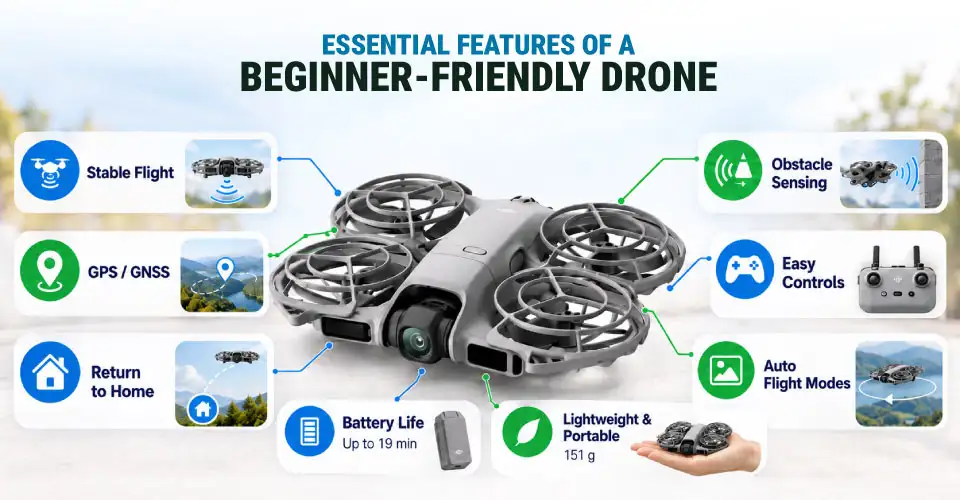
For a beginner, a compact drone with stable flight, GPS/GNSS positioning, return to home, obstacle sensing, and simple controls can be more useful than a professional model with features you may rarely use.
This guide covers 10 best budget drones for beginners in Bangladesh, divided into two price ranges: under Tk 70,000 and Tk 70,000–90,000. The focus is not only on specifications but also on which drone makes sense for your actual use.
What Makes a Drone Beginner-Friendly?
A beginner-friendly drone should be easy to control while leaving enough room to improve your skills. Look for stable flight, GPS/GNSS positioning, return to home, obstacle sensing, simple controls, and useful automated flight modes.
Weight also matters. A lighter drone is easier to carry, while a larger model can provide better wind handling and more advanced camera hardware.
Also compare the complete package. A cheaper drone with one battery may be less useful for regular flying than a slightly more expensive Fly More Combo with extra batteries and charging equipment.
Best Beginner Drones Under Tk 70,000
Drone
Price (approximately)
Camera
Max Flight Time
Package
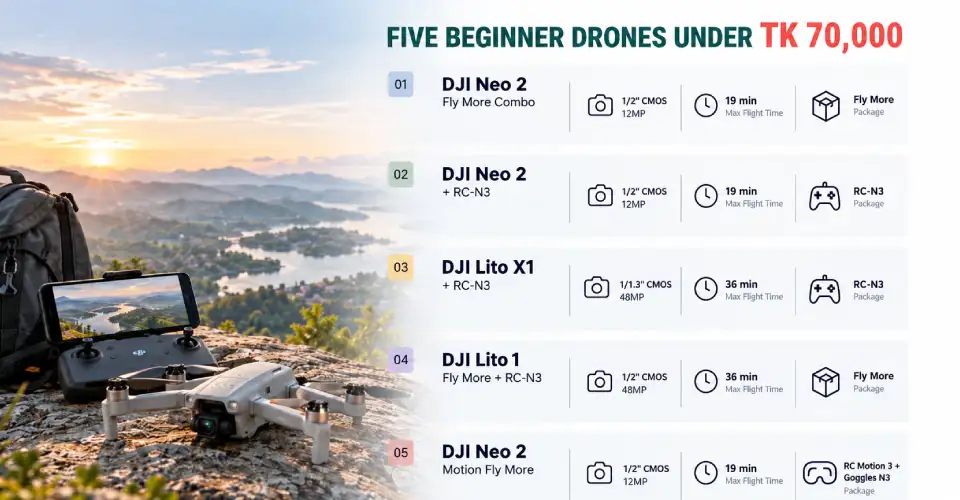
DJI Neo 2 Fly More Combo
Tk 40,000
1/2" CMOS, 12MP
19 min
Fly More
DJI Neo 2 + RC-N3
Tk 42,900
1/2" CMOS, 12MP
19 min
RC-N3
DJI Lito X1 + RC-N3
Tk 44,990
1/1.3" CMOS, 48MP
36 min
RC-N3
DJI Lito 1 Fly More + RC-N3
Tk 49,990
1/2" CMOS, 48MP
36 min
Fly More
DJI Neo 2 Motion Fly More
Tk 57,990
1/2" CMOS, 12MP
19 min
RC Motion 3 + Goggles N3
DJI Neo 2 Fly More Combo
Good for: Beginners, travel, casual aerial photography, and social content.
The DJI Neo 2 is a compact option for first-time users. Its 1/2-inch CMOS camera, 2-axis gimbal, 4K video, automated shooting features, and lightweight design make it suitable for learning and casual content creation.
The Fly More Combo is particularly useful if you plan to fly regularly because extra batteries reduce waiting between flights.
Good Sides:
Extra batteries allow longer shooting sessions with less waiting for recharging.
Compact and lightweight design.
Automated shooting modes make aerial content easier for beginners.
Drawbacks:
The 2-axis gimbal offers less stabilization than a 3-axis gimbal.
DJI Neo 2 With DJI RC-N3
Good for: Learning standard drone controls at a lower package cost.
The Neo 2 with DJI RC-N3 is suitable for beginners who prefer conventional stick controls. It keeps the compact Neo 2 platform while using a traditional controller with a smartphone for the display.
Good Sides:
Traditional stick controls.
RC-N3 provides a more familiar control experience than fully automated flying.
Drawbacks:
Requires a smartphone for the controller's display.
DJI Lito X1 With DJI RC-N3
Good for: Beginner content creators and travel photographers.
The DJI Lito X1 is a significant step up in camera capability. Its 1/1.3-inch CMOS sensor, 48MP camera, 3-axis gimbal, and up to 36 minutes of rated flight time make it more suitable for serious travel photography and video.
Good Sides:
Larger sensors can capture better detail and image quality.
3-axis gimbal provides smoother and more stable footage.
Drawbacks:
Higher camera capability makes it less budget-friendly than the Neo 2
DJI Lito 1 Fly More Combo With RC-N3
Good for: Beginners who want longer flights without moving to the higher camera tier.
The DJI Lito 1 focuses more on practical flying time than premium camera hardware. It offers a 1/2-inch CMOS camera, 48MP resolution, and up to 36 minutes of rated flight time.
Good Sides:
Flight time supports longer individual flights.
Fly More Combo provides extra batteries for extended shooting sessions.
48MP camera offers plenty of resolution for travel photos and social content.
Drawbacks:
It uses a 3-axis-gimbal-less camera setup, so stabilization is not as capable as the Lito X1.
DJI Neo 2 Motion Fly More Combo
Good for: Beginners interested in motion-controlled and immersive flying.
This package combines the Neo 2 with DJI Goggles N3 and DJI RC Motion 3. It is aimed more at users who want an immersive or FPV-style experience.
Good Sides:
Goggles N3 provides a more immersive flying experience.
RC Motion 3 offers an alternative to traditional stick-based controls.
Fly More Combo with extra batteries is useful for longer recreational flying sessions.
Drawbacks:
Motion controls may take some practice for users familiar with traditional controllers.
Best Beginner Drones From Tk 70,000 to Tk 90,000
Drone
Price (approximately)
Camera
Max Flight Time
Main Package
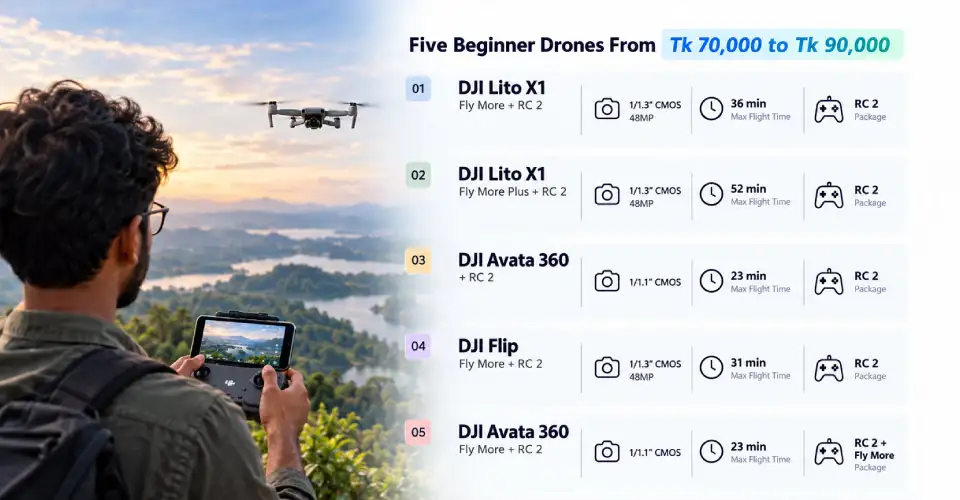
DJI Lito X1 Fly More + RC 2
Tk 72,990
1/1.3" CMOS, 48MP
36 min
RC 2
DJI Lito X1 Fly More Plus + RC 2
Tk 79,900
1/1.3" CMOS, 48MP
52 min
RC 2
DJI Avata 360 + RC 2
Tk 84,000
1/1.1" CMOS
23 min
RC 2
DJI Flip Fly More + RC 2
Tk 85,500
1/1.3" CMOS, 48MP
31 min
RC 2
DJI Avata 360 Fly More + RC 2
Tk 88,000
1/1.1" CMOS
23 min
RC 2 + Fly More
DJI Lito X1 Fly More Combo With DJI RC 2
Good for: Beginners moving into regular photography and video work.
This package keeps the Lito X1's camera and flight capability but adds the DJI RC 2 controller with its own display. Therefore, you do not need to depend on your smartphone for the live flight display.
Good Sides:
Built-in controller display
No smartphone required
Includes extra batteries
Drawbacks:
Higher package price
DJI Lito X1 Fly More Combo Plus
Good for: Travel creators and users who need fewer battery changes.
The Plus package is mainly for users who want longer flying sessions. Its rated flight time can reach 52 minutes under specified conditions. However, you should also remember that maximum flight time is a test figure. Wind, speed, temperature, recording, and battery condition affect real-world results.
Good Sides:
Up to 52-minute flight
Fewer battery changes needed
Better for longer shoots
Drawbacks:
Maximum time needs ideal conditions
DJI Avata 360 With DJI RC 2
Good for: Creators who specifically want 360-degree footage.
The DJI Avata 360 is different from a conventional camera drone. It focuses on 360-degree video and immersive FPV-style content. But if you mainly want normal aerial photography, a conventional camera drone may be easier to use.
Good Sides:
Great for creative shots
Includes dedicated controller display
Drawbacks:
Less suited for standard photography
DJI Flip Fly More Combo With DJI RC 2
Good for: YouTube, travel videos, Reels, Shorts, and beginner aerial photography.
The DJI Flip is designed for compact content creation. Its 1/1.3-inch CMOS sensor, 3-axis gimbal, 4K/60fps video, subject tracking, and protective propeller design make it suitable for vloggers and travel creators.
Good Sides:
Smooth 3-axis gimbal stabilization
Protective propeller design
Drawbacks:
Higher price than Neo 2
More equipment increases carrying weight
DJI Avata 360 Fly More Combo
Good for: Creators who specifically need 360-degree and immersive footage.
This package adds more equipment for users who plan to fly the Avata 360 regularly. But do not pay more simply because it is a larger package. The additional equipment is useful only when it matches your flying style.
Good Sides:
Supports longer shooting sessions
Includes useful extra equipment
Great for immersive content
Drawbacks:
Costs more than basic packages
Extra gear increases carrying weight
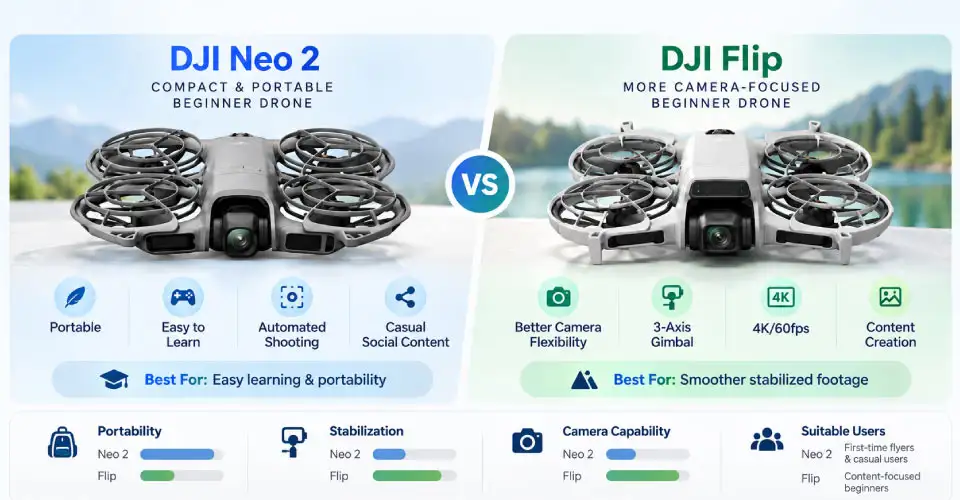
DJI Neo 2 vs DJI Flip: Which Is Better for a Beginner?
These drones suit different types of beginners. Neo 2 focuses on compact size, easy operation, automated content creation, and portability.
DJI Flip puts more emphasis on camera quality, a 3-axis gimbal, 4K/60fps recording, and content-creation features.
Choose Neo 2 if easy learning and portability matter most. Choose Flip if you are willing to spend more for better camera flexibility and smoother stabilized footage.
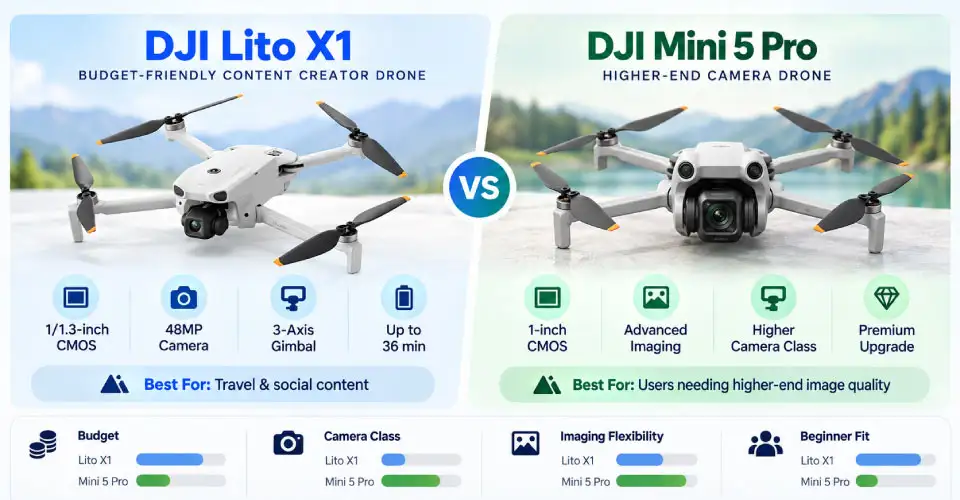
DJI Lito X1 vs DJI Mini 5 Pro: Which Is Better for Beginner Content Creators?
The Lito X1 provides a 1/1.3-inch CMOS sensor, 48MP camera, 3-axis gimbal, and up to 36 minutes of rated flight time at a lower price level. In contrast, the DJI Mini 5 Pro moves into a higher camera class with a 1-inch CMOS sensor and more advanced imaging capabilities.
For a beginner, Lito X1 can be enough for travel and social content. Mini 5 Pro becomes more relevant when you already know that you need its higher-end camera performance and are willing to increase your budget.
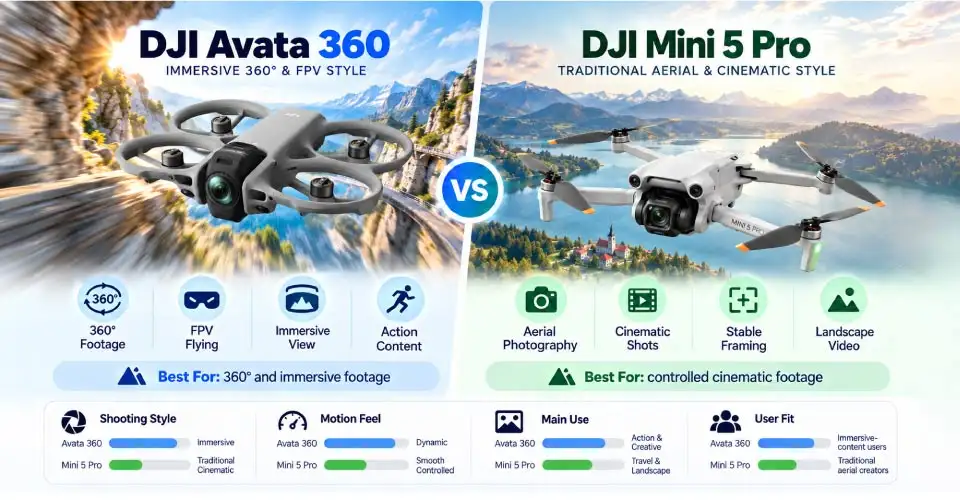
DJI Avata 360 vs DJI Mini 5 Pro: Which Flying Style Fits You?
This comparison is mainly about shooting style. The Mini 5 Pro is a conventional camera drone for aerial photography and cinematic footage. The Avata 360 is designed around 360-degree video and FPV-style flying.
Choose the Mini 5 Pro for traditional aerial photography and controlled cinematic shots. On the contrary, choose Avata 360 when immersive 360-degree footage is the main reason for buying.
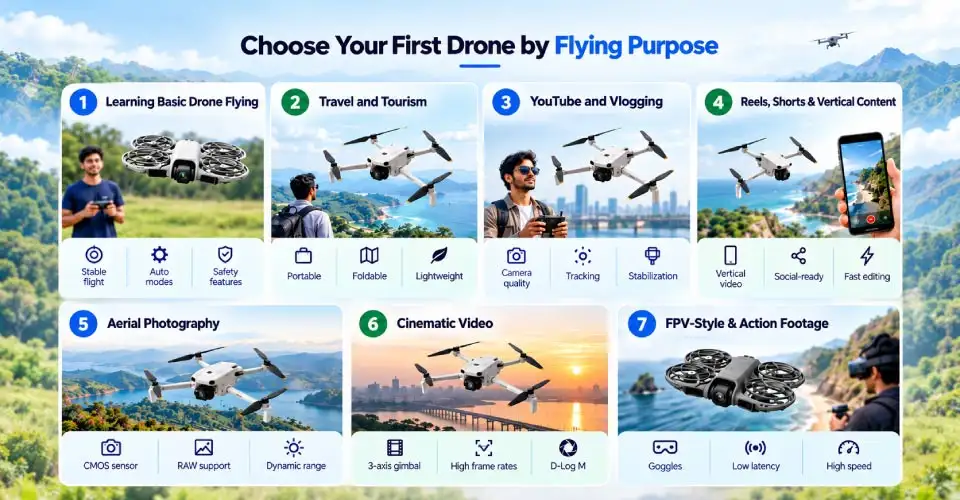
Choose Your First Drone by What You Want to Do
For Learning Basic Drone Flying
Choose a compact model with stable positioning, automated modes, and safety features. Neo 2 or Lito 1 can be enough for learning.
For Travel and Tourism
Prioritize portability, weight, folding design, battery life, and carrying convenience.
For YouTube and Vlogging
Camera quality, tracking, stabilization, and flight time matter more. Lito X1 and DJI Flip are better suited to regular content creation than entry-level models.
For Reels, Shorts and Vertical Content
Check whether the drone supports vertical shooting or suitable framing for social-media content. This can reduce cropping during editing.
For Aerial Photography
Look at the CMOS sensor, gimbal, RAW support, dynamic range, and camera controls. Do not judge image quality by megapixels alone.
For Cinematic Video
A 3-axis gimbal, suitable frame rates, sensor size, and a profile such as D-Log M can matter more than simply choosing 4K.
For FPV-Style and Action Footage
Look at the complete system, including goggles, motion controller, aircraft design, transmission, and speed. Avata 360 is more relevant to this type of flying.
Camera Specifications Beginners Actually Need to Understand
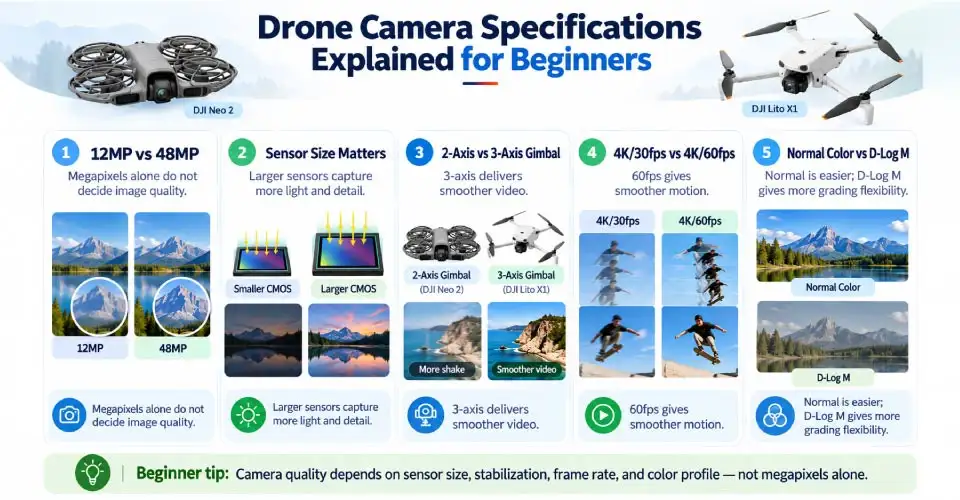
Megapixels Do Not Tell the Whole Story
A 48MP camera is not automatically better than a 12MP camera. Sensor size, lens quality, image processing, stabilization, and dynamic range also affect the result.
Why Sensor Size Matters
A larger CMOS sensor can collect more light and provide more flexibility in difficult lighting. This is why a 1/1.3-inch or 1-inch sensor can be more attractive for serious photography.
2-Axis vs 3-Axis Gimbal
A 2-axis gimbal provides useful stabilization, but a 3-axis gimbal adds control over tilt, roll, and pan. For regular video creation, the 3-axis design can produce smoother footage and is often worth paying more for.
4K/30 vs 4K/60 vs High-Frame-Rate Video
4K/30 is enough for many general videos. 4K/60 provides smoother movement and more flexibility during editing.
High-frame-rate recording is useful for slow motion, but do not pay extra for it unless your workflow actually requires it.
Normal Color vs D-Log M
Normal color is easier for quick editing and social-media content. D-Log M provides more flexibility for color grading. It is more useful if you already plan to edit your footage seriously.
Drone Safety Features That Matter to a Beginner
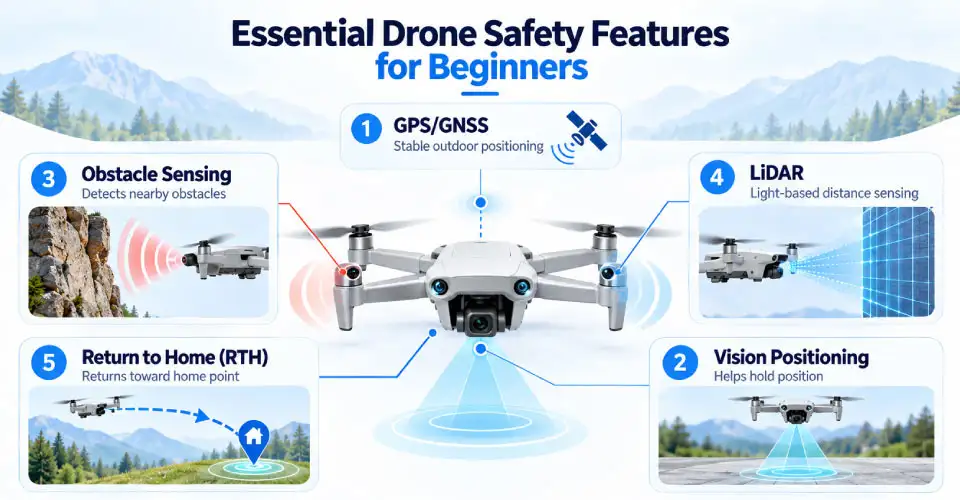
GPS/GNSS Positioning
GPS/GNSS helps the drone determine its position and maintain stable outdoor flight.
Vision Positioning
Vision sensors can help the aircraft maintain its position when suitable visual information is available.
Obstacle Sensing
Obstacle sensing can help detect objects and reduce collision risk. Check the actual sensor coverage because not every drone detects obstacles in every direction.
LiDAR
LiDAR uses light-based distance measurement to detect nearby objects. It can improve sensing in suitable conditions but does not remove the need for careful flying.
Return to Home
Return to Home (RTH) can help the drone return toward its recorded home point in certain situations. Set the appropriate RTH altitude and understand how the function works before flying.
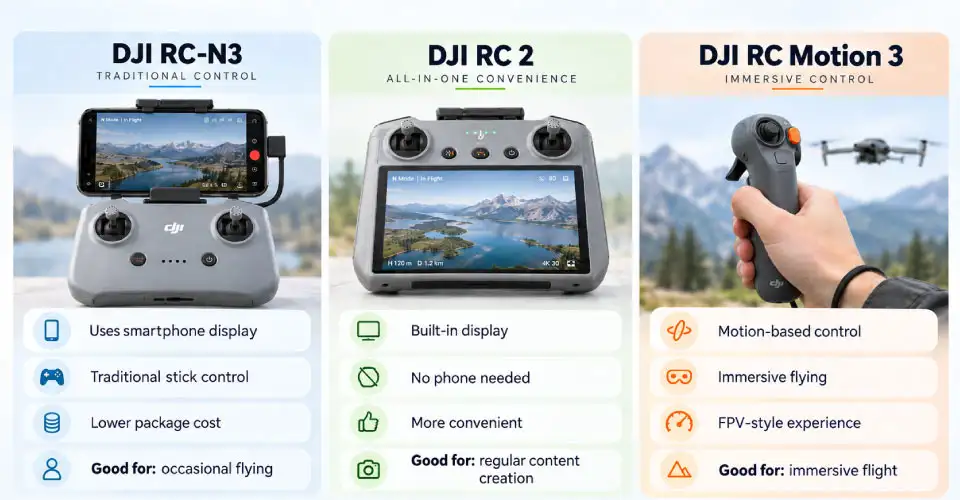
RC-N3 vs DJI RC 2 vs DJI RC Motion 3: Which Controller Should a Beginner Get?
RC-N3 uses a smartphone for the live display. It is suitable if you already have a compatible phone and want to keep the package cost lower.
DJI RC 2 has its own screen. It is more convenient for frequent flying because you do not need to attach your phone.
For occasional flying, RC-N3 can be enough. For regular content creation, RC 2 may justify the extra cost.
Normal Controller vs Motion Controller
A normal controller uses traditional two-stick controls and is the better choice if you want to learn standard drone operation. On the contrary, the motion controller changes the experience by using hand movement to control the aircraft. It is more relevant to FPV-style flying than conventional aerial photography.
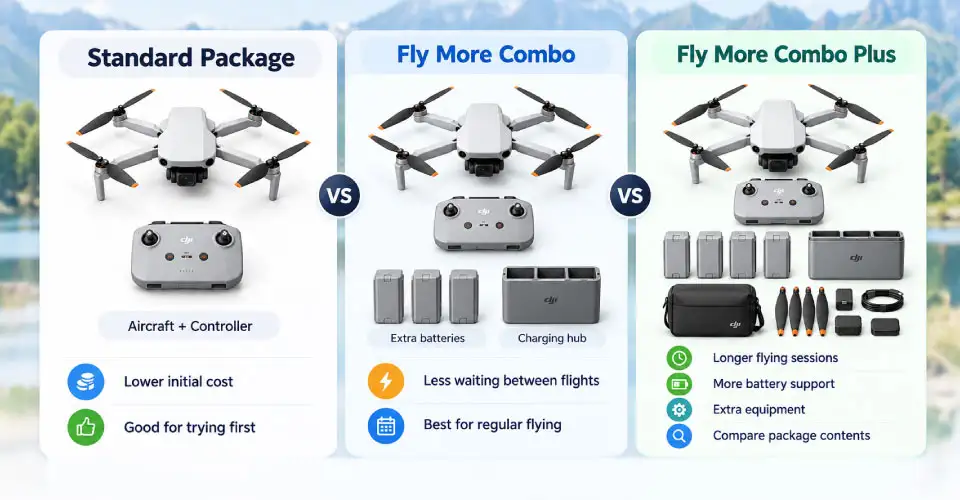
Standard Package vs Fly More Combo vs Fly More Combo Plus
Standard Package
Choose this when you are unsure how often you will fly and want the lowest initial cost.
Fly More Combo
This is useful for regular flying because extra batteries reduce waiting time.
Fly More Combo Plus
Choose it when longer sessions are important and the additional battery capacity or equipment is useful for your specific aircraft. Always compare the number of batteries, charging hub, controller, battery type, and other accessories before deciding.
How Much Flight Time Do Beginners Actually Need?
Advertised flight time is measured under specific conditions. Wind, speed, temperature, camera use, and battery condition can reduce actual flight time.
Around 20 minutes can be enough for basic practice. If you are shooting travel videos or property footage, 30–40 minutes of rated flight time becomes more useful.
For regular content creation, two or three batteries can be more valuable than a small improvement in maximum flight time.
One Battery or Three Batteries: Which Is Better?
One battery keeps the initial cost down and can be enough for occasional practice.
Three batteries are more useful for travel, content creation, and longer practice sessions because you can continue flying while another battery is being charged.
Compare the complete package instead of choosing only by the aircraft price.
How Drone Weight Changes the Flying Experience
A lightweight drone is easier to carry and can be convenient for travel. However, weight can also affect wind handling. Do not judge a drone only by its weight. Check its wind-resistance rating, camera, battery, maximum takeoff weight, and applicable flying requirements together.
Which Drone Is Suitable for Bangladesh's Outdoor Conditions?
Bangladesh can have strong sunlight, wind, humidity, dust, and sudden rain. Check the manufacturer's operating conditions before flying.
Avoid rain unless the aircraft is specifically designed for those conditions. Also check wind speed, battery condition, takeoff area, and visibility.
Obstacle sensing does not mean you can safely fly close to people, buildings, electrical wires, or other hazards.
Always check compatibility before buying accessories.
Hidden Costs of Owning Your First Drone
The drone price is only the starting point. You may later spend on batteries, memory cards, replacement propellers, carrying equipment, ND filters, repairs, and other accessories.
You should also check Bangladesh's current drone requirements before flying. The Civil Aviation Authority of Bangladesh publishes rules and guidance for drone operation, so check the latest requirements for your intended use and location.
Should You Spend More on the Camera or Controller?
If you mainly create videos or photos, spending more on the sensor, gimbal, and camera system can have a bigger effect on your finished content. But if you fly frequently, an RC 2 controller can improve convenience.
For a beginner with a limited budget, choose the aircraft and camera system that fit your work first. A premium controller is less useful if the drone itself does not meet your needs.
Should a Beginner Buy a Cheap Drone First and Upgrade Later?
If you are unsure whether you will enjoy flying, a lower-cost model can reduce your initial commitment.
However, buying a very basic drone and replacing it soon can cost more overall. If you already know you want to create aerial content, buying a proper camera drone that can grow with your skills may be more practical.
Safety features should support your flying skills, not replace them.
Beginner Drone Rules in Bangladesh
Check the latest CAAB rules before flying. Requirements can depend on the aircraft, location, purpose, and type of operation.
Do not assume that a lightweight drone is automatically free from every local requirement. Also check restrictions around airports, sensitive locations, crowded areas, and other controlled zones.
For commercial or professional aerial photography, confirm the required permissions before the shoot.
Where to Buy a Beginner Drone in Bangladesh
When comparing drones, check the aircraft, controller, batteries, package contents, warranty, availability, and after-sales support instead of looking only at the listed price.
You can compare the current drone price in Bangladesh on Ryans and browse the DJI drone category to compare available models and packages.
Prices, stock, and package contents can change, so verify the product page before ordering.
Frequently Asked Questions
Are DJI drones actually beginner-friendly?
Several DJI models are suitable for beginners, but they target different users. Neo 2 focuses on compact and simple flying, while Lito X1 and Flip offer stronger camera systems. Avata 360 is more suitable for users interested in 360-degree or immersive flying.
Which drone gives good camera quality?
Look beyond megapixels. Sensor size, lens, gimbal, recording modes, and image processing all matter. A larger sensor and 3-axis gimbal can be more useful for serious content creation.
Is Fly More worth the extra money?
It can be worthwhile if you fly regularly. Extra batteries and a charging hub reduce downtime. For occasional users, the standard package may be sufficient.
What else will I need after buying the drone?
You may need a memory card, extra batteries, spare propellers, a carrying case, charging accessories, or ND filters depending on the package. Check compatibility before purchasing.






Leave a comment