Cart (0)
Sub Total: Tk 0
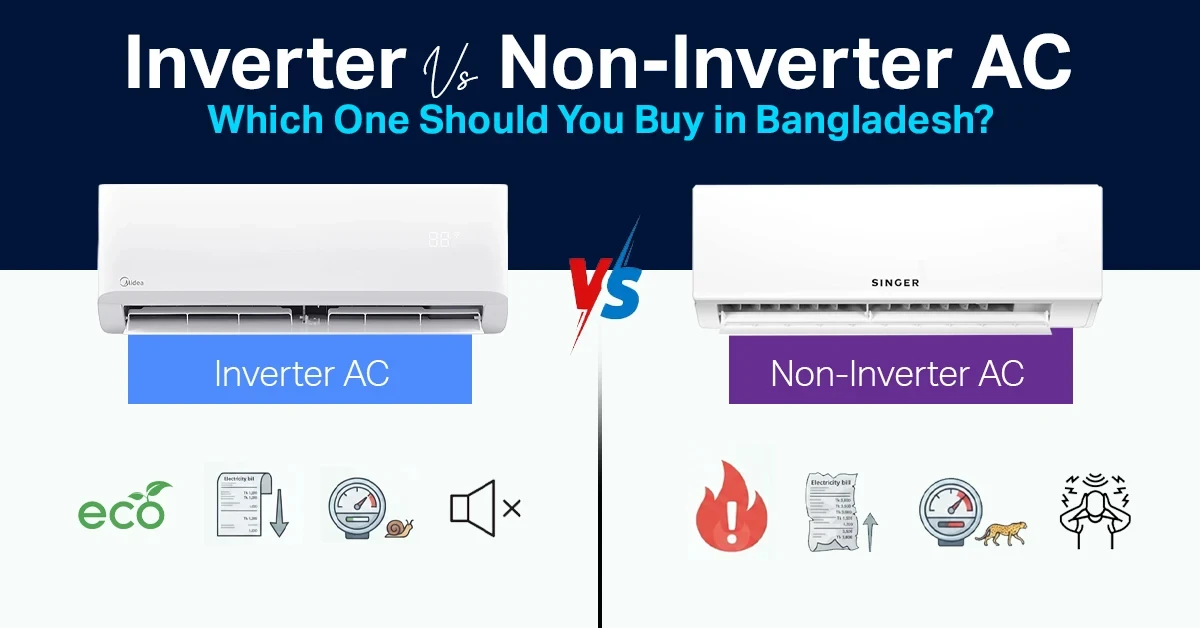
Inverter vs Non-Inverter AC: Which One Should You Buy in Bangladesh?
POSTED ON August 13, 2026 by Saiful Islam

Inverter vs Non-Inverter AC: Which One Should You Buy in Bangladesh?

Bangladesh summers do not play fair anymore. The heat stays with you throughout the day and night, so many people rush to buy an AC. Then comes the real question: inverter or non-inverter?

Walk into an AC shop in Dhaka and you may find two similar models from the same brand and with the same cooling capacity. However, the inverter model may cost Tk 15,000 to Tk 25,000 more. This choice affects your comfort, monthly electricity bill, and long-term ownership cost.

Quick answer: Choose an inverter AC when you plan to use it for five or more hours a day. Choose a non-inverter AC when your budget is tight and you only need cooling for short periods.

How the Two AC Technologies Work

Think of the compressor as the heart of your AC. How that compressor operates determines cooling comfort, noise, power consumption, and monthly running cost.

Fixed Speed 

Non-Inverter AC

A fixed-speed compressor works like a light switch. It only operates at full power or switches off completely.

The compressor runs at full speed until the room becomes cool. It then stops. When the room warms again, the compressor restarts at full power.

  • Runs at one fixed speed
  • Switches fully on and off
  • Creates noticeable temperature changes
  • Uses strong power during every restart
FeatureInverter ACNon-Inverter AC
ComfortMaintains one steady temperatureChanges between cooler and warmer conditions
Room FeelSteady and even coolingNoticeable hot and cold changes
NoiseRuns quietly through most of the dayCan become louder whenever the compressor restarts
StartupStarts and increases power graduallyStarts directly at full power
Buying PriceHigher initial purchase priceLower initial purchase price
Bill Over TimeCan reduce monthly electricity costContinues using a comparatively high amount of power
Power UseMay reduce electricity use by up to 60%Frequently operates at a high fixed power level
Best FitRegular daily use of five or more hoursOccasional use of one or two hours

Performance: Which AC Cools Better?

Fast Initial Cooling

Non-Inverter AC

A non-inverter AC starts at full compressor power. This can make a hot room feel cool quickly during the first few minutes.

However, the compressor switches off after reaching the target temperature. The room then becomes warmer before the compressor starts again, creating temperature changes of around one to two degrees.

Steady Long-Term Comfort

Inverter AC

An inverter AC may take slightly longer to provide the first strong cooling sensation because the compressor starts more gradually.

After reaching the target temperature, it adjusts compressor speed and maintains more consistent cooling without repeated full-power restarts.

Cooling difference: A non-inverter AC can provide a quicker initial blast of cold air, while an inverter AC generally provides steadier comfort over a longer period.

Energy Consumption and Electricity Cost

The electricity bill is where the difference between inverter and non-inverter AC becomes more noticeable. According to the estimates in this guide, a non-inverter AC can consume around 1.4 to 1.8 electricity units per hour, while an inverter model may consume around 0.7 to 1.1 units for similar cooling.

DESCO and DPDC electricity tariffs increase through usage slabs. A high-consumption AC may therefore increase not only its own running cost but also the average rate applied to the household's overall electricity consumption.

Usage EstimateNon-Inverter ACInverter AC
Power Draw per Hour1.4 to 1.8 units0.7 to 1.1 units
Daily Units Used for 8 to 10 HoursApproximately 12 to 17 unitsApproximately 6 to 10 units
Monthly Units UsedApproximately 460 to 500 unitsApproximately 230 to 280 units
Estimated Daily BillApproximately Tk 140 to Tk 180Approximately Tk 70 to Tk 100
Estimated Monthly BillTk 4,200 to Tk 5,400Tk 2,200 to Tk 3,000
Estimated Monthly SavingNot applicableTk 2,000 to Tk 2,400
Cost note: Actual electricity use depends on AC capacity, room size, outdoor temperature, insulation, selected temperature, operating hours, efficiency rating, and electricity tariff.

3

The 3-Minute AC Rule

Avoid switching the AC off within one or two minutes of turning it on. Allow the compressor to run for at least three to five minutes before switching it off or making major setting changes.

Choosing the Right AC Cooling Capacity for Your Room

Choosing the wrong cooling capacity wastes electricity and reduces comfort, regardless of whether the AC uses inverter or non-inverter technology.

Room SizeRecommended Capacity
Up to 120 sq ft1 Ton AC
121 to 180 sq ft1.5 Ton AC
181 to 240 sq ft2 Ton AC
241 to 300 sq ft2.5 Ton AC
High sunlight or top-floor roomAdd approximately 0.5 ton
Ceiling higher than 10 feetAdd approximately 0.5 ton
More than three people regularly use the roomAdd approximately 0.1 ton for each extra person
Home office or gaming setupAdd approximately 0.1 to 0.2 ton

Split AC or Cassette AC: Which Format Fits Your Room?

The inverter vs non-inverter decision changes according to the room, installation type, daily usage, and available budget.

Wall

Split AC

  • Indoor unit mounts on the wall
  • Compressor and condenser stay outside
  • Common choice for bedrooms and small rooms
  • Usually costs less to buy and repair

View Split AC at Ryans 

Ceiling

Cassette AC

  • Indoor unit sits above a false ceiling
  • Only the ceiling panel remains visible
  • Distributes air in several directions
  • Better suited to halls, shops, and open offices

View Cassette AC at Ryans 

Room or SituationUsage HoursBudgetTemperature StabilityBest Fit
Small bedroomFive or more hours dailyCan spend more initiallyHigh priorityInverter Split AC
Small bedroomUnder three hours dailyTightLow priorityNon-Inverter Split AC
Large hall or officeSix or more hours dailyCan spend more initiallyHigh priorityInverter Cassette AC
Large hall or shopAny usage durationTightLow priorityNon-Inverter Split or Cassette AC
Rented roomShort-term useTightLow priorityNon-Inverter Split AC

Inverter vs Non-Inverter AC Technology and Design

The core difference comes down to how the compressor motor operates. This design choice affects comfort, noise, energy use, repair cost, and purchase price.

Technology

Compressor Operation

  • A non-inverter motor operates at one fixed speed
  • An inverter motor changes speed according to cooling demand
  • A non-inverter AC cools, stops, allows the room to warm, and then restarts
  • An inverter AC reduces speed and maintains a steadier temperature

Design

Components and Efficiency

  • Non-inverter ACs use comparatively simpler components
  • Inverter ACs include additional electronic controls
  • Additional electronics contribute to the higher buying price
  • Fewer hard compressor starts may help reduce mechanical stress
  • A higher EER or ISEER rating indicates better energy efficiency
Design PointNon-Inverter ACInverter AC
Motor SpeedOne fixed speedChanges according to cooling demand
ComfortTemperature changes between cyclesMore stable temperature
Buying PriceLowerHigher
EER or ISEERUsually lowerUsually higher

Practical AC Guidance and Maintenance Tips

01

Compressor Behaviour

  • A non-inverter AC runs at full speed and then stops
  • An inverter AC slows down and continues running steadily

02

Filter and Outdoor Unit Care

  • Clean the indoor filter every two to four weeks
  • Keep dust, leaves, and debris away from the outdoor unit
  • Arrange a yearly inspection before peak summer

03

Voltage Stabilizer

  • Many inverter ACs can manage a range of voltage fluctuations
  • Use a suitable stabilizer when your area experiences frequent voltage drops

04

Hot-Climate Efficiency

  • Set the temperature between 24°C and 27°C
  • Close curtains on windows receiving direct sunlight
  • Avoid switching the AC off immediately after starting it

AC Brands, Service, and Warranty Checks

Brand Options

Available Brand Segments

Beko,Hisense,Hitachi,Hyundai,Panasonic,Singer,TCL are positioned in the guide as premium choices for build quality and inverter performance.

Gree, Haier, Midea, and Midea are presented as mid-range choices with comparatively lower prices.

Service Support

After-Sales Service

Check whether the brand has service centres near your location. Ask about hotline support, response time, technician availability, and installation quality before buying.

Coverage

Compressor and PCB Warranty

The guide notes that many inverter AC brands offer approximately five to ten years of compressor warranty. PCB coverage may be shorter, often between one and five years.

Read the warranty terms carefully because voltage damage, unauthorized repair, or incorrect installation may affect coverage.

Payment Support

Ryans EMI Options

According to the source article, Ryans offers 0% interest EMI plans for three, six, nine, or twelve months on eligible credit cards, with a minimum order value of Tk 5,000.

Check the AC Buying Guide 

Which AC Should You Buy?

Choose Non-Inverter AC

  • Your initial budget is limited
  • You use the AC for only one to three hours daily
  • You need a simpler and less expensive system to repair
  • You are buying for a rented room or temporary setup

Get the cooling capacity right before comparing technologies. Then check the EER or ISEER rating, compressor warranty, PCB warranty, installation support, and service availability.

Frequently Asked Questions

Which AC is better, inverter or non-inverter?

It depends on daily usage. An inverter AC is generally more suitable when you run it for five or more hours daily. A non-inverter AC may suit shorter usage and a tighter initial budget.

What is the 3-minute rule for AC?

Allow the AC to run for at least three to five minutes before switching it off or making major setting changes. Frequent short cycles can increase power use and place additional stress on the compressor.

How does the compressor operate in inverter and non-inverter ACs?

A non-inverter compressor operates at one fixed speed and switches fully on or off. An inverter compressor changes speed gradually and slows down after reaching the selected temperature.

Inverter split AC or cassette AC: Which should I choose?

A split AC suits bedrooms, small offices, and individual rooms. A cassette AC is more appropriate for halls, shops, showrooms, and large open offices with suitable false-ceiling space.

What are the disadvantages of an inverter AC?

The main disadvantages are the higher initial purchase price and the potentially higher repair cost. The electronic PCB and control system may require a trained technician and specialised replacement parts.

Share This!
Comments

No Comments

Leave a comment
WhatsApp