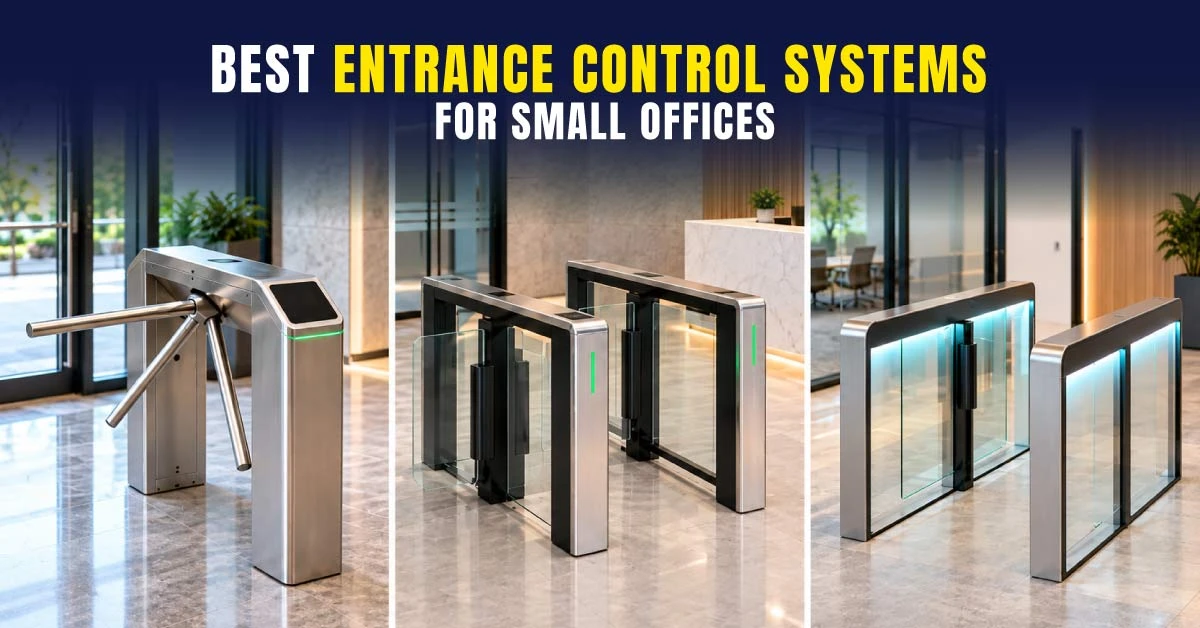
A small office does not always need a complex entrance security system. In many cases, a controlled door is enough. As employee numbers, visitor traffic, or peak arrival times increase, a tripod turnstile, flap barrier, swing barrier, or speed gate may become more useful.
The right choice depends on more than employee count. You should consider peak traffic, available entrance space, authentication method, visitor flow, accessibility, and how the system will work during emergencies.
This guide compares the main entrance control systems available for small offices and explains what to consider before buying, including space, traffic, authentication, accessibility, and total system cost.
What Is an Entrance Control System?
There is no single system that works for every workplace. A small office entrance control setup can range from a controlled door with an RFID reader to a complete turnstile system.
If only a few employees use the entrance, a door-based office entrance control system may be enough. When you need to manage a larger number of people, a tripod turnstile, flap barrier, or swing barrier can create a more controlled passage.
The key is to match the system to actual traffic. Buying a high-end system for a very small office can waste space and budget, while choosing a basic solution for heavy peak traffic can create queues.
Top Entrance Control Options for Small Office Use
Tripod Turnstile
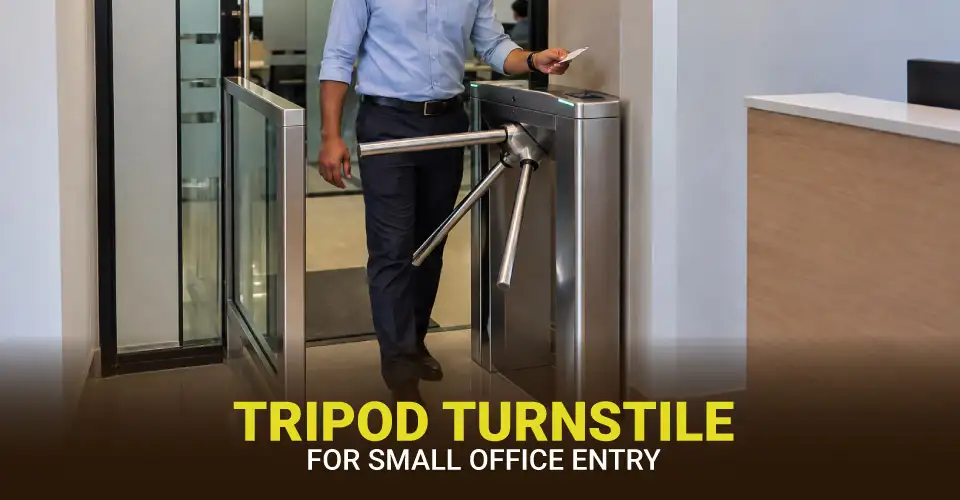
A tripod turnstile is suitable when you want controlled, one-person-at-a-time entry without using too much floor space. It works well for a dedicated employee entrance where staff already use RFID cards or another authentication method.
Its compact design makes it useful for smaller workplaces. However, it may not be the most convenient option for wheelchair users or an entrance that handles many visitors.
Choose it when: You need controlled employee entry in a limited space.
Flap Barrier
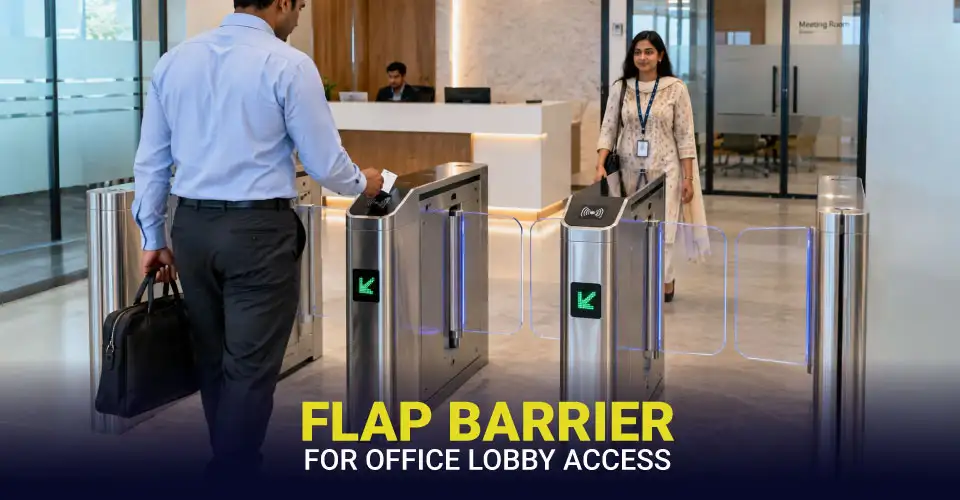
A flap barrier uses retractable panels to control a pedestrian lane. It can give an office lobby a cleaner appearance while providing stronger physical control than a standard access-controlled door.
It is a practical option when employee traffic is moderate and you want better separation between authorized users and visitors. Some models support RFID integration and biometric readers.
Choose it when: Security, appearance, and organized pedestrian flow are all important.
Swing Barrier
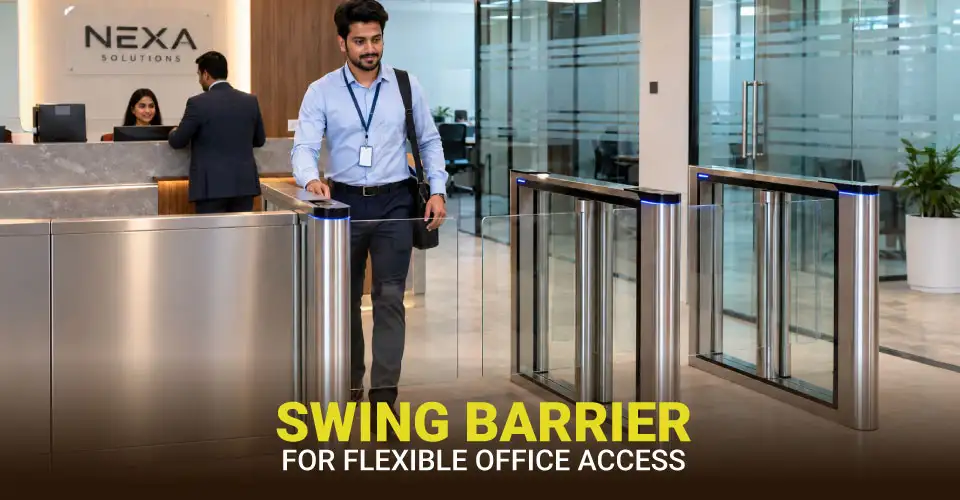
A swing barrier opens sideways after successful authentication. This makes it useful where a more open passage is preferred or where you need to accommodate different types of users.
It can work well at a reception entrance because a separate visitor lane can be planned alongside the employee route. Some models also support automatic opening during emergencies.
Choose it when: You need flexible pedestrian access and a more open entrance design.
Speed Gate
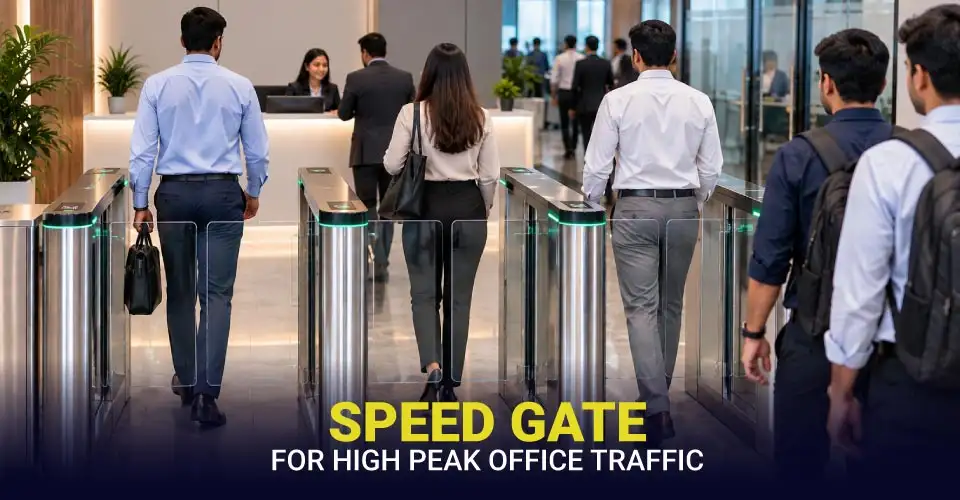
A speed gate is designed for faster movement through a controlled entrance. It becomes useful when many employees arrive within a short period and a conventional turnstile could create a queue.
For a small office, the extra cost is worth considering only when entry speed and peak traffic are genuine concerns.
Choose it when: Many employees need to enter within a short period.
Full-Height Turnstile
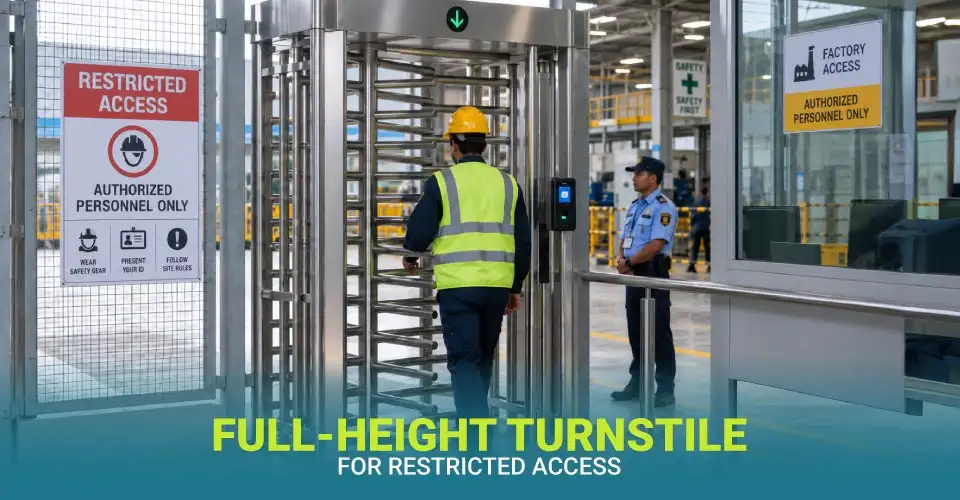
A full-height turnstile provides a stronger physical barrier than the other options. It is more appropriate for factories, restricted facilities, and locations where preventing unauthorized passage is a higher priority.
For a normal indoor office, it can be more restrictive than necessary.
Choose it when: Physical security is more important than having a welcoming office entrance.
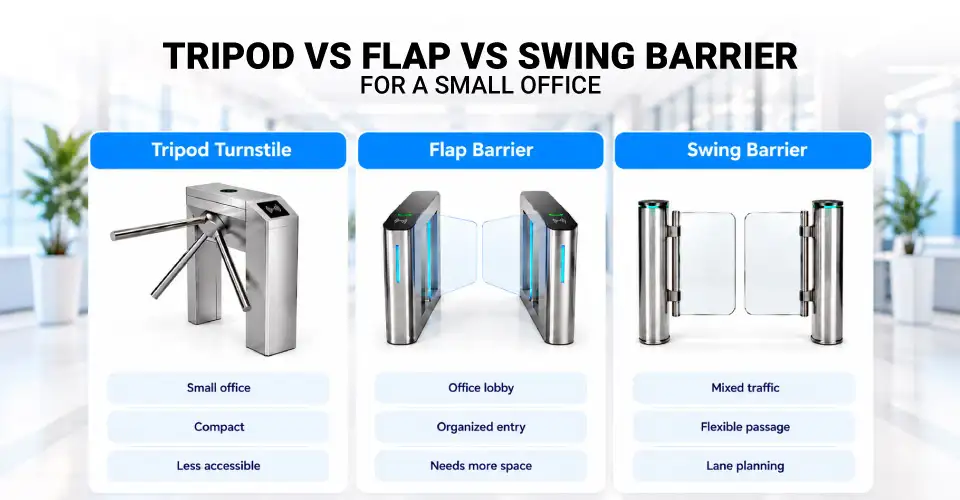
Tripod vs Flap vs Swing Barrier for a Small Office
System
Suitable for
Main Advantage
Main Limitation
Tripod Turnstile
Small employee entrances
Compact design
Less convenient for accessibility
Flap Barrier
Office lobby, medium traffic
Organized and professional entry
Needs more space
Swing Barrier
Mixed employee and visitor traffic
Flexible passage
Requires careful lane planning
Speed Gate
Higher peak traffic
Faster movement
Higher cost
Full-Height Turnstile
High-security sites
Strong physical barrier
Often excessive for offices
For around 1–15 employees, a controlled door may be sufficient. Around 15–50 employees, a tripod or barrier can become useful when arrival times are concentrated. At 50–100+ employees, throughput and queue management deserve more attention.
These are planning ranges rather than strict rules. A 30-person office with everyone arriving at once can need more capacity than a 60-person office with flexible working hours.
Do Small Offices Really Need a Turnstile?
Not always. If only a few employees enter at a time, an access control system connected to a controlled door can provide sufficient security.
However, a turnstile becomes more useful when you need to manage a controlled passage, reduce unauthorized following, or separate employee movement from visitors.
If visitors regularly enter through the same reception entrance, consider the complete workflow rather than installing a turnstile simply because it provides stronger physical control.
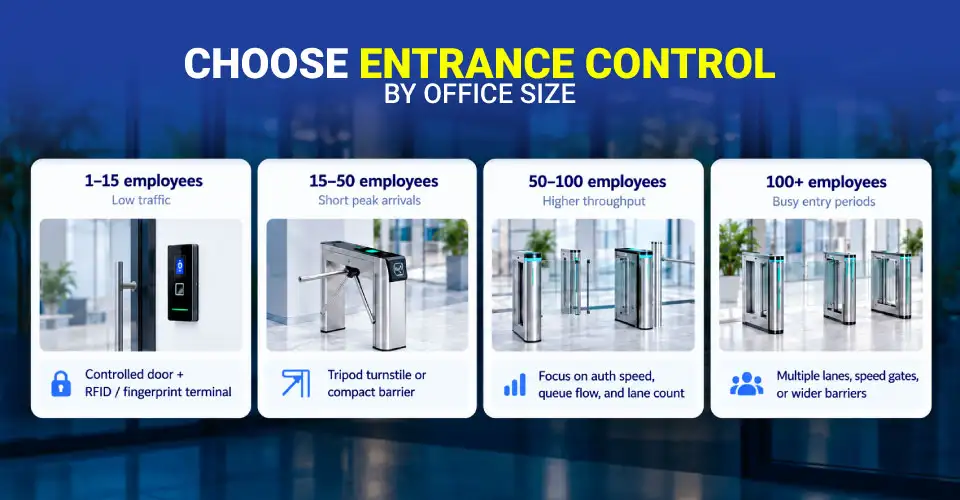
Choose Entrance Control by Office Size
Employee count can provide a starting point, but it should not be the only factor. Peak arrival patterns, visitor traffic, entrance layout, and authentication speed can change the requirement significantly.
As a rough starting point:
1–15 employees: A controlled door with RFID, fingerprint, or another access terminal is often enough when traffic is low.
15–50 employees: Consider a tripod turnstile or compact barrier if many employees arrive within a short period.
50–100 employees: Pay closer attention to throughput, authentication speed, queue formation, and the number of entrance lanes.
100+ employees: Multiple lanes, speed gates, or wider barrier systems may become relevant, depending on traffic patterns.
These are planning ranges rather than fixed rules. A 30-person office where everyone arrives within 10 minutes may need more entrance capacity than a 60-person office with flexible working hours.
Choose Entrance Control by Office Location
The location affects both security and design. For an indoor installation in a corporate building, appearance, noise, space, and visitor handling can be important. A flap barrier or swing barrier can fit naturally into an office lobby.
For factories or warehouses, durability and simple employee authentication may matter more. A tripod turnstile can be practical for a dedicated staff entrance.
If the entrance is exposed to outdoor conditions, check the product's environmental specifications. Do not assume an indoor model is suitable for outdoor use.
How Much Entrance Space Does a Small Office Need?
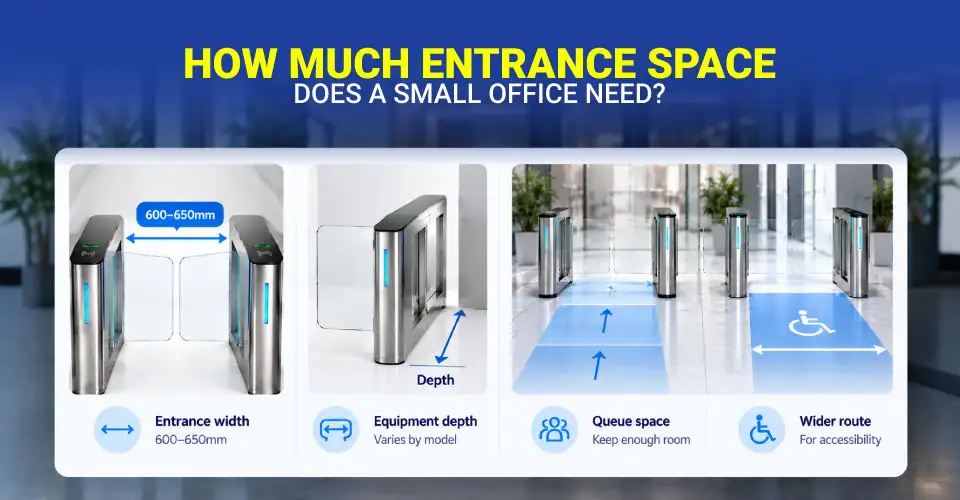
Measure the entrance before selecting the equipment. Check the available width, the depth required for the barrier, and the space where employees or visitors may need to queue.
Many standard pedestrian turnstile lanes are around 600–650mm wide, but the actual dimensions vary by model. If wheelchair users or people with other accessibility needs will use the entrance, plan a suitable wider route and verify the required dimensions against applicable local building and accessibility requirements.
Also consider the space before and after the barrier. A system may fit the entrance physically but still create problems if visitors cannot queue comfortably, doors cannot open fully, or people do not have enough room to turn and move through the entrance.
How Much Employee Traffic Should Your Entrance Handle?
Peak traffic is more useful than total employee count when choosing an entrance system.
For example, if 40 employees arrive within 10 minutes, the entrance needs to handle an average of 4 people per minute. If 80 employees arrive during the same period, that becomes 8 people per minute.
This calculation helps explain why a system suitable for 20 employees may create queues for 80 employees arriving together.
Authentication Options for Office Entrance Control
Choose authentication according to how employees and visitors use the building. RFID integration is practical when employees can carry cards or tags. Cards can also be disabled or replaced when staff leave.
Fingerprint access removes the need for physical cards but requires employee enrollment and a suitable alternative when fingerprint authentication is inconvenient.
Face recognition provides touch-free entry and can be useful at busy entrances. You can compare biometric and card-based options in the ZKTeco Access Control range when planning employee authentication.
For visitors, visitor management is usually better than giving temporary guests permanent employee credentials. A receptionist can issue temporary access or direct visitors through a separate lane.
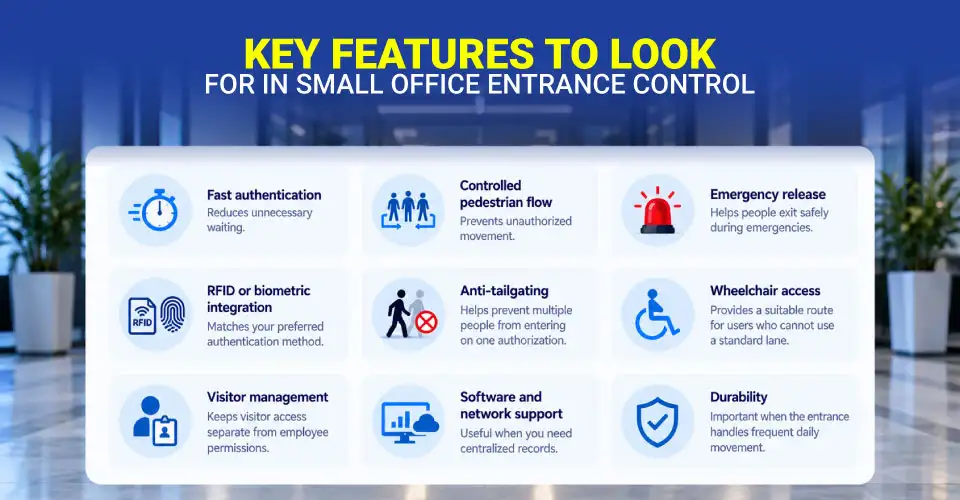
What Features Matter Most for Small Office Entrance Control?
Emergency release: Helps people exit safely during emergencies.
RFID or biometric integration: Matches your preferred authentication method.
Anti-tailgating: Helps prevent multiple people from entering on one authorization.
Wheelchair access: Provides a suitable route for people who cannot use a standard lane.
Visitor management: Keeps visitor access separate from employee permissions.
Software and network support: Useful when you need centralized records and device management.
Durability: Important when the entrance handles frequent daily movement.
If employee records, reporting, multiple devices, or centralized management are part of the project, also check whether compatible Access Control Software is required.
What Affects Entrance Control System Cost for a Small Office?
The barrier is only one part of the total cost. Your budget can also depend on:
Authentication reader or terminal
Number of entrance lanes
Barrier type
Controller and software
RFID cards or biometric enrollment
Fire-alarm and emergency integration
Backup power
Wiring and installation
Visitor management requirements
A basic employee entrance may need only a reader and controlled door. A larger office entrance gate system can require multiple readers, barriers, controllers, and software.
Small supporting components can also affect the final setup cost. Ryans offers Access Control Accessories such as RFID cards, exit buttons, magnetic locks, brackets, and related hardware for complete entrance setups.
What to Check Before Buying Entrance Control for a Small Office
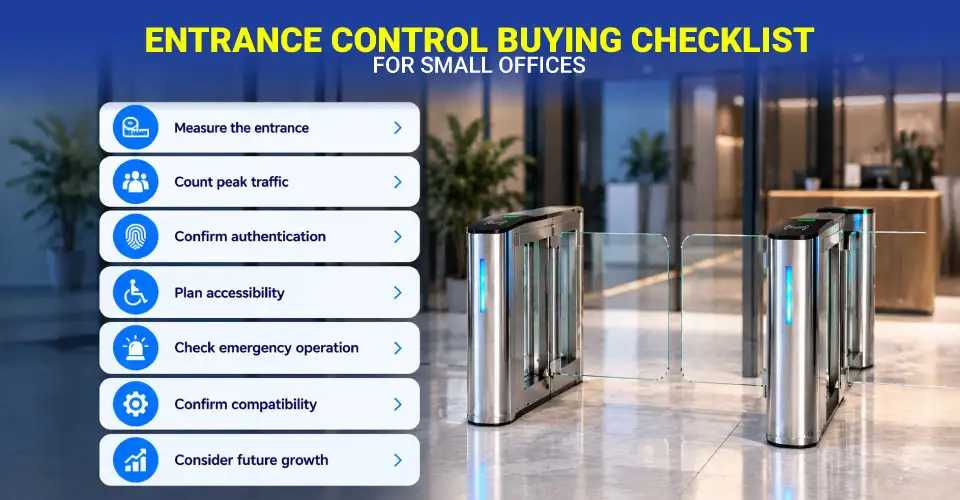
Before ordering, check these points:
Measure the entrance: Check width, depth, and available queue space.
Count peak traffic: Focus on the busiest 10–15 minutes rather than total daily traffic.
Confirm authentication: Check whether you need RFID, fingerprint, face recognition, PIN, or another method.
Plan accessibility: Make sure wheelchair users and people with mobility needs have a practical route.
Check emergency operation: Confirm what happens during a power failure or fire alarm.
Confirm compatibility: Readers, controllers, software, and barriers must work together.
Consider future growth: Leave room for additional employees, devices, or entrance lanes.
Common Mistakes Small Offices Make with Entrance Control
Choosing the cheapest system is not always economical. A low-cost setup may become inconvenient if it cannot handle peak traffic or integrate with your existing equipment.
Another common mistake is ignoring the physical layout. A barrier that fits the available floor area may still block the reception entrance or make wheelchair access difficult.
You should also decide how employees and visitors will authenticate before selecting the hardware. The right office security entrance system should fit your people, entrance, and daily workflow.
Why Buy Entrance Control from Ryans?
Ryans offers entrance-management products for different office, commercial, and institutional requirements. You can compare turnstiles, flap barriers, swing barriers, security screening equipment, authentication devices, and related components according to your project needs.
Before purchasing, confirm current product availability, compatibility, installation requirements, warranty, and any additional hardware needed for the complete setup.
Frequently Asked Questions
What is the best entrance control system for a small office?
There is no single option for every office. A controlled door can suit a very small workplace, while a tripod turnstile, flap barrier, or swing barrier may be better when employee traffic needs stronger physical control.
Is a tripod turnstile suitable for a small office?
Yes. It can work well for a dedicated employee entrance with moderate traffic and limited floor space. However, you should plan another accessible route when necessary.
Does a small office need a turnstile?
Not necessarily. A controlled door may be enough when traffic is low. A turnstile becomes more useful when you need controlled pedestrian flow or stronger physical separation.
Can office turnstiles work with RFID or fingerprint readers?
Yes. Many turnstiles can integrate with RFID readers, fingerprint devices, facial-recognition terminals, and other access-control hardware. Always check compatibility between the authentication device, controller, and turnstile before installation.
How wide should an office entrance be for a turnstile?
Many standard lanes are around 600–650mm wide. An accessible route may require around 900mm or more, depending on applicable requirements and the specific installation. Always check the actual product dimensions before planning the entrance.
What happens to a turnstile during a power failure?
It depends on the model. Some systems automatically unlock, retract, or drop the barrier during an emergency or power failure, while others use backup power. Check the product's emergency operation before installation.
Is a swing barrier better for wheelchair access?
A swing barrier can provide a wider and more convenient passage than some standard turnstiles, but accessibility depends on the actual lane width and installation. Plan the accessible route separately rather than assuming every swing barrier is suitable.









Leave a comment