01
Room size
Measure the room before choosing the blade span.
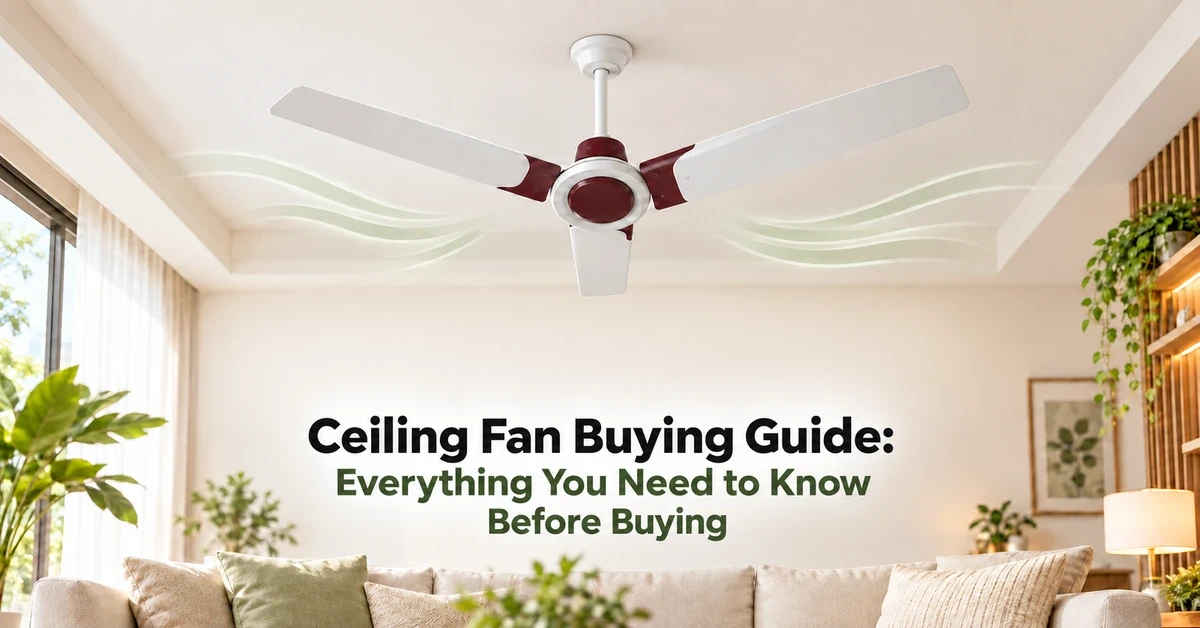
If you’re planning to buy a ceiling fan, there are more to think about rather than just the brand. The right fan should match your room size, airflow needs, ceiling height, power use, noise level, control method, installation setup, and warranty.
A fan that is too small may leave parts of the room uncomfortable, while an oversized or high-power model can use more electricity than necessary.
This ceiling fan buying guide explains how to choose a ceiling fan for homes, offices, rented rooms, and spaces that use IPS backup. The goal is simple: choose a fan that gives enough airflow without paying for features or power you do not need.

Start with these points before comparing models:
01
Measure the room before choosing the blade span.
02
Check airflow or CFM instead of judging the fan by RPM alone.
03
Compare ceiling fan wattage and motor type.
04
Bedrooms and study rooms may need quieter operation.
05
Choose between a wall regulator, remote, or app control.
06
Check ceiling height, mounting, wiring, and downrod requirements.
07
If you use IPS during load-shedding, check motor and backup compatibility.
08
Check coverage for the motor, electronics, remote, and service.
A good buying decision balances these factors instead of relying on one specification.

| Room size | Suggested fan size | Common use |
|---|---|---|
| Up to about 80 sq ft | 36-inch | Small bedroom, study, compact room |
| About 80–120 sq ft | 48-inch | Bedroom, small office |
| About 120–200 sq ft | 56-inch | Living room, larger bedroom |
| Above 200 sq ft | Larger coverage or multiple fans | Large hall, open room |
These are practical starting points. Room shape, ceiling height, furniture, and airflow can change the final choice.
Bedroom
For a small bedroom, a 36 ceiling fan or 48-inch model can fit better than a large fan. A 56-inch fan may make more sense in a larger bedroom. The fan should provide useful airflow without taking up unnecessary ceiling space.
Living Room
A living room usually needs wider air coverage. So, a 56-inch ceiling fan can suit many medium-to-large living rooms, but check the actual room area and layout first. A long or open room may need two properly positioned fans rather than one oversized unit.
Specifications become useful when you understand what they mean in everyday use. Instead of looking at one number, compare the motor, power consumption, airflow, speed control, blade construction, noise, and build quality together.
01
Ceiling fans commonly use AC, DC, or BLDC motors. DC and BLDC motors can offer better energy efficiency and quieter operation.
02
Wattage shows how much electrical power the fan uses. Compare it with airflow to understand its overall efficiency.
03
RPM indicates how quickly the blades rotate. Higher RPM does not always mean better cooling, so consider airflow and blade design too.
04
CFM indicates how much air the fan can move. For larger rooms, look for sufficient airflow rather than simply choosing a higher RPM.
05
Multiple speed levels give you better control over airflow and cooling.
06
Blade shape, size, number, and material affect airflow and durability. Look for well-balanced and sturdy blades.
07
Low noise is important for bedrooms, study rooms, and offices.
08
Check the motor housing, blades, mounting parts, controls, and warranty for reliable long-term use.
The right motor depends on how you use the fan.
| Fan type | Main advantage | Trade-off | Suitable for |
|---|---|---|---|
| Standard AC fan | Lower upfront cost | Usually higher power use than efficient alternatives | Basic everyday cooling |
| BLDC/DC fan | Lower power demand | Higher upfront price | Long daily use |
| Smart ceiling fan | More control and convenience | Higher price and more electronics | Users who want connected features |
An energy-efficient ceiling fan makes more sense when it runs for many hours each day because power savings can accumulate over time.
Therefore, a smart ceiling fan suits users who will actually use remote, app, timer, voice, or other connected features. If you only use a wall regulator, paying extra for smart controls may not add much value.
To estimate ceiling fan power consumption, use the rated wattage and your actual usage time.
60 ÷ 1000 × 8 = 0.48 kWh per day
Over 30 days:
0.48 × 30 = 14.4 kWh
One kWh is commonly called one electricity unit.
Use the rate shown on your latest electricity bill rather than relying on one fixed tariff. Your final bill can depend on total household consumption and the applicable tariff slab.
This is also why motor type and daily operating hours matter. A lower-power fan can reduce running costs when it still provides enough airflow for the room.
Bedroom
Choose a size that covers the bed and main usable area without unnecessary noise. A 48-inch model can suit many medium bedrooms, while larger rooms may need 56 inches. A BLDC model is useful if you run the fan overnight.
Living Room
Prioritize wider airflow and correct blade span. A 56-inch model can suit many medium or large living rooms. For an unusually large or open layout, consider multiple fans for more even coverage.
Study or Office
Noise, speed control, and comfort matter more here. A quieter BLDC fan with several speed settings can be useful if you spend long hours reading or working.
Large Hall
Check room dimensions and air delivery before buying. One fan may not distribute air evenly across a long hall. Multiple correctly positioned fans may provide better coverage.
Elderly Users
Simple controls can be more useful than advanced features. A remote can allow users to change speed without repeatedly reaching for a wall regulator.
IPS Users
Check the fan's motor type and the output capability of your IPS. A lower-wattage fan can reduce the load on limited backup power. However, do not assume every BLDC or DC fan works with every IPS. Check compatibility requirements first.
Ceiling fans can use a wall regulator, remote control, or app-based controls.
01
A wall regulator is simple and familiar. It works well for basic household use, but the regulator must match the fan and motor design.
02
Remote control is useful for bedrooms, elderly users, and anyone who wants to change speed without getting up. Some models also provide timers or light controls.
03
App and voice control can be convenient in a smart home. However, these features add electronics and can increase the price. Choose them when you will actually use them.
Do not replace a compatible regulator with a random one. AC and DC/BLDC motors can use different control systems.
Before buying, check the physical installation conditions.
A high ceiling may need a suitable downrod so airflow reaches the occupied area.
The ceiling structure must safely support the fan.
Check existing wiring and switches before installation.
Ask whether the selected motor and control system suit your electrical conditions.
Check backup capacity and compatibility.
Use the regulator specified for the motor type.
Keep enough space from walls, lights, cabinets, and other obstacles.
For semi-open areas, confirm that the fan is suitable for the environment.
For rented homes, also check whether changes to mounting points or wiring are allowed.
Check what the warranty actually covers. Motor, electronics, remote, LED components, and other parts may have different terms. Also check the warranty period, installation coverage, claim process, and authorized service provider. Keep your invoice and warranty documents after purchase.
However, for buyers in Bangladesh, local service access also matters. A long warranty is less useful if authorized support is difficult to reach.

01
Room area is important, but ceiling height, furniture, room shape, and airflow also affect the result.
02
High RPM does not automatically mean better room airflow. Check air delivery, blade design, and usable speed settings.
03
More blades do not automatically make a fan better. Motor design, blade shape, balance, and airflow are more useful comparison points.
04
A fan that runs for many hours every day can affect your electricity bill. Compare wattage with the airflow you actually need.
05
Lower power consumption does not mean universal IPS compatibility. Check the fan's electrical requirements and your backup system.
06
A regulator designed for one motor type may not work correctly with another. Follow the manufacturer's control requirements.
07
The remote, app, voice control, and smart functions can be useful. But do not pay extra simply because a model has more features.
Once you know the required size, motor type, airflow, controls, and warranty, you can compare suitable models instead of browsing randomly. Ryans currently lists ceiling fans across different sizes, motor types, price levels, and control options.
You can check the current ceiling fan price in Bangladesh on Ryans and compare available models before buying. Prices, stock, and specifications can change, so verify the product page before placing an order.
A 10 × 10-foot room is about 100 square feet. A 48-inch fan is a practical starting point for this size, but ceiling height, furniture placement, and desired airflow should also be checked before buying.
Neither size is automatically better. A 48-inch fan can suit smaller rooms, while a 56-inch model can provide wider coverage in larger rooms. Choose according to room area and layout.
It can be worthwhile if you run the fan for many hours and want lower power use or quieter control. Compare the higher upfront price with your expected long-term usage.
A BLDC fan can run from suitable backup power, but compatibility depends on the fan and IPS system. Check required output, waveform, and manufacturer guidance before connecting it.
Not necessarily. Blade count alone does not determine airflow. Motor power, blade design, RPM, balance, and air delivery should be considered together.
It depends on the control design. Some remote-control models require their own electronic controller and may not work correctly with a standard wall regulator. Check compatibility before installation.
Check coverage for the motor, electronics, remote, LED components, and service separately. Also confirm the warranty period, claim process, and authorized service provider.
No Comments












Leave a comment