Standard Motor
Standard ceiling fans usually use conventional AC motors, while BLDC fans are designed to provide similar airflow with lower power consumption.
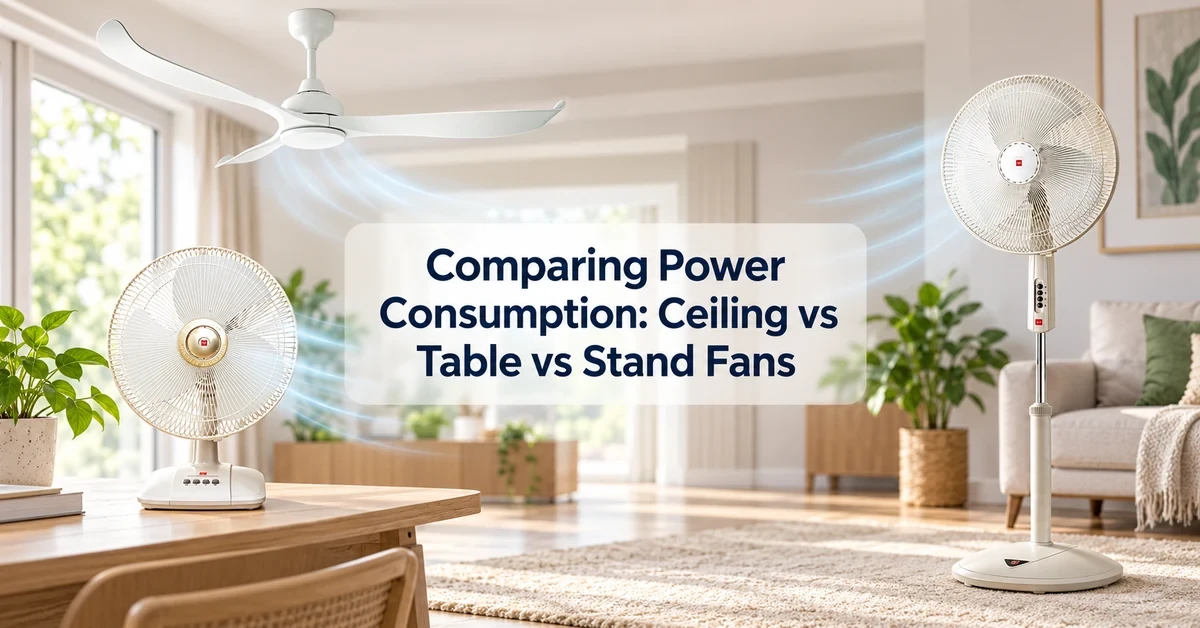
A low-watt fan may cost less to run, but it may not move enough air for your room. Therefore, a larger fan can use more power while giving wider airflow. For Bangladesh homes, students, office workers, renters, and small-room users, the practical choice is to balance power consumption with coverage, speed, operating hours, and placement.
Today, in this guide, we’ll compare ceiling fan vs table fan vs stand fan power consumption. We’ll also discuss running cost, airflow, portability, and load-shedding use.

| Fan type | Typical use | Power-use pattern | Airflow | Portability |
|---|---|---|---|---|
| Ceiling fan | Whole-room circulation | Moderate to high, depending on motor | Wide | Low |
| Table fan | Desk, bedside, small room | Low to moderate | Focused | High |
| Stand fan | Room, office, larger personal area | Moderate to high | Wide and adjustable | Medium |
Note: These are general comparisons, not fixed consumption values. Actual fan electricity consumption depends on the motor, speed setting, blade size, daily operating hours, and model.
A ceiling fan’s electricity use mainly depends on its motor, wattage, speed setting, and how long you run it. Standard AC ceiling fans generally consume more power than newer BLDC or other manufacturer-labelled energy-efficient models.
Example
For example, a Vision 56-inch ceiling fan is listed at 80W, while some inverter DC models are listed at 28W to 39W. This difference can become noticeable when a fan runs for 8–10 hours every day.
Blade sweep also matters for airflow, but a larger fan does not automatically mean higher electricity use. The motor and its efficiency remain important factors when comparing models.
Standard Motor
Standard ceiling fans usually use conventional AC motors, while BLDC fans are designed to provide similar airflow with lower power consumption.
Energy Efficient
Some manufacturers also label certain models as energy-efficient or inverter models.
However, inverter and BLDC should not be treated as interchangeable terms unless the manufacturer specifically uses them that way. When comparing fans, check the listed wattage and motor type rather than relying only on the product name.
A table fan is usually suitable for personal airflow. It sits on a desk, table, shelf, or bedside surface, so you can position it close to where you sit or sleep.
Its electricity use varies by model. Current Ryans listings include rechargeable table fans with 24W power output, while larger table-fan models can use considerably more.
The main advantage is personal cooling. If one person needs airflow while studying or working, a table fan can use less power than a larger room fan. However, low wattage does not automatically mean better. Check airflow, speed settings, blade sweep, and noise along with wattage.
A stand fan sits on the floor and normally provides wider airflow than a table fan. It is useful when you need cooling across a larger personal area but cannot install or do not want to use a ceiling fan.
Ryans offers stand fans with different power outputs, including 24W rechargeable designs and 60W or higher full-size models. This wide range means there is no single answer to how much electricity does a stand fan use? Check the exact product specification.
Height adjustment and oscillation can improve coverage. For a rented room or office where permanent installation is not possible, a stand fan is more flexible than a ceiling fan.

You can estimate fan electricity consumption with this formula:
A Watt (W) measures power, a Kilowatt (kW) equals 1,000 watts, and a Kilowatt-hour (kWh) measures energy consumption.
60 ÷ 1000 × 8 = 0.48 kWh per day
For 30 days:
0.48 × 30 = 14.4 kWh per month
A kilowatt-hour is commonly called one electricity unit. To estimate the monthly running cost, multiply 14.4 by your applicable electricity tariff per unit. Your actual bill depends on household consumption and tariff slab, so use your current rate rather than a fixed online estimate.
The same formula works for ceiling fan power consumption, table fan power consumption, and stand fan power consumption.
Suppose you compare a 40W table fan and an 80W ceiling fan, with both running for 8 hours daily.
| Fan | Wattage | Daily use | Monthly consumption |
|---|---|---|---|
| Table fan | 40W | 8 hours | 9.6 kWh |
| Ceiling fan | 80W | 8 hours | 19.2 kWh |
The ceiling fan uses twice the electricity in this example, but the table fan is not automatically better. The ceiling fan may circulate a room, while the table fan may cool one person.
So, fan wattage comparison should include useful airflow and room coverage. When calculating fan electricity cost in Bangladesh, use your current electricity tariff and actual household billing slab rather than relying on one fixed rate.
A small table fan often uses less electricity than a full-size stand or ceiling fan for personal cooling. The exact result depends on the model, motor, and speed.
However, an energy efficient fan can reduce power use without forcing you to sacrifice necessary airflow. BLDC motor and inverter technology are especially relevant for ceiling fans. Ryans currently lists inverter DC ceiling fans at 28W–39W alongside standard models rated much higher.
A low power fan for load shedding is useful when backup power is limited. Rechargeable fan models can run from their battery instead of mains power or a UPS.
Best for Low Electricity Consumption
If reducing electricity use is a priority, look for a BLDC or manufacturer-labelled energy-efficient fan with a lower rated wattage. However, wattage should not be the only factor. A fan that uses less power but does not provide enough airflow may need to run at a higher speed for longer.
For regular room use, compare the fan’s motor type, wattage, airflow, and expected daily running time. A BLDC ceiling fan can be a practical choice for long daily use, while a small table fan may consume less overall when you only need airflow for one person.
Best for Personal Use
A table fan suits one person who needs direct airflow beside a desk or bed. Adjustable speed and oscillation give more control.
Best for Small Rooms
A table or compact stand fan can work well when a small room needs personal airflow. Choose a ceiling fan when you want whole-room circulation.
Best for Larger Rooms
A ceiling fan is generally more suitable for broad room circulation. Proper blade sweep and adequate motor performance matter more than choosing the lowest wattage number. A stand fan can add airflow in a large room, but should not be judged only by wattage.
Start with wattage, but also check:
01
BLDC or inverter technology can improve energy efficiency on suitable models.
02
A low-power fan is not useful if it cannot cool the required area.
03
More control helps you avoid maximum power; higher RPM does not automatically mean better efficiency.
04
Match the fan to the space.
05
A fan used for 12 hours consumes more than one used for four.
06
Helps spread airflow.
07
Important for bedrooms, study areas, and offices.
08
Useful during load-shedding.
09
Compare its rated wattage with BLDC or inverter alternatives before buying.
10
Do not treat an IPS or backup-power label as a substitute for checking wattage and battery requirements.
Bangladesh Power Cuts

During load-shedding, power consumption is only part of the decision. You also need to consider how the fan receives power.
A rechargeable table fan can work well beside a study desk or bed. A rechargeable stand fan covers more area but may need a larger battery. Some USB-powered fans can also run from a power bank.
For regular mains operation, an efficient ceiling fan may be more practical for a family room. For short power cuts, a rechargeable fan can be easier than running a standard fan from limited backup power.
You do not always need a new fan to reduce power consumption:
01
Use the lowest comfortable speed.
02
Turn off fans in empty rooms.
03
Clean blades and guards regularly.
04
Use a timer or speed control where available.
05
Support airflow with doors and windows when weather allows.
06
Consider an energy-efficient fan for long daily use.
The right choice is the lowest-power fan that still provides enough airflow.
If you are checking current models, compare the available ceiling fans in Bangladesh based on motor type, wattage, blade size, speed options, and warranty. For flexible placement, check the stand and table fans in Bangladesh, where current listings include rechargeable and USB-powered options.
Check the product page before buying because prices, availability, and specifications can change.
Usually, lower speed reduces power demand, but the exact change depends on motor design.
It can use less power than many standard AC-motor fans, depending on the model and conditions. Ryans lists inverter DC models below many standard models in rated power.
Yes, especially for personal cooling around a desk or bed. A ceiling fan may suit whole-room circulation better.
Not always. Fan size, motor, blade design, and speed affect airflow. A stand fan offers height adjustment, while a table fan is more compact.
A rechargeable table or stand fan is useful during a power cut. Check battery capacity, runtime, charging method, and coverage.
No Comments












Leave a comment