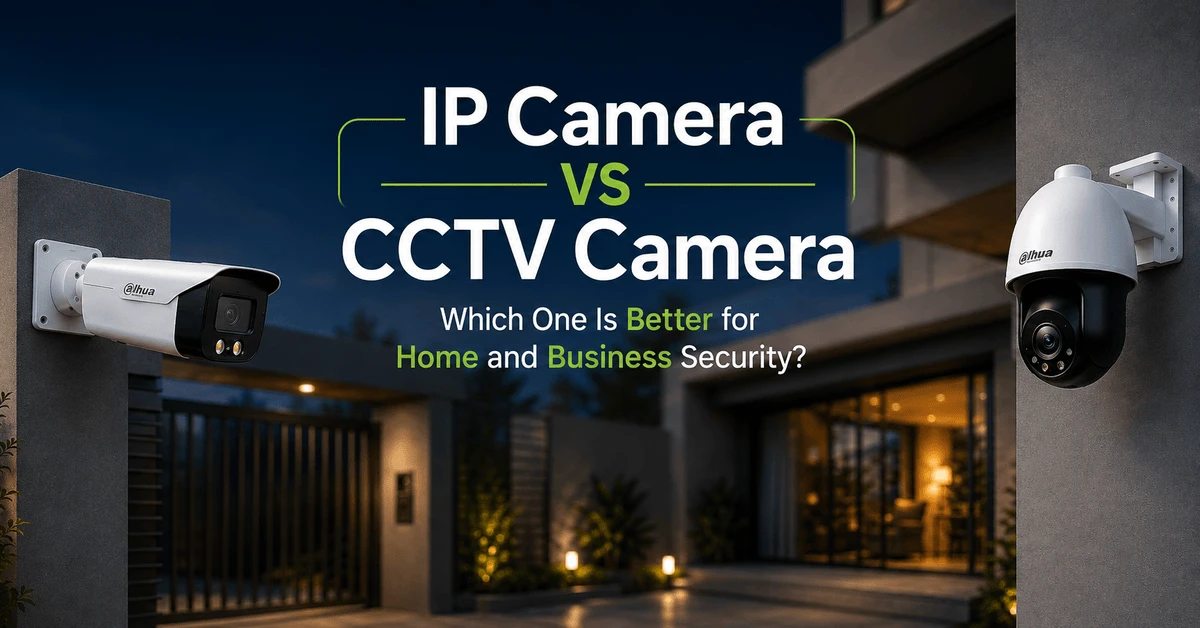
IP Camera vs CCTV Camera: Which One Is Better for Home and Business Security?
Choosing between an IP camera and a CCTV camera looks easy until you start planning the actual installation. Cables, recorders, storage, power, mobile access, internet requirements, and future expansion quickly enter the conversation, and suddenly the choice feels a little less obvious.
Both systems can provide reliable surveillance. They simply approach the job differently.
An IP camera records video digitally and sends it through a network, normally using Ethernet or Wi-Fi. Traditional CCTV usually sends its video signal through coaxial cable to a DVR or XVR. It sounds like a small distinction, but it influences almost every other part of the system, from installation and storage to remote viewing and expansion.
For a completely new setup, IP often has an advantage because network cabling, PoE, centralized management, and smart detection can make the system easier to expand later. Traditional CCTV still has a very practical place, though, especially when a property already has good coaxial wiring running through walls and ceilings.
Sometimes keeping what already works is smarter. The right answer depends on the property rather than the age of the technology.
IP Camera vs CCTV Camera: Quick Comparison
Need the simple version first?
IP cameras generally suit new, expandable, network-based security systems. Traditional CCTV often works better for straightforward surveillance or buildings where usable coaxial cable is already installed.
Feature
IP Camera
Traditional CCTV Camera
Video type
Digital network video
Analog or HD-over-coax video
Main connection
Ethernet or Wi-Fi
Coaxial cable
Recorder
NVR
DVR or XVR
Power
PoE or separate power
Usually separate power
Internet needed for local recording
No
No
Remote viewing
Yes
Yes, with compatible recorder
Resolution options
Wide range of high-resolution models
Modern HD options are available
Smart detection
Often more advanced
Depends on camera and recorder
Expansion
Generally more flexible
Mainly limited by recorder channels
Existing coax reuse
Usually not directly
Yes
Network knowledge
More important
Less important for basic systems
Best for
New and expandable installations
Simple systems or existing coax setups
Still, there is no universal winner.
Think about two very different situations. A small shop already has eight working coaxial cables installed. Meanwhile, a new office may start with twelve cameras and eventually grow to thirty across several floors.
The same recommendation would make little sense for both.
What Is an IP Camera?
An IP camera, short for Internet Protocol camera, captures video digitally and communicates through a computer network rather than relying on the traditional coaxial video path.
In a wired installation, the camera usually connects through Ethernet. Some models use Wi-Fi instead, which can be convenient when running network cable is difficult.
IP Camera → Local Network → NVR → Storage → Monitor or Mobile App
What makes IP cameras particularly useful is the network connection itself. Depending on the model, features may include PoE, mobile viewing, motion alerts, human detection, vehicle detection, microSD recording, two-way audio, active warning lights, or more advanced analytics.
The range is pretty wide.
A simple indoor camera may be enough for watching an entrance or room, while a commercial camera may be designed for warehouses, offices, outdoor boundaries, or other locations where stronger detection and centralized control matter.
If you are planning a network-based surveillance system, you can check different IP Camera options at Ryans according to resolution, connection type, recording method, and the kind of monitoring the location actually requires.
What Is PoE?
PoE stands for Power over Ethernet. The idea is wonderfully simple. A compatible IP camera can receive both network data and electrical power through one Ethernet cable.
That means fewer separate power adapters near the cameras and, in many cases, much cleaner cable management.
For one camera, the difference may not feel dramatic. Once a system grows to ten, twenty, or more cameras, however, having one cable perform both jobs becomes much more valuable, especially across offices, shops, warehouses, and permanent outdoor installations.
Less cable clutter helps too.
What Is a Traditional CCTV Camera?
The camera normally sends its video signal through coaxial cable to a DVR or XVR, while the recorder handles recording, playback, storage, display output, and often remote monitoring.
CCTV Camera → Coaxial Cable → DVR/XVR → HDD → Monitor or Mobile App
Older CCTV has a reputation for blurry footage, but modern systems have moved far beyond that.
Technologies such as HDCVI, HDTVI, and AHD can carry high-definition video through coaxial cable. As a result, modern CCTV can provide clear footage without abandoning existing coax infrastructure.
That is one reason it is still widely used.
Homes, shops, offices, warehouses, parking areas, entrances, and other fixed surveillance locations can all benefit from this type of system when the installation requirements are straightforward.
You can also browse different CCTV Camera models at Ryans based on resolution, camera shape, night-vision distance, audio support, and installation location.
Is an IP Camera Also a CCTV Camera?
Technically, yes. CCTV refers to the surveillance system itself, while IP describes how the camera communicates.
In normal shopping language, however, people often use "CCTV camera" to mean traditional analog or HD-over-coax cameras. So when someone searches for IP camera vs CCTV camera, the comparison they usually have in mind is:
IP Camera vs Traditional Analog or HD-over-Coax CCTV Camera
It is not the most precise technical wording. Still, it is how the comparison is commonly understood.
IP Camera vs CCTV Camera: Main Differences
Resolution gets plenty of attention, but it is only one piece of the decision.
Cabling, recorder type, storage, remote access, power delivery, networking, installation complexity, and future expansion can matter just as much, sometimes more.
Image Quality and Resolution
Modern IP and CCTV systems can both produce clear footage.
IP cameras come in a wide range of resolutions, starting from everyday Full HD models and extending to higher-resolution options designed for detailed surveillance.
Traditional CCTV has improved considerably too. Modern HD-over-coax cameras can provide Full HD and higher-resolution video, so the old idea that CCTV always means low-quality footage no longer holds up.
Common resolution choices include:
2MP: Suitable for rooms, counters, entrances, and general monitoring.
4MP or 5MP: Better when a wider area needs more visible detail.
8MP or 4K: Useful when detail is particularly important, although storage requirements increase.
A 1080p camera is roughly equivalent to 2MP.
Moving to 5MP gives you considerably more pixels, which can help preserve smaller details during playback. Yet resolution alone does not guarantee useful evidence.
Placement can easily ruin the advantage.
A carefully positioned 2MP camera may provide more useful footage than a poorly placed 5MP model. Lens choice, lighting, sensor quality, night vision, frame rate, bitrate, compression, and viewing angle all affect what you eventually see on screen.
Megapixels matter. They are not magic.
Cabling and Installation
Here, the difference becomes much more noticeable. IP cameras commonly use Cat5e or Cat6 Ethernet cable. When PoE is available, that same cable can carry both network data and electrical power.
Traditional CCTV normally uses coaxial cable for video and a separate power connection.
For a new property, Ethernet can be a very clean starting point, particularly if the building already uses structured network cabling.
An older property may tell a completely different story.
If reliable coaxial cables are already hidden inside walls, ceilings, conduits, or outdoor routes, replacing everything with Ethernet might add considerable labor without delivering an equally large practical benefit.
Existing infrastructure changes the economics.
For wired IP installations, dependable Network Cable is worth using because cable quality affects network stability and PoE delivery, particularly across longer runs.
DVR vs NVR
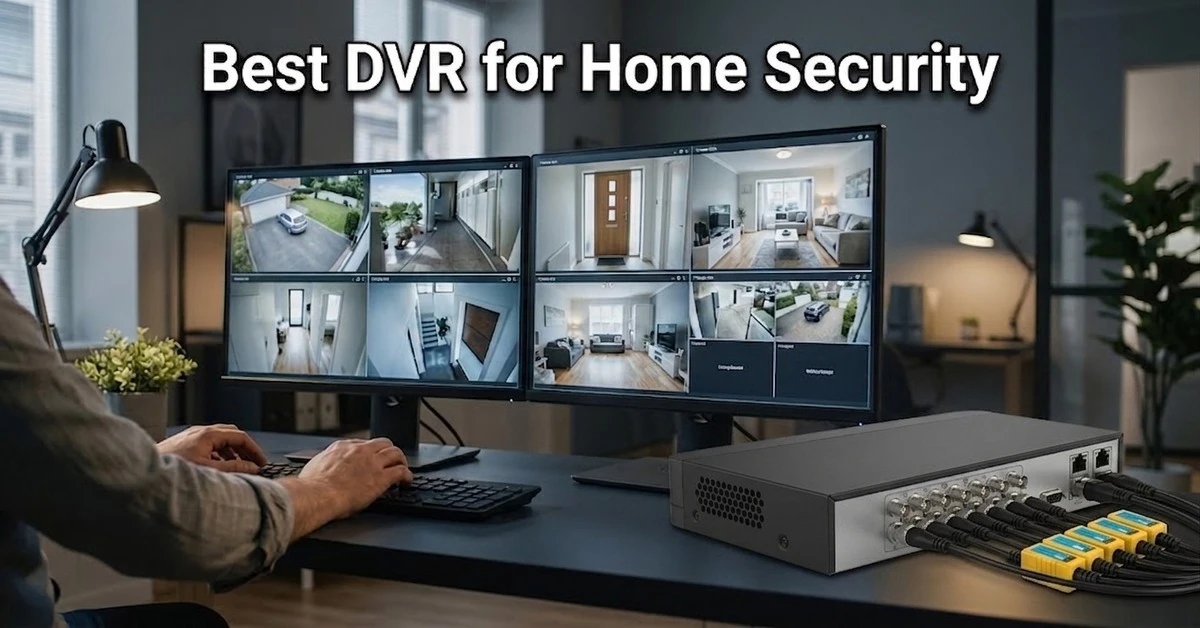
A DVR and an NVR perform similar recording jobs, but they usually work with different camera technologies.
A DVR, or Digital Video Recorder, is commonly paired with analog or HD-over-coax CCTV cameras.
Available DVR options differ in channel capacity, supported camera formats, recording resolution, frame rate, storage support, and other features.
An NVR, or Network Video Recorder, receives digital video from IP cameras through the network.
Some NVRs include built-in PoE ports. In smaller systems, this can make installation noticeably simpler because compatible cameras can connect directly to the recorder rather than needing a separate PoE switch.
One question comes up surprisingly often: is an IP camera better than a DVR?
That comparison is slightly misplaced.
The IP camera captures the video. The DVR records footage from compatible cameras.
They perform different jobs.
Does an IP Camera Need Internet?
No, This is probably one of the most persistent misunderstandings surrounding IP cameras.
An IP camera needs a network, but a local network and the internet are not the same thing.
IP Camera to Local Network , and Local Network to NVR
As long as the camera and recorder can communicate inside that local network, recording can continue even if the external internet connection fails.
Some standalone IP cameras can also record directly to a microSD card.
Internet access becomes more relevant when you want to:
View cameras from another location
Receive remote alerts
Use cloud recording
Change settings remotely
Access certain cloud-based mobile services
Traditional CCTV can continue recording locally without internet as well.
So yes, your internet can go down while the cameras keep recording.
Remote Viewing
IP cameras naturally fit remote monitoring because they already operate on a network.
Depending on the model and software, you may be able to watch live footage, review recordings, receive notifications, or adjust certain settings through a supported mobile app or desktop application.
Traditional CCTV can offer remote access too.
A compatible DVR or XVR connected to the network can allow off-site viewing through its supported app or software.
The actual experience depends on several things.
Internet upload speed, camera bitrate, video resolution, router stability, and the number of simultaneous streams can all affect performance, particularly when several high-resolution cameras are being viewed remotely at the same time.
For systems that depend heavily on Wi-Fi or remote viewing, a stable Network Router becomes more than just a household internet device. It is part of the surveillance setup.
Storage Options
Both systems can record footage locally. IP cameras simply tend to offer more ways to do it. Depending on the camera and system design, footage may be stored on:
An NVR hard drive
A microSD card
Supported network storage
Cloud storage
Traditional CCTV usually records to a hard drive installed inside the DVR or XVR. There is another misconception worth clearing up.
Buying an IP camera does not automatically mean signing up for monthly cloud storage.
Many cameras and NVRs support local recording without any recurring subscription.
For continuous surveillance, storage capacity should be calculated from the number of cameras, resolution, frame rate, compression, recording schedule, and the number of days of footage you want to keep.
A suitable Surveillance HDD can be a better fit for systems expected to record continuously for long periods, particularly when several cameras share the same recorder.
Smart Detection and Advanced Features
This is one area where IP cameras often feel noticeably more advanced. Depending on the model, available features may include:
Human detection
Vehicle detection
Motion alerts
Line-crossing detection
Intrusion detection
Smart tracking
Two-way audio
Warning lights
Sirens
Mobile notifications
These features can make surveillance much easier to manage.
A basic motion detector might react to shadows, rain, leaves, insects, or a wandering cat. More advanced detection can help prioritize people, vehicles, or specific movement patterns instead.
That sounds great, but there is a catch. Not every IP camera includes sophisticated analytics. At the same time, some modern CCTV cameras can provide intelligent detection when paired with a capable recorder.
So the better question is not simply, "Is this an IP camera?"
Ask what the camera and recorder can actually do together. That answer is far more useful.
Network Requirements and Scalability
A couple of IP cameras are normally easy to manage. Once the system starts growing, planning becomes more important.
For larger IP installations, consider:
Number of cameras
Resolution
Video bitrate
Frame rate
NVR incoming bandwidth
Ethernet cable quality
Switch capacity
PoE power budget
A Network Switch becomes particularly useful when several wired cameras need to connect across an office, warehouse, large home, or multi-floor commercial property.
Traditional CCTV expands differently.
The recorder channel count plays a much bigger role. If an eight-channel DVR already has eight cameras connected, adding camera number nine may require a larger recorder, an additional recorder, or some restructuring.
In a small setup, that may never become a problem.
In a growing business, it can become an irritating limitation sooner than expected.
IP Camera vs CCTV Camera Cost
The camera itself is only the beginning of the budget.
A complete security setup may involve:
Camera + Recorder + Cable + Storage + Power + Network Equipment + Installation + Optional Services
Once those pieces are included, the cheaper camera does not always belong to the cheaper overall system.
Camera and Recorder Cost
Traditional CCTV cameras often have lower-cost entry options, which keeps them attractive for smaller homes, shops, and offices.
IP cameras may cost more when they include features such as higher resolution, PoE, built-in audio, smart detection, or more sophisticated image processing.
Recorders can vary just as widely.
An NVR with many channels, high incoming bandwidth, several storage bays, and built-in PoE naturally belongs to a different price category from a simple recorder designed for four cameras.
Context matters here.
Comparing two individual camera prices without considering the surrounding system can give a very misleading impression.
Cabling and Installation Cost
Existing wiring can save a surprising amount of money.
If good coaxial cable is already installed throughout a property, replacing old cameras and upgrading to a compatible DVR or XVR may be easier than rewiring everything with Ethernet.
A new building changes the picture. When network cable is being installed anyway, running Cat6 to future camera points can give an IP system a clean foundation from the beginning.
That preparation may also make expansion much easier later. A little planning early can avoid an expensive retrofit.
Storage and Running Cost
Higher resolution creates more video data. That extra data may require:
Larger hard drives
More recorder bandwidth
Stronger network infrastructure
Additional storage capacity
Cloud storage fees when cloud recording is used
Does that automatically make IP expensive? Not really. It simply means the system has to be sized properly.
Traditional CCTV can sometimes start at a lower cost, but replacing a full recorder, expanding past available channels, or rewiring later may quietly increase the total cost over time.
The cheapest first purchase is not always the cheapest long-term choice.
Which One Is More Cost-Effective?
Traditional CCTV often makes sense when:
Good coaxial cable is already installed
The system will remain fairly small
Continuous local recording is enough
Advanced network features are unnecessary
IP may provide better long-term value when:
The installation is completely new
More cameras will probably be added later
Smart detection matters
PoE would simplify cabling
Several floors or buildings need coverage
Centralized network management is useful
Camera price alone tells only part of the story. Price the entire system instead.
Advantages and Disadvantages of IP and CCTV Cameras
Neither technology is flawless. That is actually helpful because the strengths and weaknesses make the choice clearer once the installation requirements are understood.
Advantages of IP Cameras
Flexible network installation
PoE support
High-resolution options
Advanced detection
Easier expansion
Remote management
Several storage choices
For modern network-based projects, those advantages can make the system much easier to grow and manage.
Disadvantages of IP Cameras
More network planning
Higher bandwidth use in large systems
Greater cybersecurity responsibility
More complicated setup for beginners
Higher initial equipment costs in some cases
The flexibility is valuable. Still, flexibility usually comes with more configuration, more choices, and a little more homework.
Advantages of Traditional CCTV Cameras
Straightforward system design
Reuse of existing coaxial cable
Affordable basic surveillance
Local recording without internet
Simple fixed-camera installations
For many homes and small businesses, that simplicity is the attraction rather than a limitation. Sometimes simple is exactly right.
Disadvantages of Traditional CCTV Cameras
Expansion depends heavily on recorder channels
Cameras often need direct cable routes
Network flexibility is lower
Some smart features may be limited
Large installations can become harder to manage
These limitations may barely matter in a four-camera setup. Once the system grows across many rooms, floors, or buildings, they can become much more noticeable.
IP Camera vs CCTV Camera for Home Security
Home surveillance can range from one camera near an apartment entrance to a complete system covering gates, stairs, parking areas, rooftops, and back doors.
For one or two locations, a Wi-Fi IP camera can be wonderfully convenient.
Mobile viewing, alerts, and two-way audio are useful when you want quick everyday monitoring without building a large recorder-based system.
For a larger house, wired PoE cameras usually offer a more stable foundation. Each camera gets a wired connection, which reduces dependence on Wi-Fi quality around the property.
Traditional CCTV still has a strong case when coaxial cable is already installed.
If the main requirement is dependable continuous recording from several fixed locations, replacing an existing wired system may offer little benefit unless new features are genuinely needed.
For a fresh smart-home installation, IP usually makes more sense.
For an existing CCTV-equipped property, upgrading what is already there may be the smarter move.
IP Camera vs CCTV Camera for Shop and Small Business
A shop usually needs more than one useful viewing angle. Typical areas include:
Cash counter
Entrance
Exit
Product shelves
Store room
Employee areas
Outdoor frontage
A small CCTV system can provide dependable continuous recording without turning the installation into a complicated networking project.
IP starts becoming more attractive when the business wants higher-detail footage, smarter alerts, frequent remote access, or room to add cameras later.
Growth changes things.
If another counter, storeroom, floor, or entrance may need coverage next year, leaving spare channels and enough network capacity now can save a painful rebuild later.
A little unused capacity is not always wasted capacity.
IP Camera vs CCTV Camera for Outdoor Security
Outdoor surveillance is less forgiving.
Rain, dust, heat, darkness, long viewing distances, power issues, and weak wireless signals can expose weaknesses that remain completely hidden indoors.
For outdoor installations, check:
Weather resistance
IP66 or IP67 protection when necessary
Night-vision range
Low-light performance
Full-color night view
Detection distance
Stable power
Secure mounting
Protected cable joints
For several fixed outdoor IP cameras, wired PoE is generally more dependable than relying entirely on Wi-Fi.
Wi-Fi can still work perfectly well for a nearby gate or entrance camera. Once thick walls, long distances, interference, or poor router placement enter the picture, though, reliability can deteriorate surprisingly quickly.
Outdoor performance depends heavily on installation quality.
Wi-Fi IP Camera vs PoE IP Camera
Both are IP cameras. The connection method is what separates them.
Wi-Fi IP Camera
Wi-Fi cameras work well for:
Apartments
One or two camera locations
Indoor monitoring
Places where Ethernet cabling is inconvenient
The setup can be pleasantly simple. Still, wireless does not necessarily mean wire-free.
Most Wi-Fi security cameras continue to need electrical power, so you may remove the network cable while keeping the power cable.
It is a small detail, but one worth knowing before installation.
PoE IP Camera
PoE is usually better suited to:
Multiple cameras
Shops
Offices
Outdoor monitoring
Permanent security installations
With a compatible setup, one Ethernet cable carries both power and data.
The result is cleaner cabling and a stable wired connection.
With one camera, that convenience may feel minor. With fifteen cameras, it becomes much more obvious.
Can You Add IP Cameras to an Existing CCTV System?
Often, yes. The real issue is compatibility.
An older DVR may support only traditional cameras. A newer XVR or hybrid recorder may accept analog cameras while also allowing a limited number of IP channels.
Another option is to leave the original CCTV system untouched and install a separate NVR for the new IP cameras.
Before buying anything, check:
Available recorder channels
Supported camera formats
Maximum IP camera support
Resolution limits
Network bandwidth
Storage capacity
Never assume compatibility because a connector looks right. The recorder specification matters far more than appearances.
Should You Upgrade From CCTV to an IP Camera System?
Not every working CCTV system needs replacing.
If the existing cameras provide useful footage, the recorder is reliable, and every important area is already covered, a complete replacement may solve very little.
New technology is appealing, but unnecessary upgrades can become expensive remarkably fast.
Keep Your Existing CCTV System When
Recorded footage is still useful
Cameras remain reliable
The recorder works properly
Major expansion is not expected
Advanced detection is unnecessary
A working system still has practical value. There is no prize for replacing equipment simply because something newer has appeared.
Consider a Hybrid Upgrade When
Existing coaxial cameras still work well
Only certain areas need IP cameras
Full replacement would be wasteful
You prefer to upgrade gradually
This allows useful equipment to remain in service while newer cameras are added only where the extra capabilities make a real difference. For many businesses, this is the more economical route.
Move Fully to IP When
A new property is being wired
Major expansion is expected
Cameras are spread across several floors
Several buildings need coverage
Advanced analytics are required
PoE is preferred
Centralized network management matters
The upgrade should solve something tangible. If it does not, there may be little reason to replace a perfectly functional system.
How Secure Are IP Cameras?
IP cameras are network devices, which means cybersecurity should be part of the setup. Good security practices include:
Change default usernames and passwords
Use strong, unique passwords
Keep camera firmware updated
Keep recorder firmware updated
Secure the Wi-Fi network
Limit administrator access
Disable unused network services
Enable multi-factor authentication where available
Choose products that continue receiving software updates
Most of these steps are simple. Ignoring all of them is where problems begin. A few careful settings during installation can prevent a great deal of trouble later.
Can an IP Camera Be Hacked?
Yes, poorly secured network cameras can be attacked. Weak passwords, outdated firmware, unsafe Wi-Fi, and unnecessary remote access all increase exposure. That does not make IP cameras inherently unsafe.
Strong credentials, current firmware, restricted permissions, and a properly secured network can significantly reduce risk.
Traditional systems are not automatically immune either. Once a DVR or XVR is connected to the internet for remote access, its security matters too.
What to Check Before Choosing an IP or CCTV Camera System
Do not start with megapixels. Start with the area you need to protect and what you expect the footage to accomplish.
Camera count: Decide how many cameras you need now and how many you might add later.
Indoor or outdoor use: Match the camera body and protection rating to the environment.
Resolution: Choose enough detail for the size and distance of the area.
Lens: Wider lenses cover more nearby space, while narrower lenses make distant subjects appear larger.
Night vision: Check both the technology and usable night range.
Connection: Decide whether coaxial, Ethernet, PoE, or Wi-Fi is the better fit.
Recorder: Confirm DVR, XVR, or NVR compatibility.
Channel capacity: Keep spare channels when future expansion is likely.
Network bandwidth: Larger IP systems require careful bandwidth planning.
Storage: Decide how many days of footage you actually need.
Audio: Consider whether a microphone or two-way audio adds useful context.
Remote viewing: Confirm app, router, and internet requirements.
Smart detection: Pay for features that solve a genuine monitoring problem.
Backup power: Keep the recorder, cameras, and essential network equipment running during outages.
Security: Use strong credentials and current firmware.
Expansion: Think about future rooms, entrances, floors, or buildings.
Warranty: Check warranty coverage and after-sales support before purchasing.
Small pieces matter more than people expect. Suitable CCTV Camera Accessories can help with mounting, connectors, cable routing, power distribution, and weather protection.
Backup power deserves equal attention. A correctly sized UPS can keep cameras, recorders, routers, and other essential equipment operating according to the total power load and the backup time you need.
After all, a recorder cannot capture footage from cameras that have already lost power.
IP Camera vs CCTV Camera: Which One Should You Choose?
Once you focus on the actual property, the choice becomes easier. Choose an IP camera system when you want:
Flexible networking
PoE
Smart detection
Easier future expansion
High-resolution options
Centralized network management
Choose traditional CCTV when:
Existing coaxial cable is already installed
Initial costs need to stay controlled
Simple local recording is sufficient
The system will remain relatively small
Advanced network features are unnecessary
For many newly built homes, offices, and expanding businesses, IP provides the stronger long-term platform.
For properties that already have dependable CCTV cabling, upgrading the existing system can still be the more sensible and cost-effective choice.
Different buildings create different answers.
Final Verdict
So, which one should you buy?
For a new surveillance system that needs PoE, flexible networking, smart detection, higher-resolution options, and room to expand, an IP camera system is usually the stronger choice.
Traditional CCTV remains a perfectly practical option.
It makes particular sense when existing coaxial cable can be reused, the surveillance requirement is uncomplicated, and keeping the initial installation cost under control matters.
Do not judge the system by megapixels or camera price alone.
Look at the recorder, cabling, storage, network equipment, backup power, installation effort, and future camera count as parts of the same system. That broader view usually reveals where the better value actually sits.
A good security setup should quietly do its job.
It should cover the important areas, record useful footage, remain dependable, and leave enough flexibility for what you may need later without loading the installation with expensive features that never get used.
Frequently Asked Questions
Is an IP camera better than CCTV?
An IP camera is generally more suitable for new or expandable installations because it can support PoE, flexible networking, advanced detection, centralized management, and a wide range of resolutions. Traditional CCTV may still be the better option when usable coaxial cabling already exists or when the surveillance requirement is fairly simple.
Can an IP camera work without internet?
Yes. Many IP cameras can record to an NVR, microSD card, or another supported local storage option without an external internet connection. Internet access is mainly required for remote viewing, cloud services, and notifications outside the local network.
Are IP cameras considered CCTV cameras?
Yes. An IP camera can be part of a CCTV surveillance system. CCTV describes the security setup, while IP describes the network technology the camera uses to communicate.
What are the disadvantages of IP cameras?
IP systems may require more network planning, consume more bandwidth in larger installations, need proper cybersecurity settings, and involve more complicated configuration. Initial equipment costs can also be higher when PoE, high resolution, or advanced analytics are included.
Which is more expensive, DVR or NVR?
There is no fixed answer. Channel count, supported resolution, recording bandwidth, storage capacity, PoE capability, and other features all affect recorder cost. Comparing the complete camera system is more meaningful than comparing DVR and NVR prices alone.
Can I use an IP camera with an existing CCTV system?
Possibly. Some XVR or hybrid recorders support traditional cameras together with a limited number of IP cameras. If the current recorder does not support IP, a separate NVR can be added while the existing CCTV system continues operating.
Is an IP camera safe from hackers?
An IP camera can be used securely when strong passwords, updated firmware, secure Wi-Fi, controlled permissions, and sensible remote-access settings are in place. Default credentials and outdated software should be avoided on any internet-connected surveillance equipment.










Leave a comment