01
Wall-mounted hood
Installed above a cooktop against a wall. It suits kitchens where the cooking area has enough wall space.
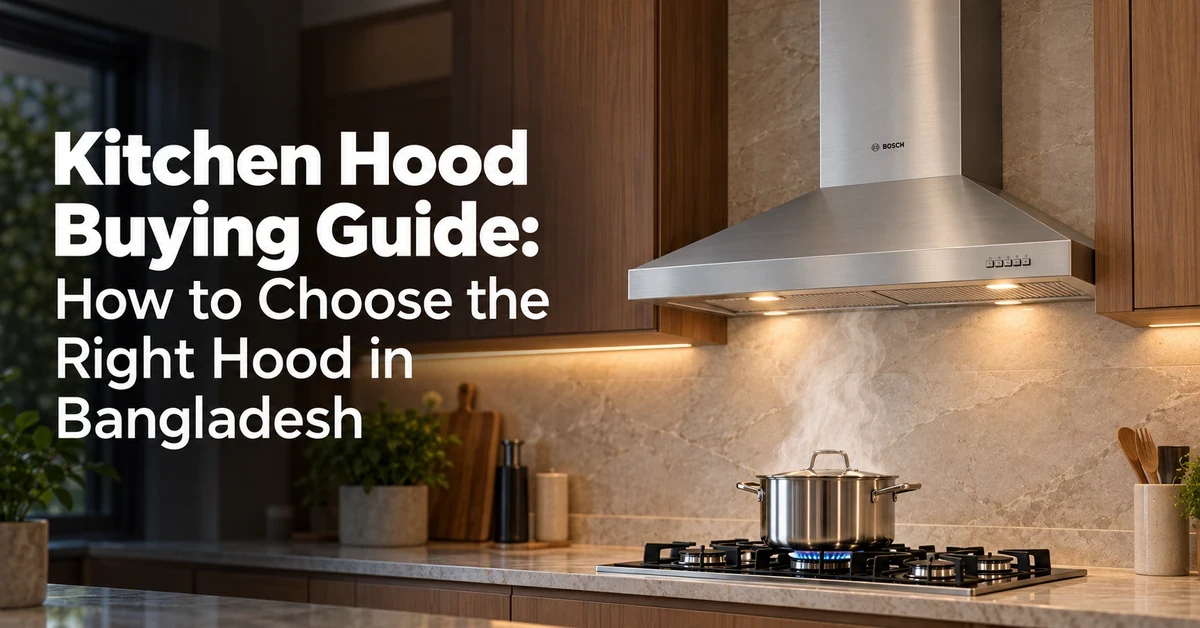
Choosing the right kitchen hood depends on your cooktop size, cooking habits, kitchen layout, and ventilation options. A hood that looks good may not remove cooking smoke, grease, and odours effectively if its airflow is too low or its installation does not suit your kitchen.
Before buying, compare the hood's extraction capacity, width, filter type, noise level, cleaning features, and installation requirements. Also, consider the total kitchen hood price in Bangladesh, including ductwork, fitting, and replacement filters.
This guide explains how to choose a kitchen hood, compare it with an exhaust fan, and find a suitable model for your home.

The hood type affects installation, appearance, and how easily you can remove cooking fumes. Choose one that suits your cooktop position and available ventilation route.
01
Installed above a cooktop against a wall. It suits kitchens where the cooking area has enough wall space.
02
Fitted beneath a kitchen cabinet. It is a practical option when you want to keep the existing cabinet layout.
03
Slides out when needed and retracts after cooking. It suits compact kitchens where a less visible design is preferred.
04
Installed above a cooktop positioned on a kitchen island. It needs suitable ceiling support and a planned ventilation route.
05
Integrated into cabinetry for a cleaner appearance. Measure the available cabinet space and cut-out dimensions before buying.

| Feature | Ducted hood | Ductless hood |
|---|---|---|
| How it works | Moves air outside through a duct | Filters air and returns it to the kitchen |
| Grease control | Uses grease filters | Uses grease filters |
| Odour control | Removes air outside | Usually relies on activated-carbon filtration for odours |
| Installation | Requires a suitable outdoor vent route | Does not need an outdoor exhaust duct |
| Ongoing maintenance | Clean filters and maintain the duct | Clean grease filters and replace carbon filters when required |
| Best suited for | Kitchens with a workable outdoor vent route | Kitchens where ducting is difficult or not permitted |
Hood width affects how well the appliance catches rising smoke and grease. Measure your cooktop before comparing models.
01
Choose a hood at least as wide as the cooking surface, unless the manufacturer recommends otherwise.
02
Consider a wider hood if you frequently use several burners at once.
03
Check the recommended mounting height above your gas or electric cooktop.
04
For built-in and telescopic models, confirm both the appliance dimensions and the required cabinet cut-out.
For example, the 28-inch KDK hood and 36-inch Midea hood have different coverage requirements. Do not choose either model by price alone; check which size suits your cooking area.

Airflow is one of the most important specifications to check. It is commonly measured in cubic metres per hour (m³/h) or cubic feet per minute (CFM). A higher airflow rating can move more air, but the right capacity also depends on your kitchen and installation.
Consider these factors:
01
Frequent frying, deep-frying, and high-heat cooking may require stronger extraction.
02
A larger or open-plan kitchen may need more airflow than a small enclosed room.
03
A wider cooking surface can release fumes across a larger area.
04
Long ducts, sharp bends, narrow pipes, and restrictive outlets can reduce actual airflow.
05
A direct outdoor outlet can make extraction more effective than a complicated duct route.
Kitchen hood noise is measured in decibels (dB). A lower rating usually means quieter operation, but check the noise level at the speed you use most. A hood may be quiet at low speed but loud at maximum extraction. This matters more in open kitchens or homes where the kitchen shares space with the living room.
Poor ducting, loose fittings, and vibration can also increase noise. Choose a hood that balances quiet operation with enough airflow for your cooking needs.
Filters affect cleaning, odour control, and long-term maintenance. Check the filter type and the cost and availability of replacement parts before buying.
Grease Filters
Grease filters capture grease particles from cooking air. Common options include:
Usually made from layers of metal mesh. They need regular cleaning as grease builds up.
Use shaped metal panels to separate grease from the airflow. They are often used in hoods designed for heavier cooking.
Carbon Filters
Carbon filters help reduce cooking odours in compatible ductless or recirculating hoods.
They generally need replacement at intervals specified by the manufacturer and should not be treated as a replacement for grease filters.
An auto clean kitchen hood can reduce manual cleaning, especially if you cook and fry food regularly. However, its benefits depend on the cleaning technology used in the model.
Some hoods use heat self-cleaning or auto steam-wash technology to loosen grease inside the appliance. Others may have simpler cleaning arrangements. Check what the function actually cleans and how collected grease must be removed.
If you cook occasionally, a basic hood with easy-to-clean filters may be enough. Pay extra for auto-clean technology only if it suits your cooking habits.
Even a suitable hood can become an expensive purchase if it does not fit your kitchen. Measure the space and check the ventilation route before placing an order.
Use this checklist:
01
Measure the available width, height, and depth.
02
Confirm the hood style and mounting method.
03
Check the required duct diameter and outlet position.
04
Find out whether the duct, bends, wall cap, and other accessories are included.
05
Confirm that the electrical connection is suitable.
06
Check the cabinet cut-out for built-in and telescopic models.
07
Ask whether professional installation is recommended.
For ducted models, avoid unnecessary bends and excessively long duct runs. If your kitchen cannot support the required route, consider a compatible recirculating model.
The kitchen hood price in Bangladesh varies with brand, size, airflow, filter type, controls, and cleaning features. You should also budget for ductwork, installation, cabinet changes, and replacement filters if needed.
Here are three models listed at Ryans for comparison. Prices and availability can change, so confirm the current listing before ordering.
| Model | Listed price | Buying consideration |
|---|---|---|
| KDK 70HQUA 28-inch White | Tk 31,500 | Twin-motor design and mesh filters |
| Midea CQ-5 36-inch | Tk 42,500 | Wider design, baffle filter, and auto-clean features |
| Bosch Series 2 DFT63CA50Q 23.6-inch | Tk 55,500 | Telescopic design for compatible cabinetry |
For better buying experience, start by comparing the kitchen hoods available, then shortlist models that fit your cooktop and ventilation setup.
01
The KDK 70HQUA 28-inch White is worth considering if you want a ducted hood with a twin-motor design. Its listing specifies 700 m³/h airflow and mesh filters. The 28-inch width makes it important to check the hood's coverage against your cooktop before buying.
This model may suit buyers who want a practical design without paying for advanced cleaning features. Compare the current details in the KDK kitchen hood range, and confirm mounting dimensions and duct requirements.
02
The Midea CQ-5 36-inch is a wider option for kitchens that can accommodate a 36-inch hood. Its listing includes a baffle filter, three speeds plus turbo mode, and auto steam-wash/heat self-cleaning technology.
It may suit households that cook and fry frequently and want to reduce some internal cleaning effort. However, check the available installation space and remember that auto-clean technology does not remove the need for all routine maintenance.
Review the Midea kitchen hood range for current product details and availability.
03
This Bosch Series 2 DFT63CA50Q 23.6-inch model is a telescopic hood designed for a more integrated appearance. Its listing specifies three speed settings and 300 m³/h airflow.
Consider it if your kitchen has suitable cabinetry and you prefer a hood that slides out when needed. Its narrower size means you should compare its coverage with your cooktop, especially if you regularly use multiple burners.
Before ordering, confirm the cabinet opening, ventilation arrangement, and mounting requirements in the Bosch kitchen hood range.

Avoid these common mistakes before placing your order:
01
A stylish design cannot compensate for insufficient airflow.
02
A narrow hood may not cover the cooking area properly.
03
Check whether the model supports outdoor extraction, recirculation, or both.
04
Confirm how filters are cleaned and replaced.
05
Compare noise ratings at the speeds you expect to use.
06
Check cabinet space, mounting height, duct diameter, and outlet position.
07
Compare the stated airflow and installation requirements instead.
08
Include installation, duct accessories, and replacement filters in your budget.
Turn on the kitchen hood a few minutes before cooking to remove smoke and grease more effectively.
Keep the hood running for a few minutes after cooking to remove the remaining smoke and odours. Follow the manufacturer's instructions.
Yes, you can use both if they are installed properly and the kitchen has enough fresh air.
Yes, but a ducted hood removes cool air from the kitchen, so the air conditioner may need to work harder.
Cooking odours may remain because of dirty filters, weak airflow, blocked ducts, or poor hood placement. Clean the filters and check the ventilation system.
No Comments














Leave a comment