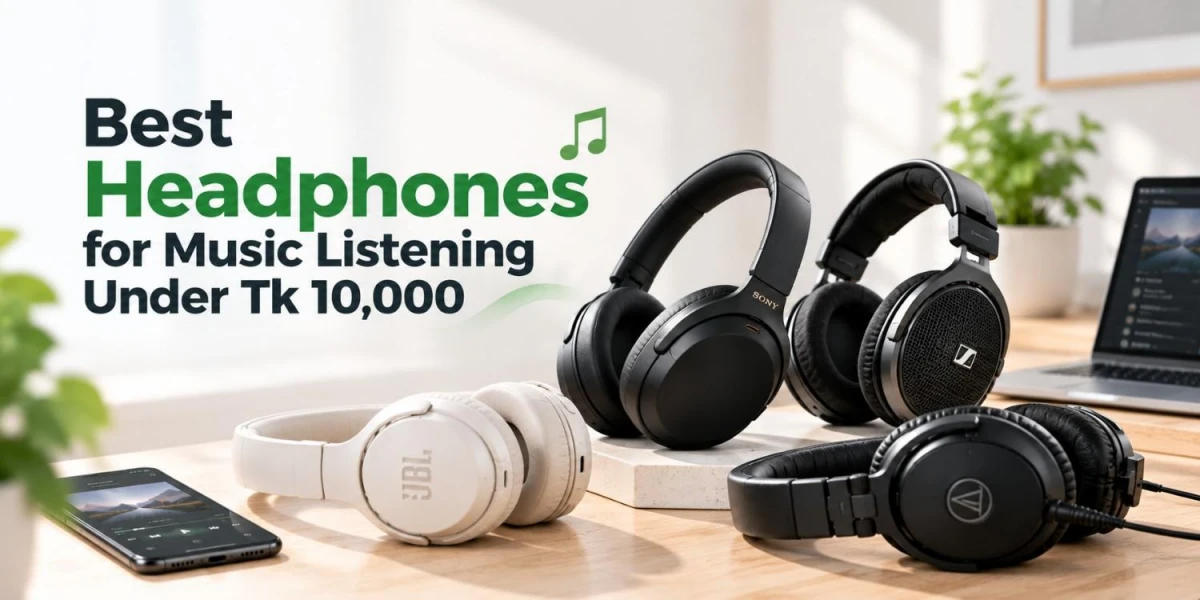
What’s the Best Headphone for Just Music Listening? Budget Around Tk 10,000
If your main goal is simply to enjoy music, there is no single best headphone for everyone. The right choice depends on what you listen to, where you listen, whether you prefer wired or wireless, and what kind of sound you enjoy. Some people want stronger bass. Others care more about vocals, detail, or a wider and more natural sound.
Around Tk 10,000, you can already get a very good headphone for music listening. Spending more can bring better refinement, comfort, build quality, and detail, but only if those improvements actually matter to you.
What Matters Most for Music Listening?
For music, the most important thing is not the number of features. It is how the headphone sounds and feels during long listening sessions.
Sound Tuning
Sound tuning describes how a headphone balances bass, mids, and treble.
A balanced headphone tries to keep everything fairly even, while some models intentionally boost bass or treble.
For general music listening, a balanced or slightly warm tuning often works well because it can handle many different genres without making one part of the sound too dominant.
Bass Quality
Good bass is not just about being loud.
A better headphone should give bass that sounds controlled, clear, and separated from vocals and instruments. Too much bass can make music feel muddy, while too little can make some genres sound thin.
If you listen to EDM, hip-hop, pop, or electronic music, bass quality will probably matter more to you.
Midrange and Vocals
The midrange is where most vocals, guitars, pianos, and many other instruments sit.
If you enjoy acoustic tracks, singers, podcasts, rock, or vocal-heavy music, a natural and clear midrange is important.
Treble Clarity
Treble covers the higher frequencies, including cymbals, small details, and some sense of air in music.
Good treble should sound clear without becoming harsh or tiring.
Some listeners enjoy bright headphones with more treble energy, while others prefer a smoother sound for longer sessions.
Soundstage
Soundstage is the sense of space around the music.
A headphone with a wider soundstage can make instruments feel more spread out rather than packed closely together.
This is especially enjoyable for classical, orchestral, acoustic, and live recordings.
Detail Retrieval
Detail refers to how easily you can hear quieter sounds in a recording, such as background instruments, reverb, or subtle textures.
More expensive headphones often improve here, but not every listener needs extreme detail.
If you mainly listen casually while working or commuting, comfort and tuning may matter more.
Wired vs Wireless for Music
For pure sound quality at the same budget, wired headphones often offer better value.
A wired headphone does not need to include batteries, Bluetooth hardware, microphones, or active noise cancellation. More of the cost can go toward the driver, build, and acoustic design.
That does not mean wireless sounds bad.
Modern wireless headphones can sound very good, especially for casual listening. They are also much more convenient for commuting, travelling, or moving around the house.
When Wired Makes More Sense
Choose wired if:
Sound quality matters more than convenience
You mainly listen at home
You use a desktop, laptop, DAC, or audio player
You do not want to worry about battery life
You want better sound value around Tk 10,000
When Wireless Makes More Sense
Choose wireless if:
You listen while travelling
You use your phone most of the time
You want fewer cables
You value convenience more than maximum sound quality
You want ANC for noisy environments
Does Bluetooth Compression Matter?
Sometimes, but not always.
Bluetooth compresses audio before transmitting it. In ideal conditions, wired audio can preserve more information.
However, for casual listening with streaming services, traffic noise, or normal office use, the difference may be small.
The quality of the headphone itself usually matters more than chasing a specific Bluetooth codec.
Should You Care About ANC?
Active Noise Cancellation can be useful, but it is not essential for a music-first headphone.
ANC helps reduce low-frequency background noise from buses, planes, air conditioners, and traffic.
If you mostly listen at home in a quiet room, you may get better value by choosing a headphone focused more on sound quality than ANC.
If you commute daily, ANC can be worth paying for because hearing more of the music without raising the volume can improve the overall experience.
Open-Back vs Closed-Back Headphones
This is one of the most important choices for music listening.
Open-Back Headphones
Open-back headphones allow air and sound to pass through the ear cups.
They often sound more spacious and natural.
They are a strong choice for:
Home listening
Classical music
Acoustic music
Jazz
Live recordings
Listeners who enjoy a wider soundstage
The main problem is sound leakage.
People around you can hear your music, and outside noise can easily enter.
They are not ideal for offices, buses, shared rooms, or noisy environments.
Closed-Back Headphones
Closed-back headphones isolate your ears more from the outside world.
They are usually better for:
Office use
Travel
Shared rooms
Gaming and music combined
Bass-focused listening
People who need privacy
Their soundstage is often smaller than an open-back design, but a good closed-back headphone can still sound excellent.
What Sound Signature Fits Your Music?
Different genres often benefit from different sound characteristics.
Bass-Heavy Music
For EDM, hip-hop, electronic, and bass-heavy pop, look for:
Strong low-end extension
Controlled bass
Good impact
Clear vocals despite the extra bass
Avoid headphones where bass overwhelms everything else.
Rock and Metal
For rock and metal, you usually want:
Clear guitars
Good midrange
Fast and controlled bass
Treble that is energetic but not harsh
Too much bass can make dense guitar tracks sound muddy.
Acoustic and Vocals
If you mainly listen to singers, acoustic guitar, folk, or softer music, prioritize:
Natural midrange
Clear vocals
Smooth treble
Good detail
This is where a well-balanced headphone can feel more rewarding than a bass-heavy one.
Classical and Instrumental
For classical and instrumental music, look for:
Wider soundstage
Good instrument separation
Natural tonal balance
Clear treble
Good detail retrieval
Open-back headphones often work very well here if your environment is quiet.
Pop
Pop music usually sounds good on slightly warm or balanced headphones.
You want:
Enjoyable bass
Clear vocals
Enough treble detail
Good all-round performance
EDM and Hip-Hop
For these genres, stronger bass can make listening more fun.
Still, bass should remain controlled. A headphone that only produces large amounts of bass without clarity may become tiring.
Mixed Music Library
If your playlist includes everything, choose a balanced headphone.
A slightly warm or neutral tuning is usually easier to enjoy across many genres.
Best Headphone Types Around Tk 10,000
Instead of asking for one universal winner, it is better to choose the right category.
Best Value Wired Headphone
A wired over-ear headphone is often the best place to start if sound quality is your top priority.
At this budget, wired models can offer:
Better tuning
Better detail
No battery concerns
Lower latency
Better long-term value
Best Closed-Back Headphone
A closed-back headphone makes sense if you want good music quality without disturbing others.
It is ideal for offices, bedrooms, shared apartments, and commuting.
Best Open-Back Headphone
An open-back headphone is a good option if you listen mainly at home.
It can offer a more natural sense of space and often feels more open with acoustic, classical, and live music.
Best Wireless Headphone
A wireless headphone is better when convenience matters.
Around Tk 10,000, focus on:
Sound tuning
Battery life
Comfort
Stable Bluetooth connection
ANC quality, if you need it
Do not choose solely based on codec support.
Best Bass-Focused Headphone
Look for a headphone with elevated but controlled bass.
The goal should be powerful low frequencies without losing vocal clarity.
Best Balanced Headphone
A balanced headphone is the safest choice if you listen to many genres.
It may not have the most dramatic bass or brightest treble, but it is often easier to enjoy for longer periods.
Best for Vocals and Acoustic Music
Prioritize midrange quality over bass quantity.
A headphone with natural vocals and smooth treble will usually work better than one designed mainly for impact.
When Is It Worth Spending More Than Tk 10,000?
Spending more can be worth it, but not automatically.
Moving from around Tk 10,000 to Tk 12,000 or Tk 15,000 may give you:
Better detail
Cleaner bass
More natural vocals
Wider soundstage
Better instrument separation
More comfortable ear pads
Stronger build quality
Replaceable cables
Better wireless features
Better ANC
However, improvements become smaller as the price increases.
A headphone that costs 50% more will not necessarily sound 50% better.
This is known as diminishing returns.
For many listeners, the biggest improvement comes from moving from a basic headphone to a well-tuned mid-range model. After that, upgrades become more about refinement than dramatic change.
Does Your Source Device Matter?
Yes, but usually less than people think.
Smartphone
Most modern portable headphones are designed to work well from a smartphone.
Some phones no longer include a headphone jack, so you may need a USB-C adapter or small DAC.
Laptop
Most laptops can drive easy-to-power headphones without trouble.
The built-in audio quality varies, but for normal headphones, it is often good enough.
Desktop PC
Desktop PCs usually have enough power for common headphones.
However, some motherboards have noisy or weak audio outputs. In that case, an external USB DAC can help.
Dedicated Audio Player
A dedicated audio player can offer better output quality and more power, but it is not necessary for most users around this budget.
What Are Impedance and Sensitivity?
Impedance is measured in ohms.
In simple terms, headphones with higher impedance may need more power to reach their best performance.
Sensitivity describes how efficiently a headphone converts electrical power into sound.
A low-impedance headphone is not automatically easy to drive, and a high-impedance headphone is not always difficult.
For most buyers around Tk 10,000, the safest choice is a headphone designed to work well with phones and laptops without a dedicated amplifier.
Do You Need a DAC or Amp?
Usually, no.
If your headphone already gets loud enough and sounds clean from your phone or laptop, you do not need to buy extra equipment.
A small USB DAC can make sense if:
Your phone has no headphone jack
Your laptop output sounds noisy
Your headphone needs more power
You want a cleaner wired connection
A dedicated amplifier becomes more useful with harder-to-drive headphones.
But remember, a poor headphone will not become a great headphone just because you connect it to an expensive DAC or amp.
Spend on the headphone first.
Comfort Matters More Than You Think
A headphone can sound excellent and still be a bad purchase if you cannot wear it comfortably.
Clamp Force
Some headphones grip the head tightly.
A little clamp is useful for stability, but too much can become uncomfortable.
Earpad Material
Velour or fabric pads can feel cooler.
Leather or synthetic leather pads can provide better isolation but may become warm in Bangladesh's climate.
Weight
Heavy headphones can cause fatigue during long sessions.
If you listen for several hours at a time, weight matters.
Heat Buildup
Closed-back headphones often trap more heat around the ears.
If you listen in a warm room, this can become noticeable.
Over-Ear vs On-Ear
Over-ear headphones surround your ears and are usually more comfortable for longer listening.
On-ear headphones sit directly on the ears and may feel less comfortable over time.
Replaceable Ear Pads
Replaceable pads can extend the life of a headphone.
This is worth checking if you plan to use it for several years.
What to Check Before Buying a Headphone for Music
Before buying, ask yourself:
What music do I listen to most?
Do I prefer wired or wireless?
Will I listen mostly at home or outside?
Do I need isolation?
Would an open-back headphone work in my environment?
Do I prefer stronger bass or a more balanced sound?
Will I use a phone, laptop, or desktop?
Is the headphone comfortable for long sessions?
Are ear pads or cables replaceable?
Does it come with a proper warranty?
Is it currently available in Bangladesh?
If I spend above Tk 10,000, am I getting a meaningful improvement?
Simple Headphone Comparison by Listening Need
Listening Need
Best Headphone Type
Why It Fits
Main Compromise
Home music listening
Open-back wired
Wider and more natural sound
Sound leakage
Office listening
Closed-back
Better isolation and privacy
Smaller soundstage
Travel
Wireless closed-back with ANC
Convenient and blocks noise
Higher cost for similar sound quality
Bass-heavy music
Warm or bass-focused closed-back
Stronger low-end impact
May be less neutral
Vocals and acoustic
Balanced wired headphone
Clear and natural mids
Less bass emphasis
Classical
Open-back headphone
Wider soundstage and separation
Poor isolation
Mixed genres
Balanced headphone
Works well with many music styles
Less specialized
Wireless convenience
Bluetooth headphone
Easy everyday use
Compression and battery dependency
So, What Should You Buy?
If pure sound quality matters most, a wired over-ear headphone is usually the strongest value around Tk 10,000.
If you listen mainly at home and do not need isolation, an open-back headphone can give you a more spacious and natural listening experience.
If you need privacy or listen around other people, choose a closed-back headphone .
If you commute often, a wireless headphone with ANC may be worth sacrificing a little sound value for convenience.
If you love bass-heavy music, look for a headphone with strong but controlled low frequencies.
If vocals matter most, choose a model with a clear and natural midrange rather than simply chasing bass.
And if you are willing to spend more than Tk 10,000, only stretch the budget when the more expensive model offers something you will actually notice, such as better comfort, cleaner sound, wider soundstage, stronger build, or better wireless features.
There is no need to overspend just to get a more expensive name.
Frequently Asked Questions
Is a wired headphone better than Bluetooth for music?
At the same price, wired headphones often provide better sound value because less of the budget goes toward wireless hardware, batteries, and ANC. Wireless headphones are still a better choice if convenience matters more.
Is Tk 10,000 enough for a good music headphone?
Yes. Around Tk 10,000, you can find headphones with good sound quality, comfort, and build. You do not need to spend much more unless you want a specific improvement.
Is an open-back headphone better for music?
It can be better for home listening because open-back headphones often provide a wider and more natural soundstage. They are not ideal for noisy places because they leak sound and provide little isolation.
Do I need a DAC for headphones under Tk 10,000?
Usually not. If your phone or laptop can drive the headphone loudly and cleanly, a separate DAC is not necessary.
Should I buy ANC headphones for music?
Only if you listen in noisy environments. For home listening, ANC is less important, and you may get better sound value from a headphone without it.
Is it worth spending Tk 15,000 instead of Tk 10,000?
It can be, especially if you gain better comfort, cleaner sound, wider soundstage, or better build. But do not expect the improvement to match the increase in price.
Which matters more, Bluetooth codec or headphone tuning?
Headphone tuning usually matters more. A well-tuned headphone using a basic codec can sound better than a poorly tuned headphone with a more advanced codec.









Leave a comment