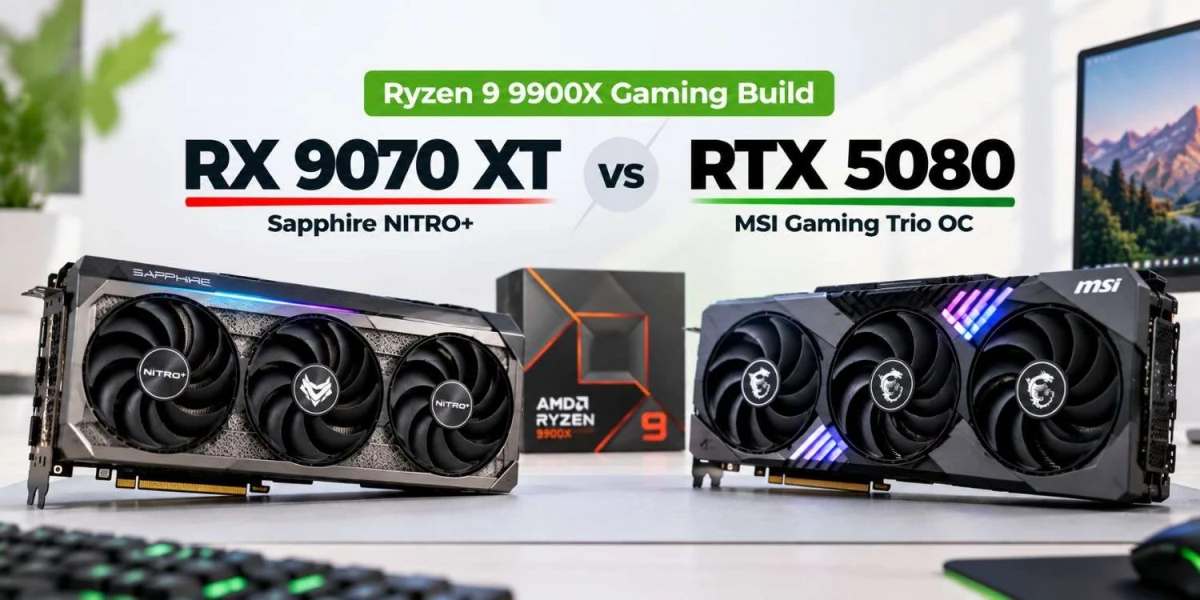
If you are building a gaming PC with an AMD Ryzen 9 9900X and an MSI X870E Gaming Plus WiFi motherboard, both the Sapphire NITRO+ Radeon RX 9070 XT and MSI Gaming Trio RTX 5080 OC are powerful GPU options.
The real question is not whether your PC can handle either card. It can. The decision is whether you actually need the extra gaming performance and NVIDIA features of the RTX 5080, or whether the RX 9070 XT already gives you enough performance for your target resolution.
AMD specifies 16GB GDDR6 memory, a 256-bit interface, 304W typical board power and a minimum 750W PSU recommendation for the RX 9070 XT.
The RTX 5080 also carries 16GB of memory, but uses faster GDDR7 with up to 960GB/s memory bandwidth. NVIDIA also positions it around DLSS 4, Multi Frame Generation and its newer ray-tracing hardware.
Which Is Better for 1440p Gaming?
For 1440p gaming, the RX 9070 XT is already a very capable option.
If your goal is high settings, high frame rates and smooth gameplay without paying for more GPU performance than you really need, the RX 9070 XT makes a lot of sense.
The Ryzen 9 9900X is powerful enough to pair comfortably with it, so you are not building an unbalanced system.
The RTX 5080 can deliver more performance, but at 1440p the extra cost may be harder to justify unless you use a very high-refresh-rate monitor, play demanding ray-traced games, or simply want more performance headroom.
Which Is Better for 4K Gaming?
This is where the RTX 5080 becomes more attractive.
At 4K, the GPU carries much more of the workload. The additional performance, higher memory bandwidth, stronger ray-tracing capability and DLSS 4 feature set can become more useful.
If you plan to keep the system for several years and your main monitor is 4K with a high refresh rate, the RTX 5080 is the more performance-focused option.
The RX 9070 XT is still suitable for 4K gaming, especially if you are comfortable adjusting a few settings or using FSR where necessary.
AMD's RX 9000 generation also supports its newer FSR technologies, including machine-learning-based upscaling features developed for the architecture.
What About Ray Tracing?
If ray tracing is one of your main priorities, the RTX 5080 has the stronger case.
Modern games can use ray tracing for reflections, lighting, shadows and other effects. These settings can also be very demanding.
NVIDIA combines its ray-tracing hardware with DLSS technologies designed to recover performance, while AMD has also significantly improved ray tracing with its newer RDNA architecture.
For someone who mostly plays competitive games or prefers traditional rasterized graphics, however, ray tracing may not be important enough to justify choosing a more expensive GPU.
Does 16GB VRAM Make Them Equal?
No.
Both cards having 16GB VRAM does not mean they perform the same.
The RX 9070 XT uses 16GB GDDR6 with up to 640GB/s memory bandwidth.
The RTX 5080 uses 16GB GDDR7 and NVIDIA lists memory bandwidth of up to 960GB/s.
VRAM capacity matters, especially at high resolutions, but GPU architecture, memory speed, processing capability and game optimization also influence performance.
Which GPU Makes More Sense With Ryzen 9 9900X?
Your Ryzen 9 9900X is powerful enough that you should choose the GPU based mainly on your monitor and gaming expectations.
Choose the RX 9070 XT if:
You mainly play at 1440p
You want strong 4K capability without moving into a much more expensive GPU tier
Ray tracing is not your highest priority
You care strongly about gaming value
You would rather spend the remaining budget on a better monitor, SSD or other components
Choose the RTX 5080 if:
You mainly play at 4K
You want higher frame rates in demanding AAA games
Ray tracing matters to you
You want access to NVIDIA's DLSS 4 feature set
You use a high-refresh-rate 4K display
You are comfortable spending significantly more for additional performance
Do You Need an RTX 5080 Just Because You Have a Ryzen 9 9900X?
No.
A high-end processor does not mean you have to buy the highest GPU you can afford.
The Ryzen 9 9900X can support a very powerful graphics card, but the correct GPU still depends on your target resolution, frame rate, games and budget.
For a gaming-focused build, it often makes more sense to choose the GPU based on your monitor rather than trying to match the CPU's price category.
Final Take
For a 1440p-focused gaming build, the Sapphire NITRO+ RX 9070 XT is the more practical choice if you want strong performance without spending extra simply because your CPU is high-end.
For a 4K high-refresh-rate gaming build, especially with demanding AAA games, ray tracing and DLSS features, the MSI Gaming Trio RTX 5080 OC is the more powerful option.
So the decision is fairly simple:
1440p and value-focused gaming → RX 9070 XT
4K, ray tracing and maximum gaming performance → RTX 5080
Your Ryzen 9 9900X works well with either. The better choice depends mainly on how much GPU performance your monitor and games can actually use.












Leave a comment