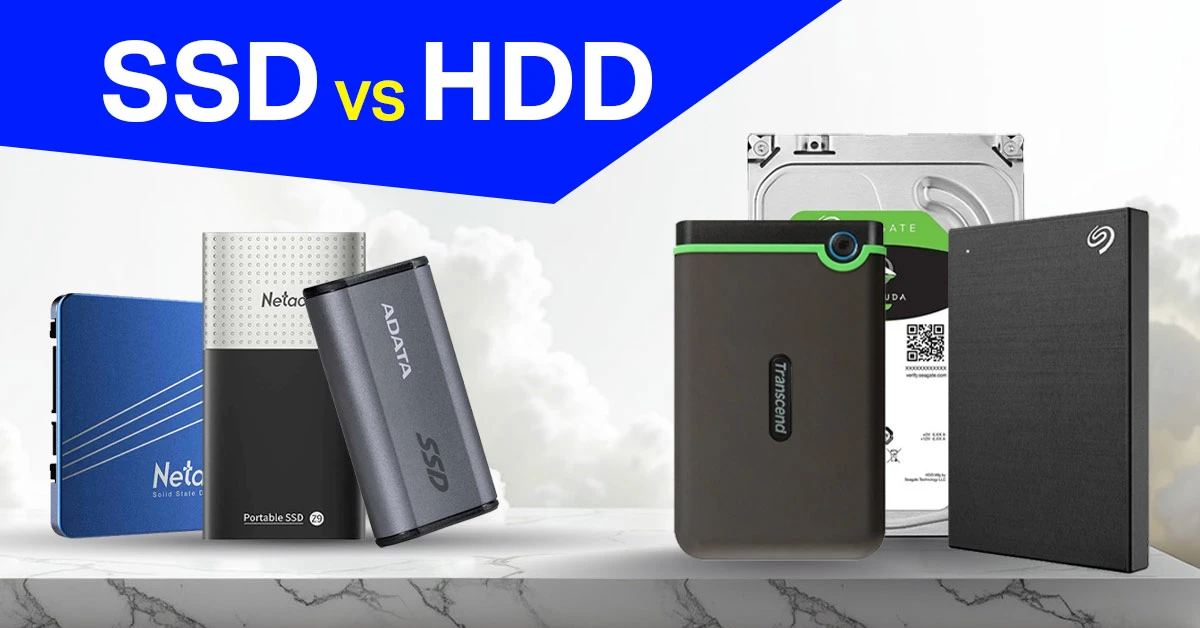
Buy an SSD for anything you use every day. It can boot your computer in 10 to 15 seconds instead of 30 to 40 seconds and delivers around 1,000 times faster random access. An HDD makes more sense for cheap bulk storage, such as archives, CCTV footage, and backups, costing roughly Tk 4 to 9 per GB compared with Tk 11 to 21 for an SSD. For many users, the best setup combines both.
Choosing between them can still be confusing when speed, storage capacity, and price all matter. An SSD makes everyday tasks faster, while an HDD gives you more storage for your money. The right choice depends on what you do with your computer, whether you are studying, working, gaming, editing videos, or simply storing large amounts of data.
SSD vs HDD: Key Differences at a Glance
Both drives store files, but they answer buying questions differently. The table below settles the key points, with current Bangladesh prices included. Compare each row to your needs, then read on to see why the two drives behave so differently.
Feature
HDD
SSD
Speed
100–160 MB/s; 100 IOPS; 30–40s boot
SATA ~550 MB/s; NVMe 3,500–7,000+ MB/s; 100,000 IOPS; 10–15s boot
Price per GB (BD, Aug 2026)
Tk 4–9 (1–2TB drives)
Tk 11–21 (240GB–1TB drives)
Capacity per drive
Up to 24TB (NAS/enterprise); 8TB consumer mainstream
Up to ~8TB consumer
Durability
Fragile: moving head and spinning platters; drop-sensitive
Tough: no moving parts; high shock resistance
Noise
Audible spin and clicking
Silent
Power use
Higher baseline: 4–7W idle, 6–10W active (3.5-inch)
Lower at idle (<1W) and light use: 1–4W active (SATA); NVMe 3–10W under load
Heat
Runs warmer (motor and friction)
Runs cooler
Lifespan
3–5 years typical use
5–10 years typical use
Inside the Drive: Why SSD and HDD Behave So Differently
Every computer runs on one of two storage technologies. They work in totally different ways. That difference drives every claim about speed, price, and reliability in this guide. Understanding it makes the rest easier to follow. Let's look inside each drive and see how it works.
How Much Faster Is an SSD Than an HDD in Real Use?
An SSD changes how the whole machine feels. Boot time drops from 30 to 40 seconds on an HDD. On an SSD, it's 10 to 15 seconds. NVMe boots in under 10. Heavy apps like Photoshop open in 10 to 15 seconds instead of 30 to 40. File transfer shows the biggest gap. A 7,200-RPM HDD transfers 100-160 MB/s. A SATA SSD reaches about 550 MB/s. NVMe drives hit 3,500 to 7,000 MB/s. A 50 GB game took over 5 minutes to copy on an HDD. On NVMe, it finishes in under 20 seconds.
The real secret is random access. SSDs handle about 100,000 IOPS while HDDs handle only about 100. That's a 1,000 times advantage. That's why bootups and multitasking feel instant. Same computer, new drive. You feel it every time you press the power button.
SSD vs HDD Price in Bangladesh: Which Gives Better Value?
HDDs cost less per gigabyte. SSDs cost less per unit of real speed, and speed matters daily. A 240GB SATA SSD costs about 5,050 BDT (21/GB), while a 480GB drive costs 6,250 BDT (13/GB). A 500GB Transcend costs just 5,600 BDT (11/GB), which is the best deal.
A 1TB HDD runs near 4,100 BDT (4/GB). The 2TB BarraCuda costs 17,500 BDT (9/GB). That extra cost buys 3x faster boots, 3x faster app launches, 4-5x faster transfers (up to 70x on NVMe), and about 1,000x better random access.
Cost per MB/s of speed runs about 11 taka for the 480GB SSD versus about 109 taka for the 2TB HDD. HDDs make sense only when raw capacity matters more than speed, such as in archives, backups, or CCTV. For daily use, SSDs win.
Is It Better to Use SSD and HDD Together?
Yes, and for Bangladeshi builders, this is the value answer of the whole guide. You pay SSD prices only for the part that needs speed. A 240–500GB SSD (Tk 5,000–6,300) runs Windows and daily apps, which need thousands of tiny random reads, and this is where an SSD beats an HDD by about 1,000 times.
Things you open rarely, like photos, videos, archives, and backups, go on a 1–2TB HDD at about Tk 4–9/GB instead of Tk 11–21/GB. Paired with a 1TB HDD (Tk 4,100), you get more total storage for less money than one 1TB SSD (Tk 14,900); and it still feels SSD-fast.
Put Windows on the smaller drive, move Documents and Downloads to the HDD, and install games on whichever drive you use most. The PC needs a second drive slot, and skip Optane or SSHD caching. A small SSD plus a big HDD beats both on speed and price.
Which Is Better for Everyday Laptop and Desktop Use?
For everyday use, SSDs win in laptops and desktops. Daily tasks are thousands of tiny random reads: booting, opening browsers, switching tabs, searching files. SSDs handle these about 1,000 times faster than HDDs (roughly 100,000 vs 100 IOPS). That's why Windows boots in 10 to 15 seconds instead of 30 to 40, and apps open instantly.
Laptops benefit even more. With no moving parts, SSDs survive drops, backpack knocks, and bumps that can crash an HDD's read head. They run silent and cooler. Laptops mostly handle light, bursty tasks, so SSDs also use less power, resulting in slightly better battery life.
A 256-512GB SSD is the practical minimum. You can add a cheap HDD later for extra space. Storage can be added anytime. Speed cannot.
SSD vs HDD for Gaming
Buy an SSD for gaming. Just know whether it buys you faster loading. FPS is determined by your GPU and CPU. Swapping an HDD for an SSD changes it by under 1% in most games. What it changes is wait time. Benchmarks show SSDs cut load times by 65-80%. Cyberpunk 2077 loads in about 8 seconds on an SSD, versus 38 to 49 on an HDD. Open-world maps that took 45 seconds now load in about 5 seconds. SSDs also cut the stutter and pop-in that an HDD shows when you enter a new area.
Get a 240-500GB SSD for Windows and your current games. Use an HDD for the rest of your library. Add new games you're playing to the SSD. The HDD keeps a big collection cheap.
SSD vs HDD for Large Files, Photos, and Videos
For creators and office workers with large files, use an SSD for work and an HDD for finished files.
Editing is where the SSD earns its price. In a 60+ hour Lightroom test, imports, exports, and previews ran about 50% faster on an SSD than on an HDD. Keep the catalog on the SSD. Editing one RAW photo barely uses the drive.
Video makes this clearer. Compressed 4K runs at about 25 MB/s, which an HDD can handle. But high-bitrate 4K (ProRes or RAW, 100 MB/s+), scrubbing, multicam, and exports slow down an HDD. Keep active projects on the SSD.
Archiving works the other way. Finished projects and exports cost Tk 4–9/GB on HDD, versus Tk 11–21/GB on SSD. So, work on SSD. Store finished files on HDD.
SSD vs HDD for Backup and Long-Term Storage
For backup and long-term storage, HDDs are the safer choice, for two reasons. Archived data runs Tk 4-9 per GB on HDD, while Tk 11-21 per GB on SSD. That gap grows with every terabyte.
Physics matters too. SSDs store data as electric charge in NAND cells, and consumer drives hold data unpowered for about a year at room temperature. Left in a drawer for years, charges leak and files can quietly corrupt. TLC and QLC drives pose the greatest risk, especially after heavy use. Magnetic platters don't decay without power, so a stored HDD keeps data for many years.
SSDs do handle drops and knocks well, making them the right choice for travel backups. Follow the 3, 2, 1 rule. Power up SSD backups every few months. Keep everything cool and dry.
Which One Should You Buy?
There's no single best drive for everyone. It depends on who you are: a student, an office worker, a gamer, or a video editor; each needs something different.
Find your row, take your pick, then check the buying mistakes to avoid before spending.
Buyer
Recommended Setup
Student
A 240–500GB SSD (Tk 5,000–6,300). Everything feels instant; add a cheap HDD later if space runs out.
Office worker
The same SSD for Windows and daily apps. Costs more but saves hours of waiting; you rarely need the extra HDD.
Gamer
A 240–500GB SSD for Windows and current games, plus a 1–2TB HDD for the backlog. FPS stays the same; the waiting disappears.
Video editor
SSD for Windows, your catalog, and active 4K projects. HDD for finished renders, footage archives, and backups.
PC builder
Go hybrid: a small SSD plus a big HDD gives the most storage per taka while still feeling SSD fast.
Common SSD vs HDD Buying Mistakes to Avoid
Most storage buying mistakes fall into five categories These are:
Buying a big HDD and expecting speed.Capacity and speed aren't linked. A 2 to 4TB HDD still boots Windows in 30 to 40 seconds. It handles only about 100 IOPS. An SSD hits 100,000 IOPS. That's what makes a PC feel fast. A big HDD alone means a slow PC.
Undersizing your SSD for games. Modern AAA games top 100GB. Call of Duty installs run 150 to 240GB. GTA 6 is estimated at 150 to 200GB or more. A 240GB SSD fits Windows plus two or three games. Then you run out of space. Treat 500GB as the minimum. Or pair it with a cheap HDD for extra games.
Confusing SATA SSDs with NVMe speeds.Both are sold as "SSD." But SATA III maxes out near 550 to 580 MB/s. NVMe Gen3 hits 3,500 MB/s. Gen4 hits 7,000 MB/s or more. A "high-speed SSD" in a 2.5 inch case can't beat SATA's limit. Want 3,500 MB/s? Buy NVMe. Check your slot first.
Skipping the compatibility check.M.2 drives come in SATA and NVMe versions. The wrong one in the wrong slot may not work. RPM matters too. A 5400 RPM drive suits storage. A 7200 RPM drive runs faster for daily use.
Ignoring power cuts.If power drops mid-write, an HDD can corrupt the file. It can even damage the platter if the head doesn't park in time. An SSD just stops. In areas with frequent blackouts, that's another reason to keep your OS off a spinning drive.
Finally, check any discounted "high capacity" drive before trusting it. Check the warranty. Read its S.M.A.R.T. health with CrystalDiskInfo. Buy from a trusted retailer.
Frequently Asked Questions
Will replacing my old HDD with an SSD make a slow laptop noticeably faster?
Yes, a lot faster. Boot time drops from 30 to 40 seconds to just 10 to 15. Apps open almost instantly. The laptop no longer freezes during updates and startup tasks. No other upgrade gives this much value for the price.
Is a 256GB SSD better than a 1TB HDD for everyday use?
Yes, for daily tasks. Browsing and office work rarely need more than 256GB. An SSD loads instantly, while an HDD takes 30 to 40 seconds to boot. The 1TB HDD only wins if your files exceed 256GB and you rarely open them.
Which is better for CCTV recording, SSD or HDD?
HDD, especially surveillance models like WD Purple, Seagate SkyHawk or Toshiba S300. Cameras record nonstop, which wears out an SSD's limited write life fast. Surveillance HDDs also give more storage per taka. Pick SSD only if instant playback really matters.
Can I use an SSD and HDD together in the same desktop PC?
Yes, if there's a spare bay and SATA port. Put Windows and daily apps on the SSD. Keep photos, videos and backups on the HDD. You get speed plus storage, for less than a single large SSD.
Which lasts longer in normal use, SSD or HDD?
For daily use, SSDs last longer. They have no moving parts and last 5 to 10 years, compared to 3 to 5 for HDDs. The exception is heavy, nonstop writing, like 24/7 camera recording, which wears out an SSD faster. HDDs also outlast SSDs stored unpowered for years.
When is buying an HDD actually a better decision than buying an SSD?
When you need cheap bulk storage or long-term archives, like CCTV footage, backups, or media libraries. HDDs cost about Tk 4 to 9 per GB, while SSDs cost Tk 11 to 21. Magnetic platters keep data safe for years without power. If you store more than you open, HDD wins.






Leave a comment