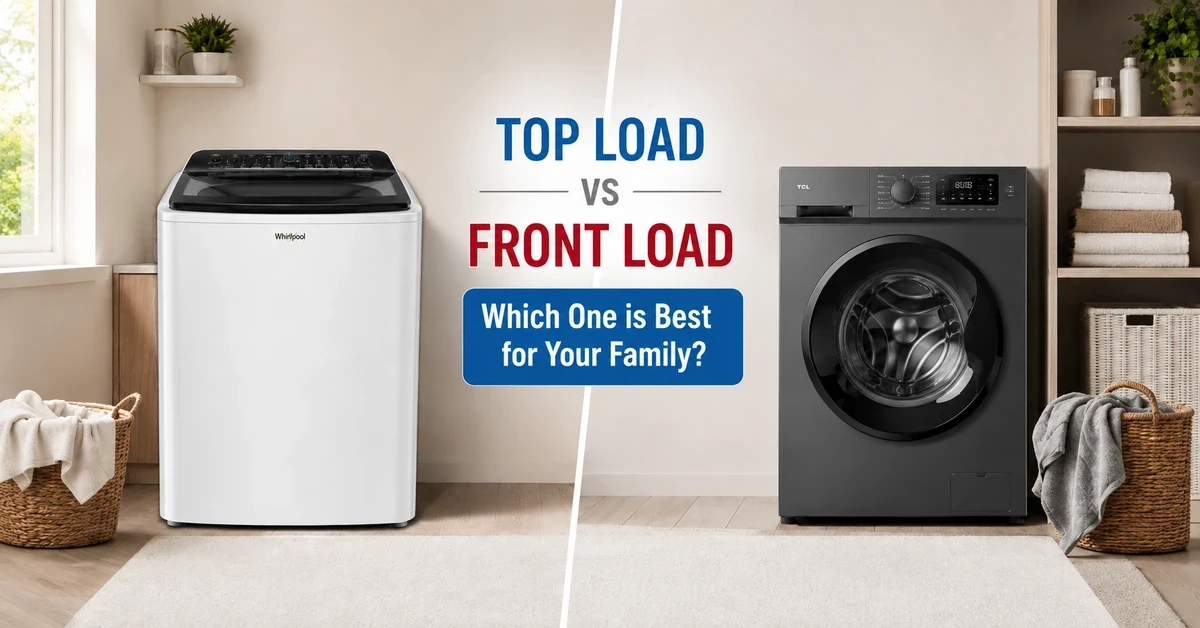
Top Load vs Front Load Washing Machine: Which One is Best for Your Family?
Choosing between a top load washing machine and a front load washing machine can be confusing when both offer convenient washing and modern features. The best choice depends on your family size, budget, available space, water supply, and laundry habits.
For example, a top loader can be convenient if you want shorter wash cycles and easy loading from the top. A front loader can be a better choice if you care more about water consumption, energy efficiency, fabric care, and higher spin speed.
With Ryans offering a wide range of washing machines in different types, capacities, and price ranges, this guide compares top load vs front load washing machines to help you make a clear and practical buying decision.
Quick answer: Choose a top load washing machine if convenient loading, shorter wash cycles, and a lower starting price matter more. Choose a front load washing machine if you prioritize lower water consumption, higher spin speed, fabric care, and energy efficiency.
Top Load vs Front Load: How They Work
TOPTop Load
What Is a Top Load Washing Machine?
As the name suggests, a top load washing machine features a vertical drum and a door at the top. You have to put clothes into the machine from above.
Depending on the model, it may use an agitator or an impeller to move the clothes through the water.
An agitator is a central post that moves clothes around during the wash cycle.
An impeller is a lower-profile plate that creates water movement inside the drum.
Loading from the top means you normally do not need to bend down as much.
Many models may allow clothes to be added during the wash cycle.
FRONTFront Load
What Is a Front Load Washing Machine?
Unlike a top loader, a front load washing machine has a horizontal drum and a door at the front.
Instead of filling the drum with a large amount of water, it uses a tumbling action to move clothes through water and detergent.
Front loaders generally use less water.
Many have higher spin speed than top loaders.
Higher spin speed can remove more water before drying.
Many models can be stacked with a compatible dryer.
Wash cycles are commonly longer than top load machines.
Top Load vs Front Load: Key Differences at a Glance
Feature
Top Load
Front Load
Loading
From the top
From the front
Typical price
Usually lower starting price
Usually higher starting price
Capacity
Commonly available from around 7–12 kg+
Commonly available from around 7–12 kg+
Water consumption
Usually higher
Usually lower
Durability
Depends on brand, motor, and wash system
Depends on brand, motor, and components
Energy efficiency
Depends on model
Often better
Spin speed
Usually lower
Usually higher
Wash time
Often shorter
Often longer
Fabric care
Good, depending on wash system
Generally gentle
Mid-cycle loading
Often easier
Depends on model
Noise / vibration
Depends on model and installation
Depends on model and installation
Stackable
Usually no
Many models can be
Best for
Convenience and budget
Efficiency and fabric care
Water & Electricity Consumption: Which Saves More?
Water Use
Front Load Machines Usually Use Less Water
Water consumption is one of the biggest differences between the two types. Front load machines generally use less water because the horizontal drum tumbles clothes through a smaller amount of water.
Some manufacturer comparisons show front loaders using substantially less water than traditional top loaders, although the actual difference depends on the model and wash cycle.
Electricity Use
Efficiency Depends on the Exact Machine
Lower water consumption can support better energy efficiency, particularly when less water needs to be heated.
Electricity consumption still varies by machine, heater, motor, wash program, and usage. An inverter motor can also help reduce energy use and noise in some models.
For Bangladesh: Consider your home's water supply and load shedding situation as well. A washing machine should be connected to a suitable electrical supply. Follow the manufacturer's installation requirements rather than assuming every machine can safely operate during unstable voltage.
Washing Performance & Fabric Care
Both types of washing machines can clean clothes well, but they use different washing actions.
Top Load
Agitator or Impeller Washing
Top loaders use either an agitator or impeller. Agitator models create strong movement inside the drum, while impeller models use a rotating plate to circulate the clothes.
Convenient for everyday family laundry
Many models offer shorter wash cycles
Loading from the top can be easier
Front Load
Tumbling Action
Front loaders use a tumbling action that lifts and drops clothes through water and detergent. This can provide effective cleaning while being relatively gentle on fabrics.
Generally gentle on fabrics
Higher spin speed can remove more water
Useful when water saving is a priority
Good option when fabric care matters
Detergent tip: Always follow the recommended detergent dosage. Using too much detergent does not necessarily make clothes cleaner and can leave residue inside the machine.
Price Comparison: Top Load vs Front Load in Bangladesh
The price difference between top load and front load is significant in Bangladesh. At Ryans, currentwashing machine listings range from about Tk 18,400 to Tk 170,000, depending on capacity, loading type, brand, motor, features, and technology.
Model Name
Type
Price at Ryans
Singer 9 Kg semi-automatic washing machine
Semi-Automatic
Around Tk 18,400
Hitachi 8 Kg
Top Load
Around Tk 37,500
Whirlpool 9.5 Kg
Top Load
Around Tk 51,000
TCL 8 Kg
Front Load
Around Tk 58,500
Panasonic 8 Kg
Front Load
Around Tk 80,000
BOSCH 8 Kg
Front Load
Around Tk 142,000
Price note: These prices are examples rather than fixed market prices. Check the current product page before publishing or buying because price and stock can change.
EMI option: Ryans also lists EMI options on eligible washing machines, which can make a higher-priced model easier to purchase without paying the full amount at once.
Space, Installation & Maintenance
01
Check Available Space
A top load machine needs enough vertical clearance to open its lid. A front load machine needs enough space in front for the door to open comfortably.
02
Check Stackability
Some front load models can be stacked with a compatible dryer, making them useful when floor space is limited.
03
Check Water Pressure
Do not assume every washing machine will work correctly with very low water pressure. Check the minimum pressure requirement for the exact model.
04
Clean the Machine Regularly
Front loaders may need more attention around the door seal and drum. Leaving the door open after washing can help the inside dry. Both types still require regular cleaning.
Warranty matters: Coverage varies by model. Many washing machines may include around 1–2 years of parts or service coverage, while some brands provide longer motor warranties. Always check whether the warranty covers the motor, parts, service, or all three.
Which Capacity Is Best for Your Family?
The capacity you choose should match the amount of laundry your household normally washes.
7–8 KG
Small Households or Couples
Around 7–8 kg may be enough for regular laundry.
This can suit a few days worth of everyday clothes, shirts, trousers, and undergarments.
8–10 KG
Families of 4–5
Around 8–10 kg can be a practical range depending on washing frequency.
It can handle regular family clothes along with towels and smaller bedsheets without requiring too many separate loads.
9–12 KG+
Large Families
Around 9–12 kg or more may be useful for frequent loads, towels, bedding, and larger households.
A family of six washing clothes once or twice a week may benefit more from a larger drum.
Do not choose by capacity alone: A larger load capacity does not automatically mean better value. If you usually wash small loads, paying extra for a very large machine may not be necessary.
For heavy laundry, also check drum size, wash programs, spin speed, and whether the machine is suitable for bedding or other bulky items.
How to Choose: A Quick Decision Framework
Choose Top Load
A Top Loader May Suit You If...
You want a simpler and convenient loading design.
You prefer shorter wash cycles on many models.
You want to stay within a lower or mid-range budget.
You prefer easier mid-cycle loading where supported.
You do not need a stackable design.
Choose Front Load
A Front Loader May Suit You If...
Lower water consumption is a priority.
You want higher spin speed for easier drying.
Fabric care is important.
You want stackable space flexibility.
You are comfortable with longer wash cycles.
Budget tip: If your budget is limited, compare both types instead of assuming that a front loader is always the better machine.
Quick tip: Before choosing a model, check capacity, wash programs, energy efficiency, spin speed, dimensions, warranty, and current price. This will help you find a machine that fits both your laundry needs and budget.
What to Check Before Buying
01
Load capacity
02
Wash programs
03
Spin speed
04
Water consumption
05
Energy efficiency
06
Noise & vibration
07
Motor type
08
Warranty
09
Installation requirements
10
Current price
Final Recommendation
Top Load or Front Load: Which Should You Buy?
Top load vs front load washer is not really about finding one universal winner. It is about finding the washing machine that matches your home, laundry habits, available space, and budget. A top loader can be a practical choice if you want easy loading, convenient daily washing, and a lower starting price.A front loader can be a better option if you want lower water consumption, higher spin speed, good fabric care, and better energy efficiency. Before buying, compare the load capacity, wash cycle, spin speed, water consumption, noise and vibration, motor, warranty, installation requirements, and current price. Also consider your water pressure, available space, and how your household handles load shedding before making the final decision.
Frequently Asked Questions
Which type of washing machine lasts longer?
Neither type automatically lasts longer. Durability depends on the brand, model, build quality, installation, maintenance, and how heavily the machine is used.
Is a top load washing machine good enough for daily family use?
Yes. A good top load machine can handle daily family laundry effectively. Choose the capacity based on your household size and check the available wash programs.
Are front load washing machines more expensive to repair?
Repair costs vary by model and the part that needs replacement. Front loaders may have more specialized components, so compare warranty coverage and local service support before buying.
Can a washing machine work with low water pressure?
It depends on the model. Some washing machines are designed to work with lower water pressure, while others require a specific amount of pressure. Check the manufacturer's water pressure requirements before purchasing.
Are front load washing machines noisier than top load machines?
Not necessarily. Noise depends more on the specific washing machine, motor, spin speed, installation, and load balance. Properly leveling the machine and avoiding overloading can significantly reduce noise and vibration.








Leave a comment